Southern California—a region defined by its sun-drenched landscapes and sprawling urban density—rests precariously atop one of the most volatile geological architectures on the planet. For decades, seismologists have kept a watchful eye on the intersection of the San Andreas and San Jacinto fault systems, two tectonic giants that accommodate the grinding motion of the Pacific and North American plates.
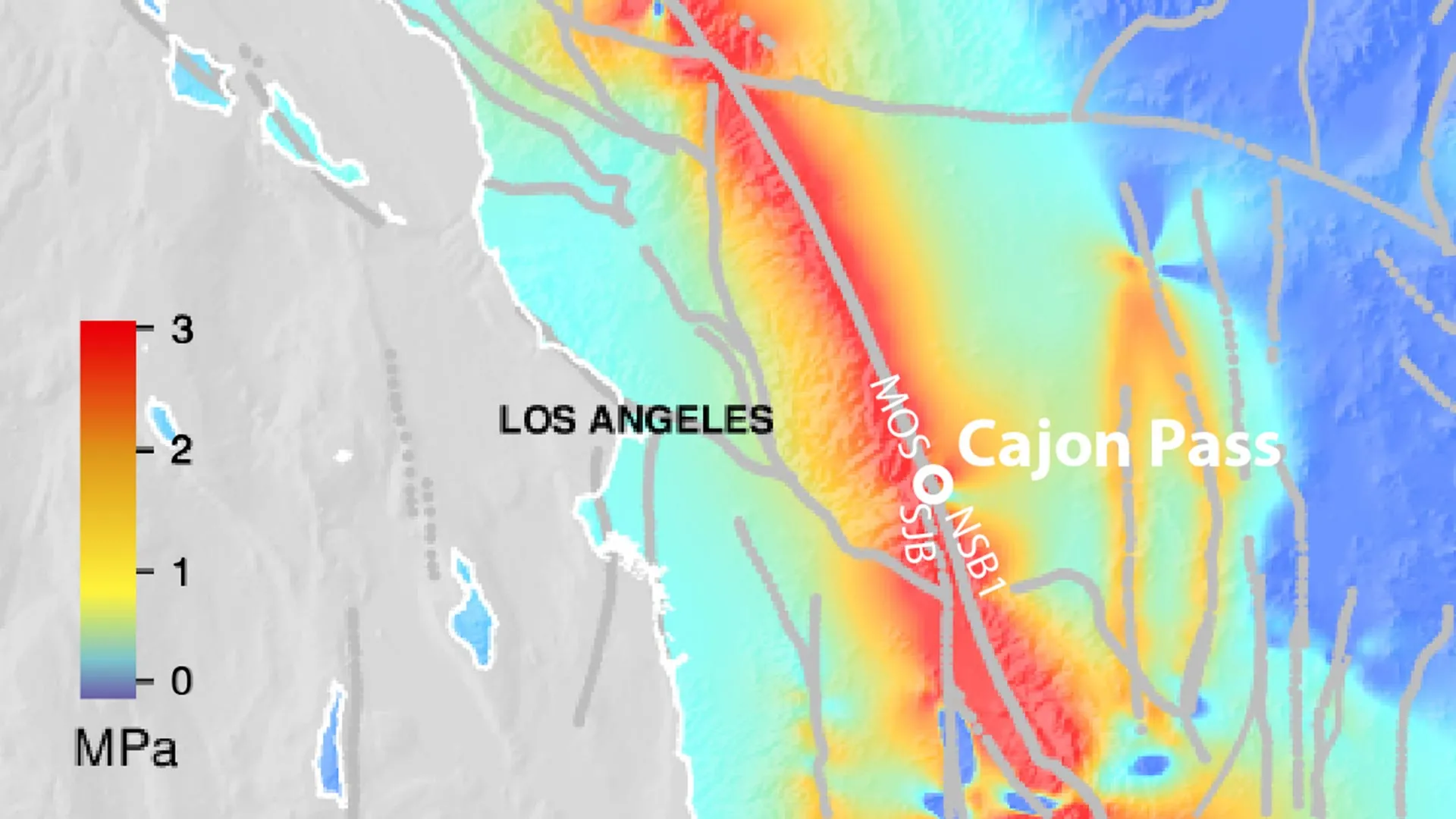
Now, a groundbreaking study published in the Journal of Geophysical Research: Solid Earth has provided the most detailed analysis to date of the stress accumulating at the Cajon Pass, a critical junction northeast of Los Angeles. Led by Dr. Liliane Burkhard of the University of Bern, an international team of researchers has determined that tectonic stress in these fault systems has reached, and in some areas exceeded, the highest values observed in a 1,000-year historical model. While the study does not predict an imminent catastrophe, it presents a sobering reality: the region’s fault network is currently in a state of critical tension that could facilitate a multi-fault rupture of significant magnitude.
The Mechanics of a Tectonic Junction
Earthquakes are the Earth’s way of releasing the immense energy trapped by the friction of moving crustal plates. When these segments become locked, they do not remain static; they continue to accumulate elastic strain. When the rock’s structural integrity finally fails, that energy is released in a sudden, violent displacement.
In Southern California, the San Andreas and San Jacinto faults act as the primary conduits for this tectonic movement. At the Cajon Pass, these two systems converge in a complex geological "node." This area serves as what geologists now term an "earthquake gate." Unlike a simple barrier that might halt a seismic rupture, the Cajon Pass acts as a dynamic valve. Depending on the precise state of stress at the moment of a rupture, this junction can either contain an earthquake to a single fault line or allow the energy to bridge the gap, triggering a cascading, multi-fault event.
A 1,000-Year Chronology of Stress
To understand the current danger, the research team—which included experts from the University of Hawaiʻi at Mānoa, the U.S. Geological Survey (USGS) Earthquake Science Center, and the Scripps Institution of Oceanography—constructed a physics-based, four-dimensional earthquake cycle model. This model tracks how stress evolves across three spatial dimensions while accounting for the passage of time.
Historical Reconstruction
The team reconstructed a millennium of seismic activity by synthesizing diverse data points:
- Radiocarbon Dating: Analyzing organic materials buried by past ground ruptures.
- Dendrochronology: Examining tree rings that show trauma or sudden displacement from historical seismic events.
- Historical Records: Integrating anecdotal and recorded accounts of surface ruptures dating back to the pre-industrial era.
By simulating the "relaxation" of the crust following large earthquakes and the subsequent "loading" phase that occurs during quiet intervals, the model provides a window into the current state of the system. According to Dr. Burkhard, the simulation confirms that the region is currently in a state of "unprecedented loading."
Supporting Data: Quantifying the Tension
The study utilizes the megapascal (MPa) as its primary unit of measurement for tectonic pressure. The findings are stark:
- San Jacinto-Bernardino Section: The model estimates stress at 3.6 MPa, a figure that eclipses any value reached during the previous 1,000 years of simulation.
- Mojave South (San Andreas): Stress levels here have hit 2.8 MPa.
The significance of these figures lies not just in their absolute magnitude, but in their relationship to one another. The researchers discovered that when both the San Andreas and San Jacinto systems reach high, relatively similar levels of stress, the probability of a "through-going" rupture increases dramatically.
Historically, the behavior of these faults has been inconsistent. In 1857, the magnitude 7.9 Fort Tejon earthquake—the last major event of its kind in the region—saw a rupture that terminated at the Cajon Pass. Conversely, the 1812 Wrightwood earthquake successfully breached the gate, transferring its energy across both systems. The current stress configuration appears to mirror the pre-1812 conditions, suggesting that the "gate" is currently primed for a more significant, interconnected rupture.
Implications for Southern California
The prospect of a joint rupture involving both the San Andreas and San Jacinto faults poses a challenge far beyond that of a singular fault event. A multi-fault earthquake would theoretically affect a much broader geographical swath, impacting not just Los Angeles, but the San Bernardino, Riverside, and Coachella Valley regions.
Infrastructure and Economic Vulnerability
Cajon Pass is not merely a geological curiosity; it is a critical artery for modern civilization. The pass hosts major interstate highways, high-voltage energy transmission lines, rail corridors, and fiber-optic networks that support the Southern California economy. A large-scale rupture at this location would be a "cascading disaster." Even if structural buildings in the urban core remain standing, the failure of the transit and energy infrastructure passing through the Cajon Pass could paralyze the regional supply chain for weeks or months.
Dr. Burkhard emphasizes that the research provides a vital framework for hazard assessment. By mapping these scenarios, urban planners and emergency management agencies can better understand the potential "worst-case" configurations. The model serves as a tool for resilience, helping authorities decide where to reinforce pipelines, retrofitting bridges, and improve redundant power grid connections.
The Distinction Between Risk and Prediction
It is imperative for the public and policymakers to understand that this study is not a crystal ball. Seismology remains a science of probabilities rather than exact timing. High stress levels do not mean an earthquake is "due" tomorrow, next week, or even next year.
"The study is not a prediction of when an earthquake will occur," Dr. Burkhard reiterated. "What we can say is that the system is critically stressed and that physics-based models like ours give a clearer picture of the range of scenarios we should be prepared for."
The core takeaway is that the current state of the fault system is physically capable of producing a large-scale, dual-fault rupture. For a region that has experienced a "long quiet period" since the 19th century, this study serves as a scientific wake-up call. The focus now shifts from the abstract concept of earthquake risk to the concrete reality of physical infrastructure preparedness.
A Global Framework for Geosciences
While the research is focused on Southern California, the methodology developed by the University of Bern team has global utility. Complex fault junctions—where multiple plates or fault segments meet—are common in regions such as Turkey, Japan, and New Zealand. The four-dimensional modeling approach developed for this study provides a universal template for geologists to analyze these "earthquake gates" worldwide.
By treating the fault system as a living, breathing mechanical entity that responds to centuries of stress accumulation, the team has moved the field closer to a more rigorous, evidence-based approach to disaster mitigation. As cities continue to expand into these high-risk zones, the integration of high-fidelity physical modeling into policy-making will be the most effective defense against the inevitable, yet unpredictable, movements of the Earth’s crust.
In summary, while the ground beneath Southern California may feel solid under our feet, the data confirms that it is under extreme, historic, and potentially transformative pressure. The "earthquake gate" remains closed for now, but its hinges are under a strain that underscores the necessity for proactive regional planning and continued, rigorous seismic monitoring.