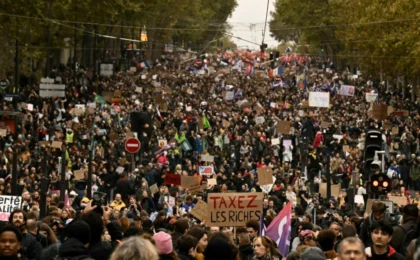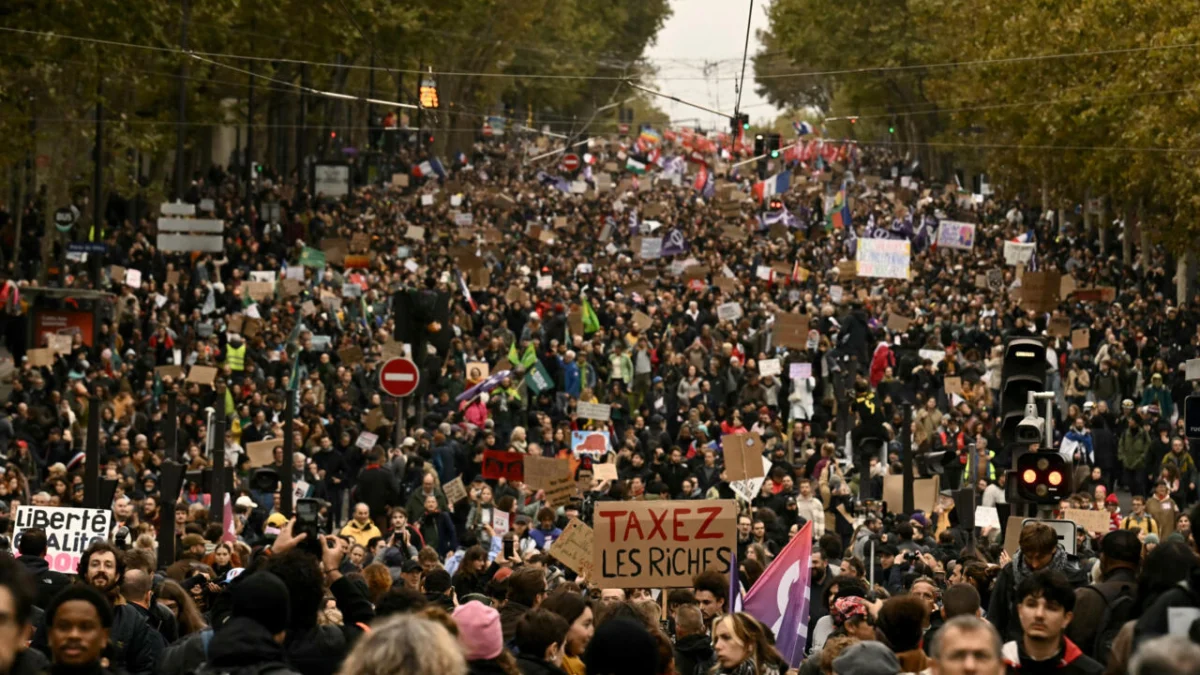
PARIS – On Saturday, October 24, 2026, the streets of major French cities transformed into hubs of collective dissent as hundreds of thousands of citizens mobilized to protest against the persistent erosion of purchasing power, the perceived degradation of public services, and the demand for a more equitable fiscal landscape.
The demonstrations, which saw significant turnout in Paris, Lyon, Marseille, and Bordeaux, represent a critical juncture in the French political climate. As inflation continues to squeeze household budgets and public infrastructure faces increasing strain, the movement has transcended traditional labor union lines, drawing in students, retirees, and middle-class families concerned about the future of the French social model.
Main Facts: A Tale of Two Figures
The scale of the mobilization has once again highlighted the perennial divide between official government data and union-led estimates. According to the French Ministry of the Interior, approximately 410,000 individuals participated in the nationwide rallies, with a concentration of 110,000 demonstrators in the capital.
Conversely, labor organizers and coalition groups—including the CGT and various grassroots activist networks—reported a significantly higher figure, claiming nearly 800,000 people took to the streets across the country, with 250,000 in Paris alone.
While the variance in counting methods is a hallmark of French industrial action, the sheer magnitude of the turnout confirms a widespread public discontent. In Paris, the atmosphere remained largely disciplined and peaceful throughout the day, as demonstrators marched from the Place de la République toward the Place de la Nation. However, the scene was starkly different in several regional hubs, where tensions escalated. Police reported isolated clashes and localized skirmishes in cities such as Nantes and Rennes, where groups attempted to breach unauthorized zones, leading to a heavy deployment of riot police and the occasional use of tear gas to disperse crowds.
Chronology: How the Unrest Unfolded
Friday, October 23: The Pre-Emptive Stance
The surge in protest activity did not occur in a vacuum. On Friday, the Élysée Palace signaled deep concern regarding the looming unrest. President Emmanuel Macron held a series of high-stakes meetings with student union leaders and senior law enforcement officials. The administration’s objective was two-fold: to signal an openness to dialogue regarding youth unemployment and educational funding, while simultaneously issuing a stern warning to those who might incite violence.
Saturday, October 24: The Day of Action
- 09:00 AM: Demonstrators began gathering in major transit hubs. The atmosphere was somber but resolute.
- 11:30 AM: The first major columns of protesters commenced their marches in Paris. Placards reading "Justice for the Working Class" and "Stop the Inflationary Spiral" dominated the visual landscape.
- 02:00 PM: Peak attendance reported in Paris. The intersection of major boulevards was gridlocked, not by vehicles, but by the sheer density of the crowd.
- 04:30 PM: Reports of localized violence began filtering in from outside the capital. In Nantes, protesters clashed with security forces near the municipal administrative buildings.
- 07:00 PM: The formal end of the demonstrations in Paris. While the city returned to relative quiet, activists pledged that these rallies were merely the beginning of a broader campaign.
Supporting Data: The Economic Roots of Anger
The current protests are not merely expressions of partisan political disagreement; they are deeply rooted in a series of economic indicators that have soured the public mood.
The Purchasing Power Gap
Data from the national statistics agency, INSEE, indicates that while nominal wages have risen, they have consistently lagged behind the Consumer Price Index (CPI), particularly regarding energy, food, and housing costs. For many households, the "cost of living" is no longer a theoretical debate but a daily struggle to balance essential expenses.

Public Services Under Duress
The call for the "protection of public services" refers to a growing perception that the state is retreating from its traditional responsibilities. With hospital staffing shortages, a crisis in primary care access, and concerns over the quality of public transport in rural areas, the protesters are demanding a reversal of fiscal policies that have historically favored budget austerity over social investment.
Fiscal Inequality
The demand for "fiscal and social justice" is a recurring theme in the movement. Critics of the government argue that the current tax structure places a disproportionate burden on the working and middle classes while failing to adequately address the windfall profits of major energy and retail corporations.
Official Responses and Political Implications
The government finds itself in a precarious position. The Ministry of the Interior has maintained that the state is committed to ensuring the right to protest, provided it remains within the bounds of the law. "We hear the concerns of our citizens," a spokesperson for the government stated late Saturday, "but we must also ensure the safety of our cities and the continuity of public life."
However, the political implications are profound. The breadth of the coalition—spanning traditional left-wing parties, environmentalist groups, and independent citizen movements—suggests that the administration may struggle to divide the opposition.
A New Political Paradigm?
The success of the mobilization suggests that the "social contract" in France is undergoing a significant stress test. If the government fails to address the underlying economic anxiety, observers suggest that the current movement could evolve into a long-term campaign similar to the Gilets Jaunes (Yellow Vest) protests of 2018. The challenge for President Macron is to navigate this crisis without appearing either unresponsive to the plight of the working class or beholden to radical factions of the protest movement.
Future Outlook: What Comes Next?
As of Sunday morning, the nation remains in a state of watchful waiting. The unions have called for a follow-up series of local meetings to discuss the government’s response to the October 24 demonstrations.
The Path to Resolution
- Direct Negotiations: There is increasing pressure on the government to initiate a "National Dialogue on the Cost of Living," involving representatives from labor unions, business associations, and civil society.
- Legislative Intervention: Some members of the opposition have already begun drafting proposals for targeted price freezes on essential goods—a move the government has previously rejected but may now be forced to reconsider.
- Public Spending Reform: The budget discussions currently underway in the National Assembly are expected to become significantly more contentious as deputies attempt to reconcile the government’s deficit reduction goals with the public’s demand for increased spending on social services.
The events of October 24 serve as a clear message to the administration: the status quo is increasingly untenable. For a nation that prides itself on its history of social mobilization, the coming weeks will be a testament to the resilience of the French democratic process and the ability of its leaders to pivot in the face of widespread public demand.
This report was compiled by the FRANCE 24 editorial team, drawing on extensive on-the-ground reporting from AFP, Reuters, and AP. For ongoing updates, follow our liveblog coverage as the situation develops.