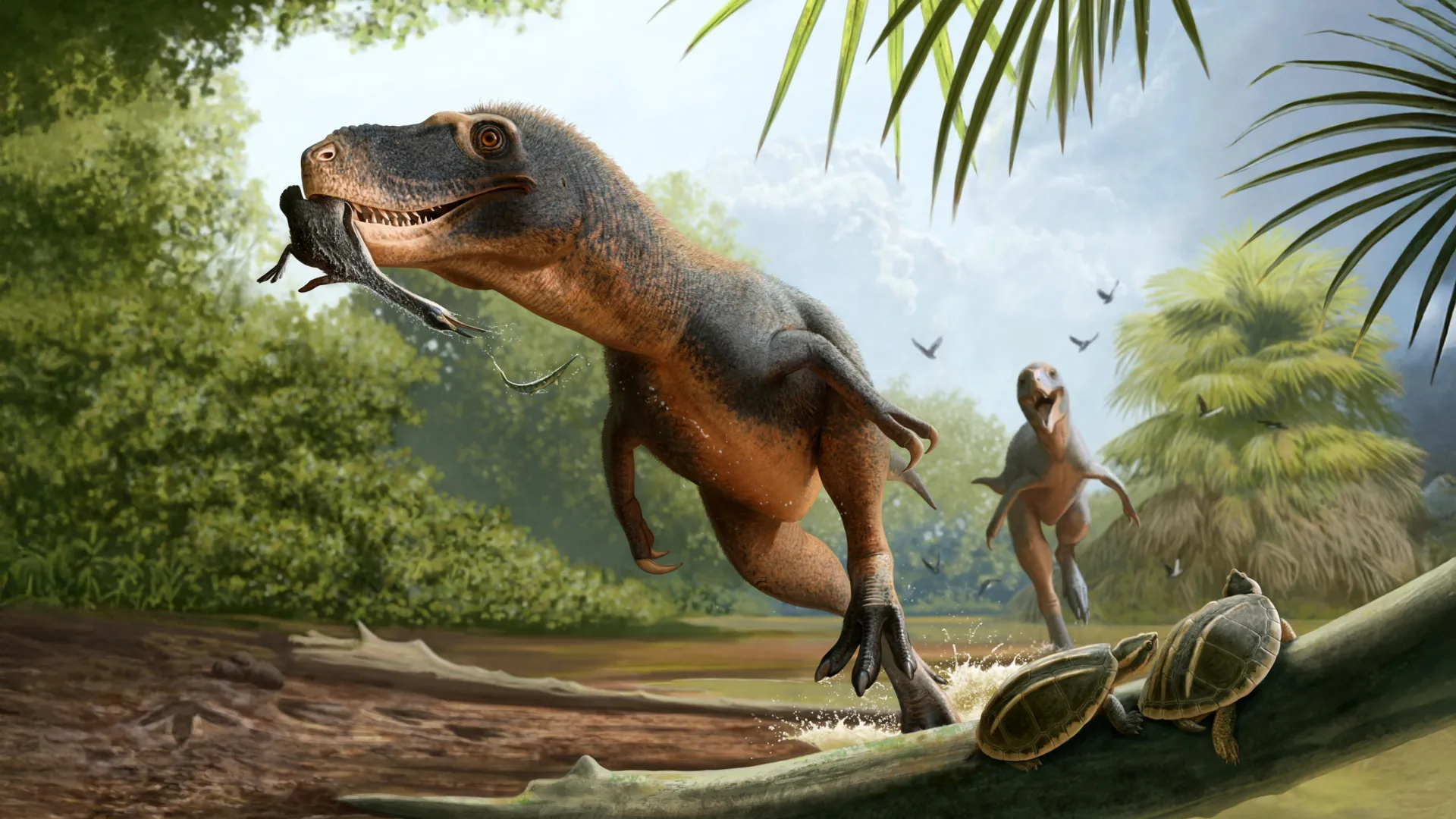
Sixty-six million years ago, in the twilight of the Cretaceous Period, a massive predator—likely a T. rex or its close relative, Nanotyrannus—consumed a final meal that would ultimately provide modern science with one of its most profound paleontological breakthroughs. The predator’s digestive system did not entirely destroy the evidence of this feast; instead, it preserved it in a fossilized dropping, or coprolite, that has recently unveiled the finest feather specimen ever recovered from the age of dinosaurs.
This remarkable discovery, published in the journal Current Biology, suggests that the key to why birds survived the mass extinction event that wiped out their dinosaurian cousins may be hidden within the structure of their feathers. By analyzing these ancient remnants, researchers are shifting the focus of extinction studies from broad environmental factors to the intimate, biological nuances of plumage and insulation.
The Chronology of a Discovery
The journey of this scientific revelation began in 2016, buried deep within the Hell Creek Formation of northeastern Montana. For over 150 years, paleontologists had combed this rugged landscape, yet fossilized feathers remained frustratingly elusive.
David DeMar, Jr., a research scientist and collections manager at the University of Washington Burke Museum, was conducting routine fieldwork, scouring a rocky outcrop for fish fossils. His attention was snagged by an unremarkable, dark reddish-brown nodule, roughly half the size of a golf ball. "I picked it up and scanned its surface through my hand lens," DeMar recalls. "That’s when I couldn’t believe what I was seeing—a tiny fossil feather."
The nodule was brought to the laboratory, where researchers employed micro-CT scanning—a technology that allows scientists to create detailed 3D reconstructions of an object’s interior without damaging the fossil itself. Nate Carroll, a paleontologist at the Carter County Museum and co-author of the study, described the moment the data began to process: "Every hour of processing revealed another feather, another scale, another bone—in stunning 3D. Realizing that fossil poop from my home state could yield such exceptional specimens was a game changer."
The scan confirmed that the nodule was indeed a coprolite, containing not only the feathers but also the remains of gar fish scales and the leg bones of a hesperornithiform bird.
Supporting Data: The Anatomy of a Lost Species
The feathers identified within the coprolite belonged to a hesperornithiform, a group of flightless, aquatic birds that were ecologically similar to modern-day loons. These birds were specialized divers, utilizing their powerful feet to hunt prey in the water.
The Hybrid Nature of Ancient Plumage
The structural analysis of the feathers revealed a complex, hybrid nature. While some feathers exhibited the waterproof, modern characteristics required for an aquatic lifestyle, others retained a primitive, "fuzzy" quality typical of earlier dinosaurs and enantiornithines—the dominant bird group of the Cretaceous.
This mix of traits is critical. It demonstrates that hesperornithiforms were in a transitional state of evolution. They were close relatives of the Neornithes—the lineage that would eventually evolve into every bird species alive today—but they remained distinct enough that they were unable to survive the environmental collapse that followed the asteroid impact.
Predator-Prey Dynamics
The presence of these remains in a predator’s waste provides a rare "fossilized" snapshot of a Cretaceous food web. Greg Wilson Mantilla, a professor at the University of Washington, notes that finding both predator waste and prey tissue in a single, well-preserved context is exceptionally rare. It provides a definitive window into the dietary habits of large theropods, confirming that these giants were opportunistic feeders, capable of hunting diverse avian prey.
Official Responses and Scientific Context
Jingmai O’Connor, associate curator of fossil reptiles at the Field Museum in Chicago and the lead author of the study, characterizes the find as a "beautiful, well-preserved feather" from a source that no one had previously considered exploring.
"As far as I know, no one has ever thought to look for feathers or to study feathers in coprolites," O’Connor says. "It’s exciting that it could help us answer this huge question in paleontology: Why did birds survive the end-Cretaceous extinction when everything else died?"
The scientific community has long debated the "survival of the birds." One prevalent hypothesis was that birds living in aquatic environments were better protected from the initial heat and debris of the asteroid impact. However, the discovery of the hesperornithiform—an aquatic bird that went extinct—effectively complicates this theory. If living in water were the only requirement for survival, the hesperornithiforms should have persisted. Their disappearance indicates that habitat alone was not the deciding factor.
Implications: The "Impact Winter" and Feather Evolution
The study posits that the difference in survival may lie in the evolution of plumage and the efficiency of molting. When the asteroid struck 66 million years ago, it threw vast quantities of dust and sulfate aerosols into the atmosphere, blocking the sun and plunging the Earth into a brutal "impact winter."
Insulation as a Survival Mechanism
During this period of global cooling, the ability to regulate body temperature became the ultimate test of survival. The researchers hypothesize that the primitive, fuzzy feathers of the hesperornithiforms and enantiornithines were less efficient at trapping heat compared to the advanced, plumaceous feathers of the Neornithes.
If the ancestors of modern birds possessed superior, more efficient insulation, they would have been better equipped to endure the prolonged, freezing temperatures of the impact winter. This suggests that the extinction event was not random; it was a biological filter that selected for specific traits—namely, the ability to maintain metabolic warmth in a world where the sun had vanished.
A New Methodology for Paleontology
Beyond the biological insights, this study serves as a manifesto for future paleontological research. O’Connor emphasizes that the detective work required to reconstruct the story from a single, fragmented coprolite opens a new frontier.
"I usually work with fossils that are preserved in big stone slabs, where the skeleton and soft tissue make things easy for me," O’Connor explains. "With this, we had to piece together clues from a coprolite. It was a lucky break that this one was split open to expose the feather. I hope more scientists start CT-scanning coprolites to see what else has been hiding in plain sight."
This discovery suggests that museum collections globally are likely holding thousands of coprolites that have never been fully examined. By applying high-resolution imaging to these discarded remnants, researchers may soon identify other soft-tissue structures, dietary patterns, and evolutionary markers that were previously thought lost to time.
Conclusion: The Persistence of Life
The discovery of the hesperornithiform feathers within a predator’s meal is a reminder of the fragility and the tenacity of life. While the massive dinosaurs and the primitive birds that filled the Cretaceous skies vanished, a small, insulated, and perhaps more adaptable lineage—the Neornithes—managed to endure the cataclysm.
As researchers like O’Connor and DeMar continue to peer into the digital interiors of fossilized feces, they are not just looking at waste; they are looking at a record of survival. The evolution of the feather, once a tool for simple insulation or display, became the key to surviving the darkest chapter in Earth’s history. The legacy of that survival is the modern world, where the descendants of those few survivors still soar above us today, carrying with them the biological secrets of their ancestors.