In the annals of paleontological discovery, few finds bridge the gap between external morphology and internal physiology as elegantly as a recently unveiled specimen from China. Scientists have identified a remarkably preserved fossil of Austronaga minuta, a long-necked marine reptile that navigated the prehistoric seas approximately 245 million years ago. This discovery, published in the journal Science Advances, offers an unprecedented, high-resolution look into the biological architecture of a creature that existed during the Middle Triassic—a time when the ancestors of today’s crocodiles and dinosaurs were beginning to experiment with the challenges of a life aquatic.
The international research team, comprised of experts from institutions in China, Europe, and the United States, notes that this specimen is not merely a skeletal curiosity. It is the oldest known example of a largely complete digestive system preserved within a reptile, providing a rare "biological blueprint" of how these creatures processed their food while transitioning from terrestrial to marine habitats.
The Anatomy of an Evolutionary Pioneer
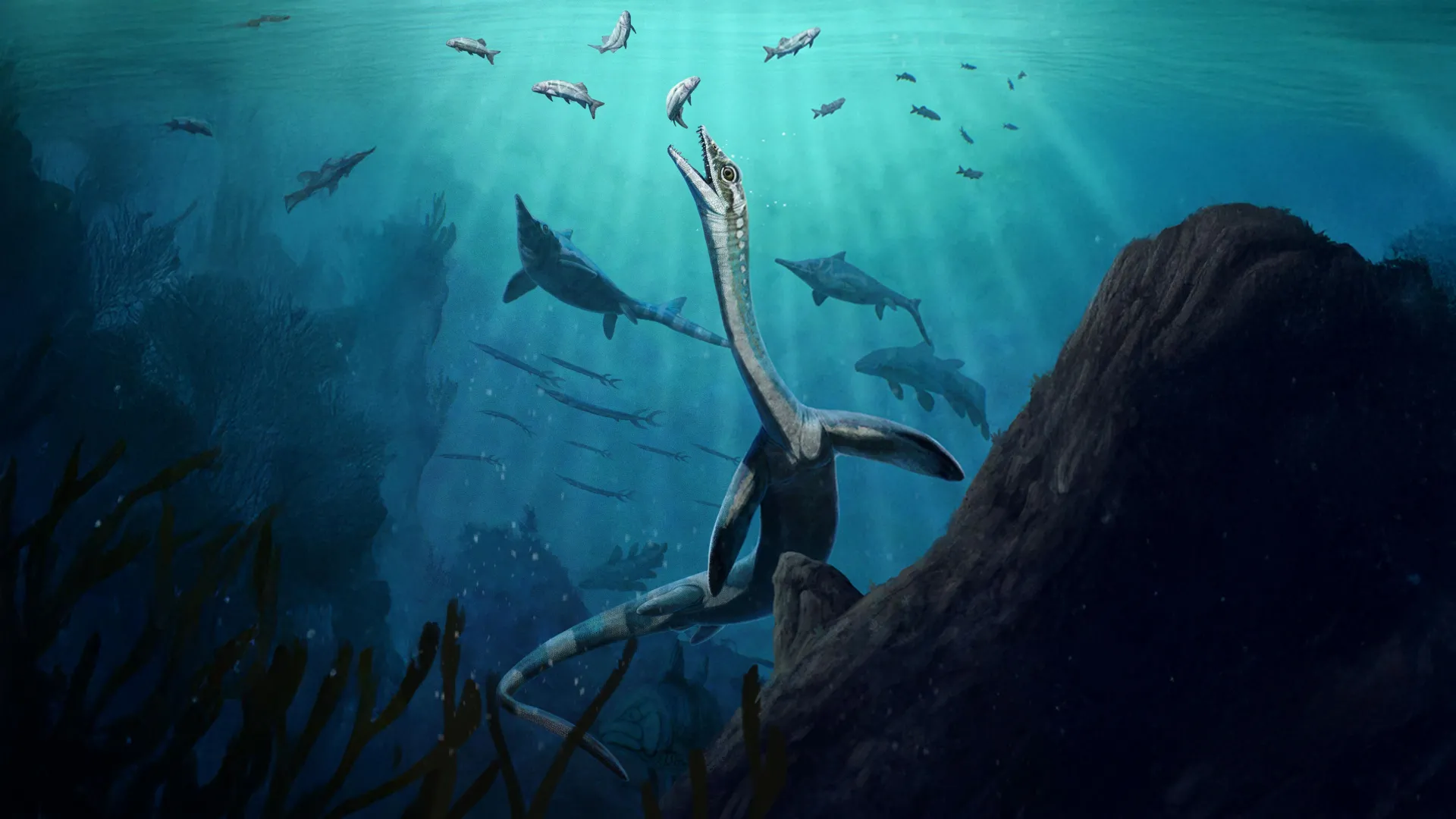
Austronaga minuta was a creature of stark contrasts. Measuring a modest 60 centimeters in length, the reptile was diminutive by the standards of the massive marine giants that would later dominate the Mesozoic seas. However, its anatomical specialization suggests a predator far more sophisticated than its size might imply.
Structural Specializations for Aquatic Life
The fossil reveals a body plan optimized for hydrodynamics. Its neck and tail were significantly elongated, a classic hallmark of Triassic marine reptiles that likely served both as a sensory tool and a means of propulsion. While its ancestors were tethered to the land, Austronaga had undergone a rapid evolutionary metamorphosis.
The animal’s front limbs had evolved into elongated, fin-like structures, serving as the primary rudders for steering and stabilization in the water column. In contrast, its hind limbs were reduced in size, indicating that they played a negligible role in locomotion. This configuration suggests that Austronaga utilized a "front-wheel drive" swimming mechanism, an efficient, if highly specialized, method of navigating the coastal waters of what is now China.
Chronology of Discovery and Analysis
The discovery of the Austronaga specimen represents the culmination of years of field exploration and rigorous laboratory analysis. Found within the rich fossil beds of China, the specimen was initially identified as an exceptional skeletal find. However, it was only through the application of cutting-edge analytical technologies that the full scientific value of the fossil was realized.
Modern Imaging Techniques
To peer beneath the surface of the rock, the team employed a multi-modal approach. UV light photography was utilized to highlight the contrast between the fossilized organic remains and the surrounding matrix. This was supplemented by mass spectrometry, which allowed the team to chemically analyze the "dark area" preserved between the ribs.
These sophisticated tools revealed that the shadows within the fossil were not random decay patterns, but rather the remnants of internal organs—specifically, the stomach, liver, and intestines. The identification of traces of hemoglobin within the liver tissue provided definitive proof of the organ’s biological identity, a finding that stunned the research community given the 245-million-year age of the specimen.
A Comparative Perspective: Internal vs. External Evolution
One of the most compelling aspects of the study is the discrepancy between the reptile’s highly modified exterior and its relatively conservative internal anatomy.
The Simple Anatomy of a Specialist
Dr. Wei Wang, lead author of the study and an expert at the Institute of Vertebrate Palaeontology and Palaeoanthropology in Beijing, notes the irony of the creature’s biology: "Compared with the highly specialized body shape of Austronaga, its internal organs seem less modified."
While the external form was drastically altered to meet the hydrodynamic demands of a marine environment, the internal plumbing remained strikingly primitive. The stomach, for instance, appears as a single, large, sac-like chamber. This stands in stark contrast to the complex, two-part digestive systems seen in modern crocodiles and birds—the living descendants of the archosaur lineage to which Austronaga is related.
Evolutionary Implications for Archosaurs
The discovery provides a missing link in our understanding of archosaur evolution. Dr. Nick Fraser of the National Museums Scotland, a co-author of the paper, emphasizes the significance of this simplicity: "While today’s birds and crocodiles have a two-part stomach, Austronaga had only a single stomach chamber. This shows that the stomachs of archosaurs were initially quite simple and only evolved later in the evolutionary process."
This simplicity suggests that the "advanced" digestive features of modern archosaurs were not present at the inception of the lineage’s foray into the ocean, but were instead evolutionary innovations that developed over subsequent millions of years. The digestive tract of Austronaga is, by all measures, short and uncomplicated, remarkably similar to that of contemporary fish-eating reptiles.
Official Responses and Scientific Context
The implications of this study extend far beyond the classification of a single species. It challenges long-held assumptions regarding the adaptability of early archosaurs.
Challenging the "Limited Adaptation" Paradigm
For decades, the consensus among paleontologists was that while archosaurs were the masters of the terrestrial world during the Mesozoic, their potential for marine life was severely restricted compared to other groups like the ichthyosaurs or the massive mosasaurs.
Dr. Stephan Spiekman of the State Museum of Natural History Stuttgart and the University of Hohenheim, a lead specialist in the study of long-necked marine reptiles, argues that Austronaga forces a reassessment of this narrative. "The archosaurs and their ancestors were the most diverse group of reptiles on land during the time of the dinosaurs, but we always thought that their adaptation to life in the sea was limited. However, the discovery of Austronaga shows that early representatives of this lineage had already developed complex adaptations to life in the oceans, comparable to those of other, better-known groups of fossil marine reptiles."
This discovery suggests that the evolutionary "experiment" of marine colonization was occurring much earlier, and across a wider breadth of lineages, than previously documented.
The Broader Scientific Investigation
The study of Austronaga minuta is part of a larger, collaborative effort to reconstruct the biodiversity of the Triassic seas. The research team involved a global coalition of experts from:
- The Institute of Vertebrate Palaeontology and Palaeoanthropology (Beijing, China)
- National Museums Scotland (UK)
- State Museum of Natural History Stuttgart (Germany)
- University of Hohenheim (Germany)
- The Field Museum (Chicago, USA)
- Luoping Biota National Geopark (China)
- University of Zurich (Switzerland)
This collaboration reflects the international nature of modern paleontology, where data from disparate sites and diverse disciplines are synthesized to solve complex evolutionary puzzles. The fossil itself remains housed in Beijing, serving as a primary reference point for future research into the history of marine life.
Future Research Directions
What does this discovery mean for the future of the field? According to the researchers, the study of Austronaga is just the beginning. The existence of such a well-preserved digestive tract opens up the possibility of investigating the dietary habits of these reptiles with far greater precision than ever before.
Future studies aim to analyze the isotopic signatures within the digestive tract to confirm the creature’s exact prey, thereby providing a more nuanced view of the marine food web in the Middle Triassic. Furthermore, researchers are hopeful that this specimen will serve as a catalyst for re-examining existing fossils in museum collections. It is highly probable that other specimens—previously thought to be "only" skeletons—contain similar organic remnants that were simply overlooked due to a lack of high-resolution analytical techniques.
The "Austronaga" discovery is a testament to the persistent power of scientific inquiry. By peering into the stomach of a creature that died 245 million years ago, researchers have not only identified a new species but have gained a clearer understanding of the evolutionary pressures that shaped the early reptilian pioneers of the ocean. It reminds us that even a small, 60-centimeter reptile can hold the key to understanding the grand, unfolding history of life on Earth.