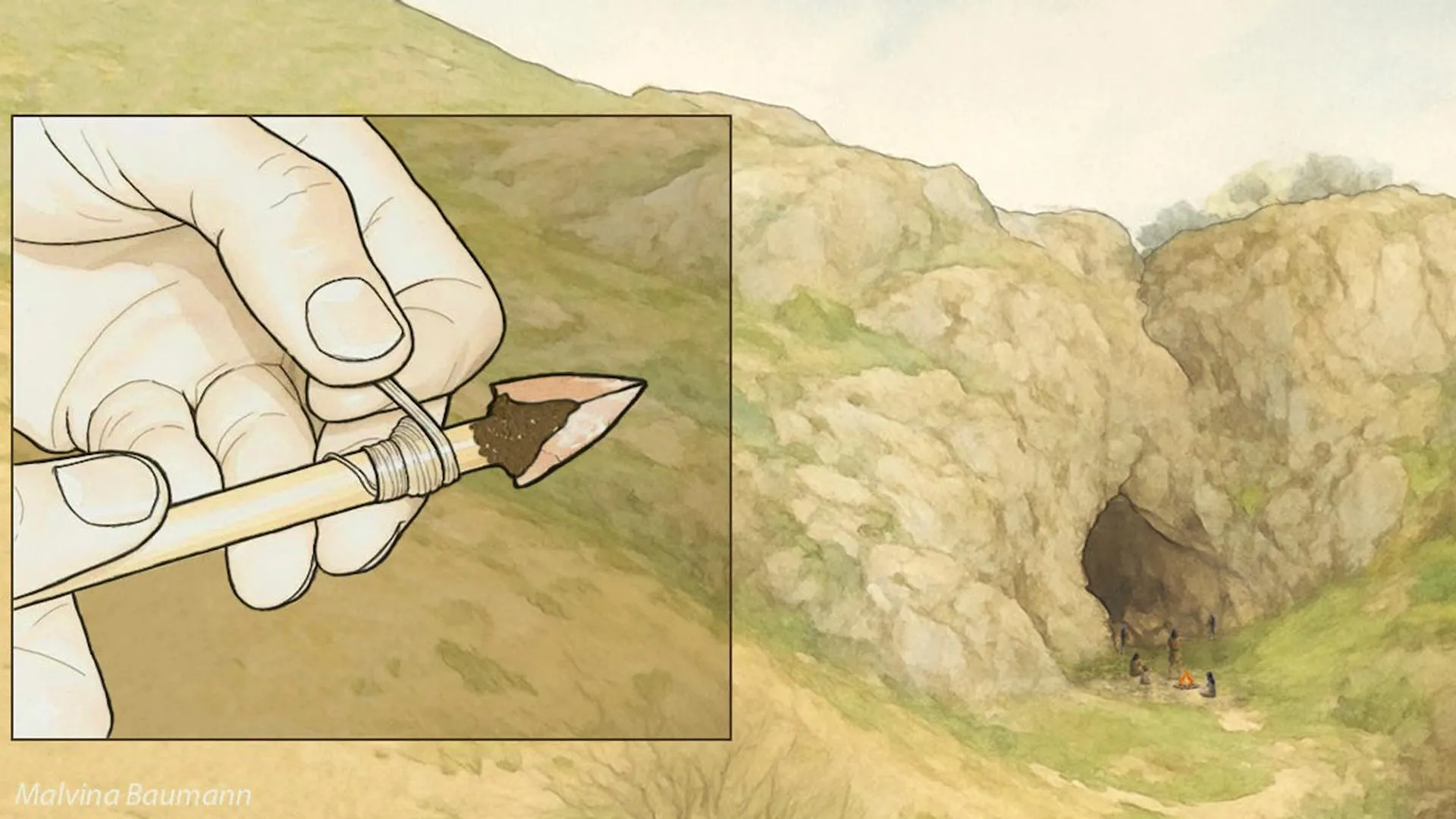
In a revelation that challenges the traditional narrative of human migration, a multidisciplinary research team has uncovered evidence suggesting that the story of Homo sapiens in Europe began far earlier and far further east than previously imagined. The identification of unretouched, triangular microlithic projectile points at the Obi-Rakhmat site in Uzbekistan, dating back 80,000 years, provides a startling link to later technological developments in Western Europe. This discovery suggests that our ancestors were not merely wandering bands, but innovators with a sophisticated grasp of ballistics who utilized Central Asia as a cradle for cultural and technological advancement long before their eventual expansion into Neanderthal territories.
The Traditional Narrative Under Scrutiny
For over a century, the history of human evolution was defined by a Eurocentric bias. Established in the 19th century, the prevailing models suggested a linear progression from Neanderthals to early modern humans (Cro-Magnons) in Europe, effectively casting the continent as the primary stage for civilizational development. This "Western-first" framework dominated academic thought until the mid-20th century, when the paradigm finally shifted to acknowledge the African origins of Homo sapiens.
However, even with this shift, the narrative remained tethered to the assumption that Homo sapiens arrived in Europe in a relatively direct and rapid expansion around 45,000 years ago. Current archaeological evidence for the earliest modern humans in Australia, dating back 65,000 years, already predates European findings by 10,000 years, creating a glaring temporal and geographical discrepancy. The "Levantine bridge"—the assumed route from Africa through the Levant—has long been the standard explanation, yet the archaeological data there remains frustratingly inconsistent. The recent study published in PLOS One proposes a bold alternative: a Central Asian origin point for the technological innovations that would eventually characterize the Initial Upper Paleolithic.
A Strategic Hub: The Obi-Rakhmat Rock Shelter
Located in the southwestern foothills of the Talassky Alatau range of the Tien Shan mountains in Uzbekistan, the Obi-Rakhmat rock shelter has been a site of intense interest since its discovery in 1962. Excavations led by Andrei Krivoshapkin have revealed a remarkably consistent stratigraphic sequence spanning 40,000 years, from 80,000 to 40,000 years ago.
The site is significant not only for its longevity but for its diverse lithic industry. The layers contain a mixture of large blades, bladelets, and points that have long puzzled researchers. Initially classified as "Initial Upper Paleolithic," the industry shows strong affinities with the Levantine Early Middle Paleolithic. Adding to the site’s mystery is the 1962 discovery of a child’s skull, which features a mosaic of Neanderthal and anatomically modern human traits, hinting at a complex history of hybridization in this remote mountain corridor.
Ballistics and the Technology of the Hunt
The core of the recent breakthrough lies in the re-examination of "lithic debris" from the oldest layers at Obi-Rakhmat. Researchers identified tiny, triangular, unretouched stone points that were previously overlooked. Through microscopic traceology—the study of wear patterns—the team compared these artifacts to experimental reference data.
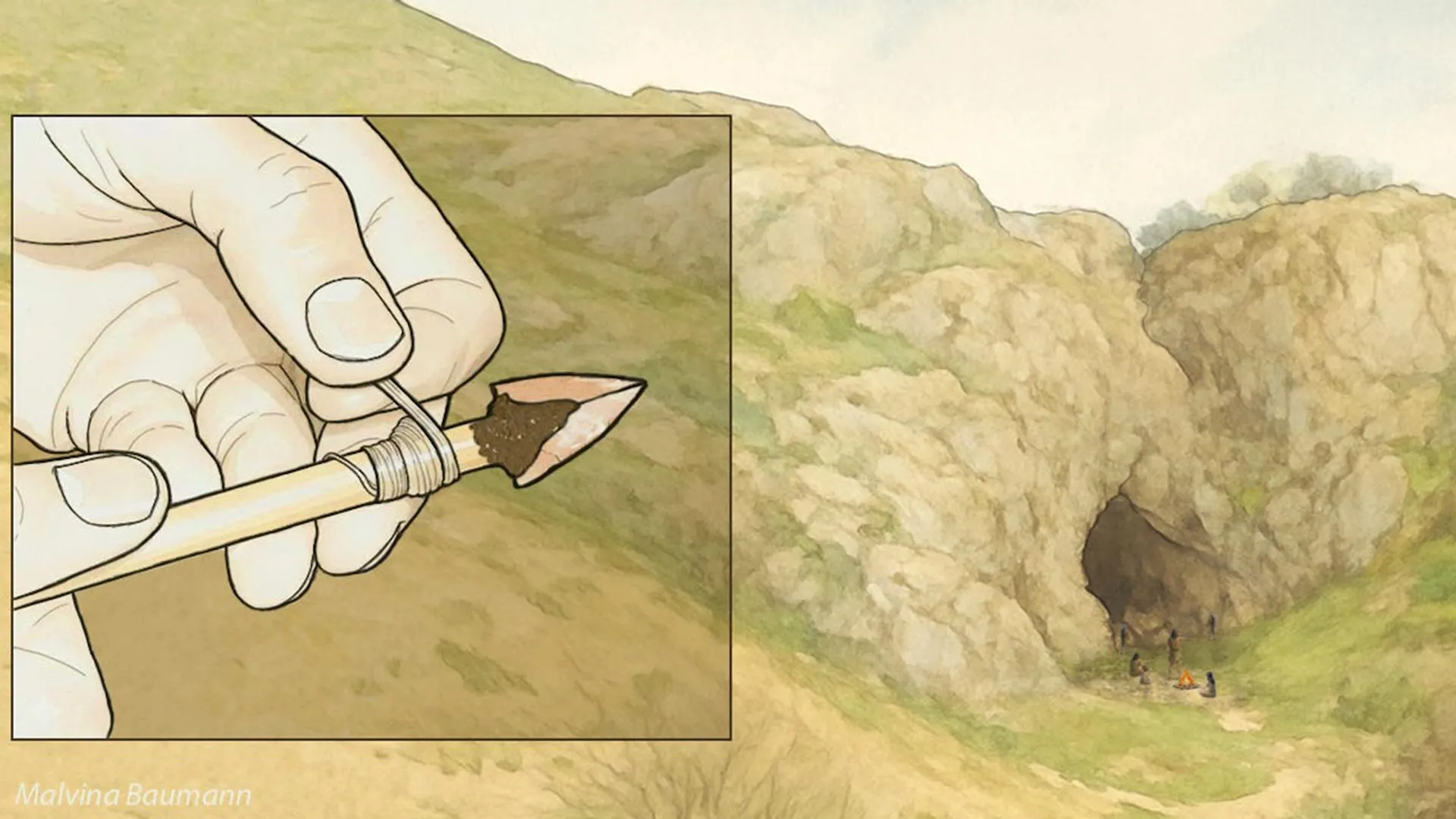
The findings are compelling: these points, measuring less than 2 cm in width and weighing only a few grams, could not have been mounted on heavy, hand-thrown spears. The physics of projectile weapons is unforgiving; mass is required for the force of a hand-thrown spear, but velocity is the critical factor for light, long-distance projectiles. The sharpness and dimensions of the Obi-Rakhmat points align perfectly with ethnographic records for arrowheads used with low-poundage bows.
Unlike the Neanderthal record, where lithic points are often large, heavy, and multipurpose, the Obi-Rakhmat assemblage shows a clear functional specialization. The presence of both massive, robust points and delicate microlithic points in the same layer suggests that Homo sapiens hunters were employing a sophisticated, multi-tiered weapon system. This intentional design—creating specific tools for specific ballistic requirements—is a hallmark of Homo sapiens behavior, mirroring findings from South African sites like Sibudu Cave.
The 25,000-Year Connection: From Uzbekistan to the Rhône
The most startling aspect of the study is the direct comparison between the Uzbekistani micro-points and those found at the Grotte Mandrin in the Rhône Valley, France. In 2023, researcher Laure Metz identified identical projectile technology at the French site, dating to 54,000 years ago.
Despite being separated by 6,000 kilometers and 25,000 years, the points are morphologically and technologically interchangeable. This suggests that the "archery" technology present in France was not an isolated invention, but part of a long-standing tradition developed in Central Asia. Genetic studies conducted by Leonardo Vallini and Stéphane Mazières support this, identifying the Persian Plateau and Central Asia as a critical "population hub" where the ancestors of all non-African populations resided for millennia. This region, rich in resources and relatively isolated, provided the necessary conditions for the demographic regeneration and technical innovation that would eventually fuel the global dispersal of our species.
Implications for Human History
This discovery fundamentally disrupts the established timeline of human settlement in Europe. If Homo sapiens were utilizing advanced bow-and-arrow technology in Central Asia 80,000 years ago, and if this same technology appears in Western Europe 54,000 years ago, we must rethink the nature of the "incursion" into Neanderthal territory.
Rather than a single, rapid wave of migration from Africa, the evidence points to a much more complex, multi-stage process of dispersal. Homo sapiens appear to have been established in the heart of the Eurasian continent for tens of thousands of years before pushing into the western Mediterranean.
Critical Reception and Scientific Rigor
As is expected with any paradigm-shifting research, the study has faced skepticism. Critics have questioned whether the "bow and arrow" conclusion is overly speculative, suggesting that we should remain cautious regarding the specific mechanism of projection. However, the researchers argue that the consistency of the evidence—from the microscopic impact traces to the ballistic requirements—is far more parsimonious than the assumption that such identical, specialized technology was invented independently in two disparate locations.
A New Framework for Prehistory
The convergence of genetic data and material culture is rare in Paleolithic studies. When the genetic memory of our ancestors aligns so precisely with the physical tools left behind in the soil, the argument for a rewritten history becomes difficult to ignore.
The "Obi-Rakhmat-Mandrin connection" suggests that we have been looking at human migration through too narrow a lens. By moving beyond the Eurocentric models of the 19th century and acknowledging the significance of Central Asian sites, archaeologists are beginning to uncover a more nuanced, dynamic, and ancient history of humanity. We are no longer looking at a simple expansion, but a long, deliberate, and technologically driven migration that spanned the globe, fueled by an ingenuity that was already flourishing in the shadow of the Tien Shan mountains 80,000 years ago. As researchers continue to analyze sites between Central Asia and Europe, it is highly likely that more of these "invisible" micro-points will come to light, further cementing this new narrative of our collective past.