For over a century, the field of paleontology operated under a fundamental, near-sacrosanct assumption: the process of fossilization is a great eraser of biological history. As organic tissues turn to stone over millions of years, the delicate molecular architecture of life—proteins, DNA, and soft tissues—was presumed to be obliterated, replaced by minerals or degraded into unrecognizable chemical sludge. Under this prevailing paradigm, the notion of finding original proteinaceous material in a creature that walked the Earth during the Mesozoic Era was considered scientific heresy.
However, a landmark study led by the University of Liverpool has shattered this long-standing consensus. By applying cutting-edge analytical chemistry to an exceptionally preserved Edmontosaurus fossil, researchers have provided what many are calling the definitive evidence that ancient organic molecules can, against all odds, survive the ravages of deep time.
The Resurrection of the "Impossible" Molecule
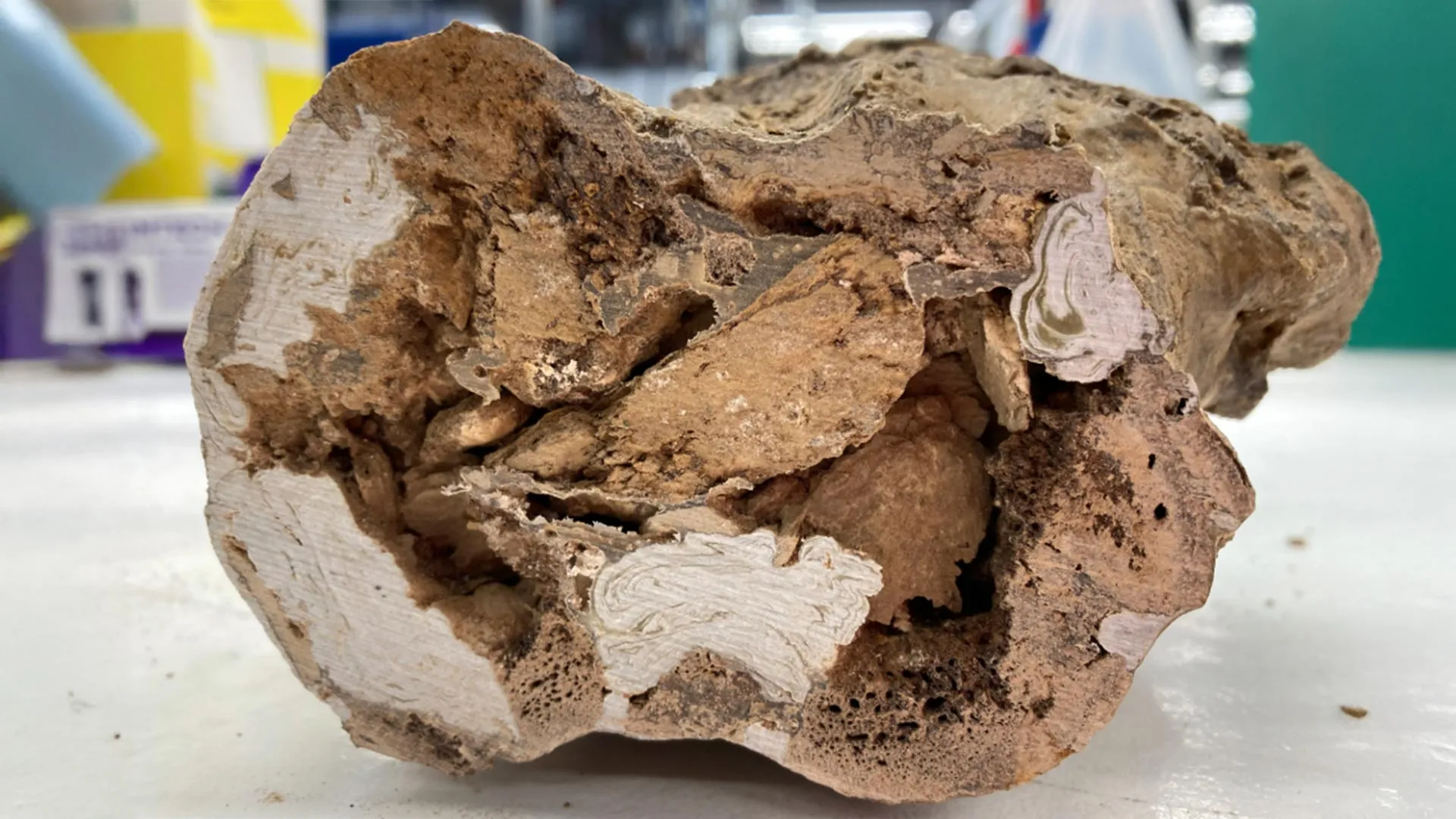
The study, published in the journal Analytical Chemistry, centers on a 22-kilogram sacrum—a fused segment of the lower spine—belonging to an Edmontosaurus, a genus of hadrosaur, or "duck-billed" dinosaur. Excavated from the fossil-rich Hell Creek Formation in South Dakota, a geological hotspot that captures the final chapter of the dinosaur age, the specimen had been tucked away in the University of Liverpool’s collections, waiting for the right technology to reveal its secrets.
For decades, the paleontology community has been embroiled in a heated debate regarding "soft tissue" in fossils. When researchers previously claimed to find collagen in dinosaur bones, critics were quick to dismiss the findings as modern contamination—microbes, environmental runoff, or human handling. This new research, however, utilizes a multi-institutional approach to isolate and identify collagen fragments with a level of rigor that leaves little room for such skepticism.
Chronology of a Scientific Breakthrough
The path to this discovery was not linear; it was a decades-long accumulation of suspicion, trial, and technological evolution.
The Era of Skepticism (1990s–2010s)
For thirty years, the scientific community maintained a skeptical stance toward "fossil organics." The argument was rooted in the laws of chemistry: proteins are unstable polymers. Without the protection of a living cell’s maintenance machinery, the peptide bonds holding collagen together should hydrolyze and vanish within a few million years, long before a dinosaur reaches the tens of millions of years required to qualify as a Mesozoic fossil.
The Technological Leap (2020–2023)
The University of Liverpool team, led by experts in mass spectrometry, realized that the problem wasn’t the absence of proteins, but the lack of sensitivity in older detection methods. By combining traditional paleontological preparation with state-of-the-art mass spectrometry and protein sequencing, they moved beyond simple visual identification.
The Validation Phase (2024)
The study involved a coordinated effort between the University of Liverpool’s Department of Electrical Engineering & Electronics, the Materials Innovation Factory, the Centre for Proteome Research, and partners at UCLA. By using tandem mass spectrometry, the team was able to detect hydroxyproline—an amino acid that is a biological "fingerprint" for collagen. Its presence confirmed that what the researchers were looking at was not modern bacterial film, but the degraded remnants of original dinosaur bone matrix.
Supporting Data: The Anatomy of Discovery
The evidentiary weight of the study rests on the collaboration of several high-precision techniques. The researchers did not rely on a single data point; they built a case through convergent evidence.
Mass Spectrometry and Protein Sequencing
Mass spectrometry functions by ionizing chemical species and sorting the ions based on their mass-to-charge ratio. This allowed the team to create a "molecular map" of the Edmontosaurus sacrum. The identification of collagen alpha-1 fragments provided the smoking gun. Alpha-1 is the primary structural protein in vertebrate bone; finding it preserved in a 66-million-year-old specimen suggests that the fossilization environment in the Hell Creek Formation acted as a protective vault, perhaps shielding the protein from the typical microbial and chemical degradation that usually destroys such materials.
The Role of Hydroxyproline
Perhaps the most crucial piece of evidence is the quantification of hydroxyproline. In bone biology, this amino acid is essential for the stability of the collagen triple helix. Because it is highly specific to collagen in vertebrate systems, its detection serves as an internal control against contamination. If the sample had been contaminated by modern human or microbial material, the signature would have been vastly different. The presence of these specific amino acid sequences provides a chemical timestamp that points directly back to the dinosaur.
Official Responses and Theoretical Shifts
Professor Steve Taylor, chair of the Mass Spectrometry Research Group at the University of Liverpool, has been at the forefront of interpreting these findings. His perspective on the implications is twofold: the immediate validation of the biological material and the long-term shift in how we approach the fossil record.
"This research shows beyond doubt that organic biomolecules, such as proteins like collagen, appear to be present in some fossils," Taylor stated. "Our results have far-reaching implications. Firstly, it refutes the hypothesis that any organics found in fossils must result from contamination."
Taylor emphasizes that the field must now pivot from asking if these proteins exist to asking how they survive. "The findings inform the intriguing mystery of how these proteins have managed to persist in fossils for so long," he noted. This "mystery" is now the new frontier of biochemistry—investigating the chemical environments (such as iron-rich mineral bonds) that might "cross-link" and stabilize proteins against the entropy of millions of years.
Implications for Paleontology and Beyond
The ramifications of this discovery extend far beyond a single dinosaur bone. The researchers argue that this finding provides a blueprint for a massive re-examination of existing museum collections.
Revisiting the Archive
For over a century, paleontologists have used cross-polarized light microscopy to study the microstructure of fossilized bone. While these images were intended to examine mineral structure, the Liverpool team suggests that many of these century-old slides may actually contain intact patches of bone collagen that were simply overlooked or misidentified.
If this hypothesis holds true, museums across the globe are sitting on an unmined "trove" of molecular data. By revisiting these archives, researchers could potentially conduct protein analysis on hundreds of species, mapping the evolutionary connections between dinosaurs in a way that skeletal anatomy alone never could.
Molecular Phylogeny
Traditional paleontology relies on morphological features—the shape of a hip bone or the serration of a tooth—to determine evolutionary relationships. However, morphology can be deceptive due to convergent evolution. If scientists can extract and sequence protein fragments from a wide array of dinosaur fossils, they could construct a "molecular phylogeny." This would allow researchers to track the lineage of dinosaurs with the same precision currently used to map the evolution of modern mammals, effectively turning the clock back tens of millions of years further than previously thought possible.
The Unresolved Mystery: The Persistence of Life
Despite the success of the Liverpool study, a profound scientific enigma remains. How does a protein, which is essentially food for bacteria and susceptible to moisture and heat, survive in the Earth’s crust for 66 million years?
The answer likely lies in the unique "taphonomy"—the study of how organisms decay and become fossilized—of the Hell Creek Formation. The environment was likely one of rapid burial, specific mineral chemistry, and perhaps a lack of oxygen that inhibited the usual decomposers. The collagen may have undergone a process of "tanning" or mineral complexing that made it indigestible to microbes and chemically inert to the environment.
As we move forward, the collaboration between chemists and paleontologists will become the standard for the field. The Edmontosaurus sacrum is no longer just a piece of bone; it is a time capsule. By unlocking these molecular records, scientists are moving from the era of simply describing the anatomy of extinct giants to the era of decoding their biology.
The study from the University of Liverpool marks the end of the assumption that fossilization is a total erasure. Instead, it seems that even when the light of an animal’s life goes out, the chemical echoes of its existence can linger, waiting for the right technology to bring them back into the light of scientific understanding.