For more than two decades, a peculiar, circular scar buried 700 meters beneath the floor of the North Sea has stood as one of geology’s most contentious enigmas. Known as the Silverpit Crater, this massive geological structure—located roughly 80 miles off the coast of Yorkshire, England—has been the subject of fierce academic debate since its discovery in 2002. Was it the site of a violent, cosmic catastrophe, or merely the result of mundane terrestrial forces?
Today, that debate has been decisively settled. A research team led by Dr. Uisdean Nicholson of Heriot-Watt University in Edinburgh has unveiled "the smoking gun," providing definitive evidence that the Silverpit Crater was indeed formed by a high-velocity asteroid impact some 43 to 46 million years ago. This revelation not only closes a long-standing chapter in planetary science but also offers a harrowing glimpse into a prehistoric event that triggered a tsunami of gargantuan proportions.
The Anatomy of a Cosmic Collision: Main Facts
The Silverpit Crater is not a singular hole in the ground but a complex geological complex. It measures approximately three kilometers across, yet it is encircled by a much larger, 20-kilometer-wide system of concentric faults—fractures in the Earth’s crust that reveal the sheer scale of the energy released during the event.
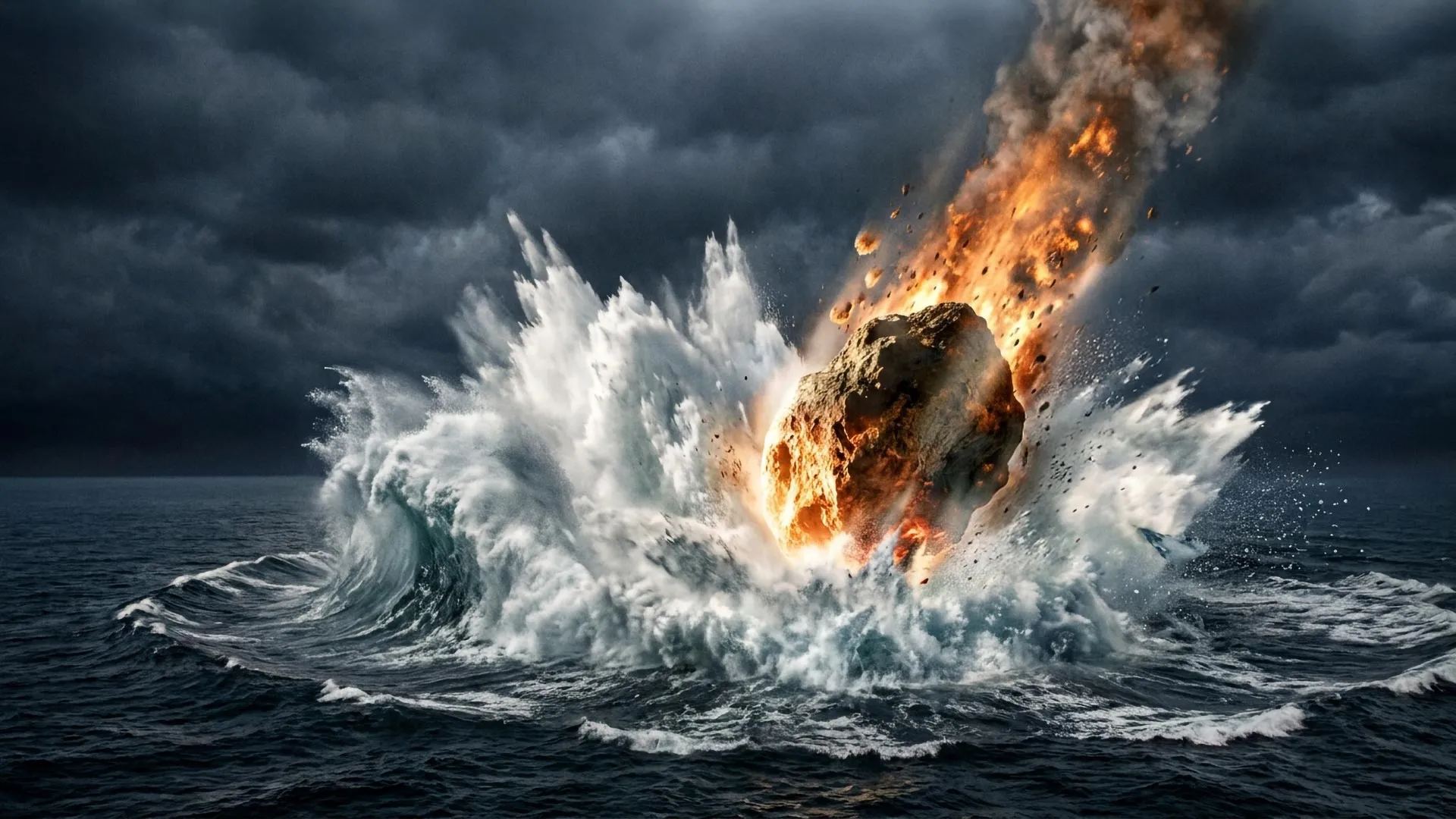
The research, recently published in Nature Communications, confirms that an asteroid measuring roughly 160 meters in diameter struck the North Sea at a shallow angle, approaching from the west. While 160 meters is significantly smaller than the multi-kilometer-wide asteroid that ended the reign of the dinosaurs, at cosmic speeds, it was more than enough to unleash apocalyptic power.
The simulations conducted by the research team indicate that the impact displaced immense volumes of rock and seawater instantaneously. This created a curtain of debris and water that shot 1.5 kilometers (nearly a mile) into the atmosphere before collapsing back into the ocean. The displacement generated a tsunami estimated to have reached heights exceeding 100 meters (330 feet)—a wall of water taller than a 30-story building, surging outward from the impact site.
A Twenty-Year Chronology of Contention
The history of Silverpit is a classic study of the scientific method’s slow, often turbulent grind.
2002: Discovery
When seismic data first revealed the crater, geologists were immediately struck by its resemblance to known impact structures. Its near-perfect circular symmetry and the presence of a central peak—formed when the compressed rock of the seafloor rebounded upward like water after a splash—seemed to be textbook indicators of a meteorite strike.
2003–2008: The Age of Skepticism
Despite the visual evidence, the scientific community remained largely unconvinced. Skeptics proposed alternative "terrestrial" theories. Some argued that the crater was the result of salt tectonics—the movement of subterranean salt deposits that can cause overlying rock layers to collapse or deform. Others suggested ancient volcanic activity, positing that a localized explosion or seafloor collapse could mimic the appearance of a crater.
2009: The Geoscientist Vote
The debate reached a fever pitch in 2009, when Geoscientist magazine documented a formal vote among experts regarding the origins of Silverpit. The majority of the participants voted to reject the asteroid hypothesis, favoring terrestrial explanations. For a decade thereafter, the impact theory was relegated to the fringes of mainstream geology.
2024: The Breakthrough
The narrative shifted when Dr. Nicholson’s team leveraged modern, high-resolution seismic imaging alongside microscopic analysis of physical rock samples recovered from an oil well near the crater site. By synthesizing this data, the team was able to bypass the speculation that had hampered previous generations, proving that the crater’s architecture could only have been produced by a hypervelocity impact.
Supporting Data: The "Needle-in-a-Haystack" Evidence
The strength of the current findings lies in the synthesis of two distinct data streams: advanced imaging and mineralogy.
Seismic Imaging
Seismic imaging acts as an "X-ray" for the Earth’s crust. By sending sound waves into the seabed and measuring their reflections, researchers can map the subterranean landscape. The new data allowed Nicholson and his team to visualize the internal structure of the Silverpit formation in unprecedented detail, revealing the distinct fracturing patterns consistent with the shock waves of a massive impact rather than the slow, plastic deformation associated with salt movement.
Shocked Minerals
The most damning evidence, however, was found at the microscopic level. Within rock cuttings recovered from a nearby oil well, the researchers identified "shocked" quartz and feldspar crystals. These minerals possess a unique, deformed internal lattice structure that can only be generated under the extreme, instantaneous pressures of a hypervelocity impact.
"We were exceptionally lucky to find these—a real ‘needle-in-a-haystack’ effort," Dr. Nicholson noted. "These prove the impact crater hypothesis beyond doubt, because they have a fabric that can only be created by extreme shock pressures." This physical signature cannot be replicated by volcanic activity or the slow shift of underground salt.
Official Responses and Peer Perspectives
The resolution of the Silverpit mystery has been met with relief and excitement within the geological community, particularly among those who stood by the impact theory when it was unpopular.
Professor Gareth Collins of Imperial College London, who participated in the 2009 debate and contributed the numerical simulations to the new study, expressed a sense of professional vindication. "I always thought that the impact hypothesis was the simplest explanation and most consistent with the observations," Collins said. "It is very rewarding to have finally found the silver bullet. We can now get on with the exciting job of using the amazing new data to learn more about how impacts shape planets below the surface."
The team’s work has been praised for its methodological rigor, combining classical field geology (the analysis of physical rock samples) with state-of-the-art computational modeling. The Natural Environment Research Council (NERC), which funded the research, highlighted the study as a prime example of how technological advancements—such as higher-resolution seismic data—can breathe new life into old questions.
Implications: Understanding Earth’s Violent History
The confirmation of the Silverpit Crater is significant for reasons that extend far beyond the North Sea.
A Window into Subsurface Impacts
Because the crater is buried beneath 700 meters of sediment, it has been shielded from the erosive forces of wind, water, and ice that typically obliterate craters on the Earth’s surface. This "time capsule" effect makes it a rare and invaluable laboratory for studying the long-term effects of cratering on planetary surfaces. By understanding how the surrounding rock layers were fractured and displaced at Silverpit, scientists can refine their models for interpreting impact sites on other planets, such as Mars or the Moon, where direct exploration is far more challenging.
Assessing Future Risks
The study also serves as a sobering reminder of the hazards posed by near-Earth objects. While the asteroid that hit Silverpit was relatively small (160 meters), it was capable of producing a 100-meter-high tsunami. In today’s world, with heavily populated coastlines, an event of this magnitude would be catastrophic. By reconstructing the mechanics of the Silverpit collision, researchers are better equipped to model the potential impacts of future near-Earth objects.
The Rarity of the Record
Earth is a geologically "alive" planet. Plate tectonics, volcanic activity, and constant erosion are remarkably efficient at recycling the crust and erasing the scars of the past. There are roughly 200 confirmed impact craters on land, but only 33 identified beneath the ocean. Silverpit is now a crown jewel in this small collection, joining the ranks of the Chicxulub crater in Mexico and the Nadir Crater off the coast of West Africa.
Each of these sites tells a chapter of the story of our planet’s relationship with the cosmos. As Dr. Nicholson concluded, "We can use these findings to understand how asteroid impacts shaped our planet throughout history, as well as predict what could happen should we have an asteroid collision in future."
With the Silverpit debate finally closed, the focus of the scientific community now shifts to the broader implications of the discovery: a renewed appreciation for the frequency and violence of cosmic collisions, and a greater understanding of the hidden history buried beneath the waves.