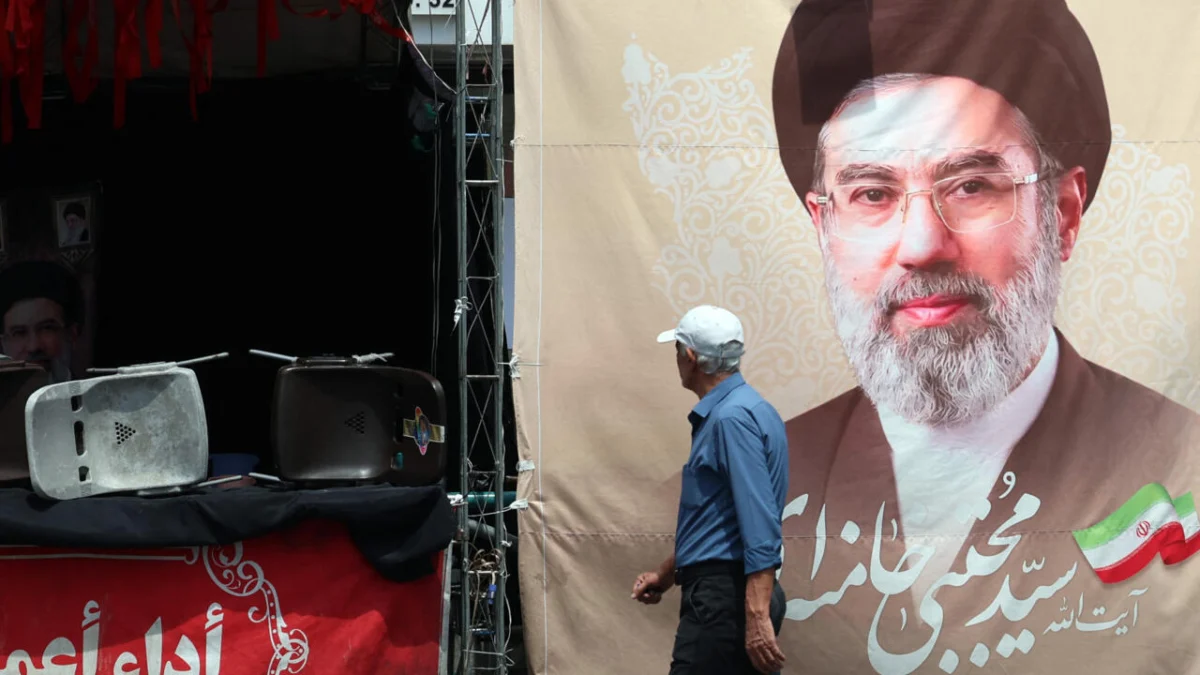
TEHRAN — The political landscape of the Islamic Republic of Iran has undergone its most significant transformation since the 1979 Revolution. Following a period of intense speculation and quiet internal maneuvering, the transition of power to Mojtaba Khamenei, the son of the late Supreme Leader Ali Khamenei, has been solidified. This generational shift marks a pivotal moment for Tehran, as it navigates a complex web of regional instability, internal dissent, and the tightening grip of the Islamic Revolutionary Guard Corps (IRGC).
As of July 2026, the state-sanctioned portraits of the new Supreme Leader adorn the boulevards of Tehran, signaling a definitive end to the era of his father and the commencement of a new, perhaps more rigid, chapter in Iranian governance.
I. Main Facts: A Succession Long in the Making
The ascension of Mojtaba Khamenei was not an overnight occurrence but the culmination of a decade-long consolidation of influence. Unlike his father, who rose to prominence through the clerical ranks and the furnace of the Iran-Iraq War, Mojtaba’s path has been one of behind-the-scenes institutional control.
The Institutional Shift
Mojtaba Khamenei, long considered a "grey eminence" within the power structure of the clerical establishment, has effectively utilized his proximity to the Office of the Supreme Leader to build a loyalist network within the intelligence and security apparatus. His rise represents a transition from a charismatic clerical leadership to one anchored in the operational strength of the IRGC and the bureaucratic machinery of the Office of the Supreme Leader.
The Role of the Assembly of Experts
The Assembly of Experts, the constitutional body tasked with appointing the Supreme Leader, moved with surprising cohesion to ratify the succession. Observers note that the selection was largely a formality, as the ground had been prepared through the systematic vetting of candidates and the sidelining of potential reformist or moderate voices within the clergy.
II. Chronology of the Transition
The transition process was meticulously orchestrated to prevent power vacuums that could be exploited by internal rivals or foreign adversaries.
- Mid-2025: The Pre-emptive Purge: As the health of the late Supreme Leader Ali Khamenei began to decline, the state apparatus initiated a series of reshuffles within the Guardian Council. This ensured that any potential opposition to Mojtaba’s candidacy within the clerical establishment was effectively neutralized.
- January 2026: Consolidation of Security: The IRGC issued a series of public statements pledging "absolute allegiance to the principles of the Revolution," a thinly veiled signal of support for the transition to the younger Khamenei.
- May 2026: The Symbolic Rollout: Giant portraits of Mojtaba Khamenei began appearing across Tehran and major provincial cities. This served as a psychological "softening" of the public, normalizing the image of the next leader.
- July 2026: Official Proclamation: Following the final transition of administrative responsibilities, the Assembly of Experts held an emergency session to formally declare Mojtaba Khamenei as the third Supreme Leader of the Islamic Republic.
III. Supporting Data: The Iranian Power Matrix
Understanding the new leadership requires a granular look at the power dynamics currently at play in Tehran. The "Khamenei-IRGC" nexus is the primary engine of the current administration.
The Economic Influence
Mojtaba Khamenei has historically exercised control over significant portions of the Setad (The Execution of Imam Khomeini’s Order), an economic conglomerate with assets worth billions of dollars. This financial independence allowed him to maintain a private patronage network, securing the loyalty of key military commanders and regional administrators without relying solely on the state budget.
Demographics and Dissent
According to data compiled by independent research institutes, the youth demographic—which constitutes nearly 60% of the Iranian population—remains largely alienated from the clerical establishment. The transition to a hereditary-style succession has intensified debates regarding the legitimacy of the clerical system among the middle class. While the security forces remain firmly in control, the "silent friction" between the government and the urban youth continues to be a primary metric of instability.
IV. Official Responses: A Divided World
The international response to the transition has been varied, reflecting the deep geopolitical divides regarding Iran’s regional and nuclear policies.

The Western Perspective
Washington and Brussels have adopted a stance of "cautious containment." Official statements from the U.S. State Department emphasized that the internal choice of leadership in Tehran does not alter the fundamental concerns regarding Iran’s nuclear program, ballistic missile development, and regional proxy networks. Diplomatic channels remain strained, with little expectation of a "thaw" in the immediate future.
Regional Alignments
Tehran’s neighbors have reacted with pragmatism. In the Gulf, capitals are watching closely to see if Mojtaba Khamenei maintains his father’s "Forward Defense" doctrine—a strategy of projecting power through regional proxies—or if he will prioritize internal economic stabilization. The normalization agreements signed over the past few years are currently in a "wait-and-see" mode, with regional powers prioritizing border security above ideological alignment.
The View from Moscow and Beijing
Russia and China have signaled continued support for the status quo. Both nations view the stability of the Iranian state as a key component of their own regional security architectures, particularly in Central Asia and the Persian Gulf. For Beijing, the transition represents a continuation of existing energy and infrastructure contracts, with little expectation of ideological friction.
V. Implications: The Future of the Islamic Republic
The appointment of Mojtaba Khamenei is not merely a change in personnel; it is a fundamental test of the resilience of the Islamic Republic’s ideology.
The Challenge of Legitimacy
The greatest challenge facing the new leader is the erosion of the revolutionary fervor that once anchored the clerical establishment. By shifting toward a model that resembles a hereditary monarchy, the Islamic Republic risks undermining its core "anti-monarchical" identity. The survival of the regime now depends heavily on its ability to provide economic relief to a population struggling with systemic inflation and international sanctions.
The Military-Clerical Balance
There is an ongoing debate among analysts regarding whether Mojtaba Khamenei will be a "clerical autocrat" or a "figurehead" for the IRGC. If the former, he may attempt to assert traditional clerical authority over the military. If the latter, the IRGC may effectively become the state, reducing the Supreme Leader to a symbolic role. The next 12 to 24 months will be crucial in determining which dynamic gains the upper hand.
Foreign Policy and Nuclear Ambitions
Given the current climate, it is unlikely that Tehran will deviate from its existing nuclear trajectory. Mojtaba Khamenei’s past statements suggest a commitment to "strategic patience." His administration is expected to maintain a posture of defiance against Western pressure while seeking to exploit any cracks in the global consensus regarding sanctions.
Conclusion: A Delicate Path Forward
As the sun sets on the era of Ali Khamenei, the rise of his son represents a calculated gamble by the Iranian establishment to preserve the existing order. The streets of Tehran remain calm, yet beneath the surface, the tensions that have characterized the last decade of Iranian politics persist. Whether Mojtaba Khamenei can bridge the widening chasm between the state and its citizenry—while navigating a hostile international environment—remains the defining question of the coming decade.
The Islamic Republic has proven remarkably adept at survival, but the transition to a new generation of leadership introduces variables that have never been tested before. For the international community, the focus remains clear: the internal dynamics of Tehran will continue to dictate the security architecture of the Middle East for years to come.