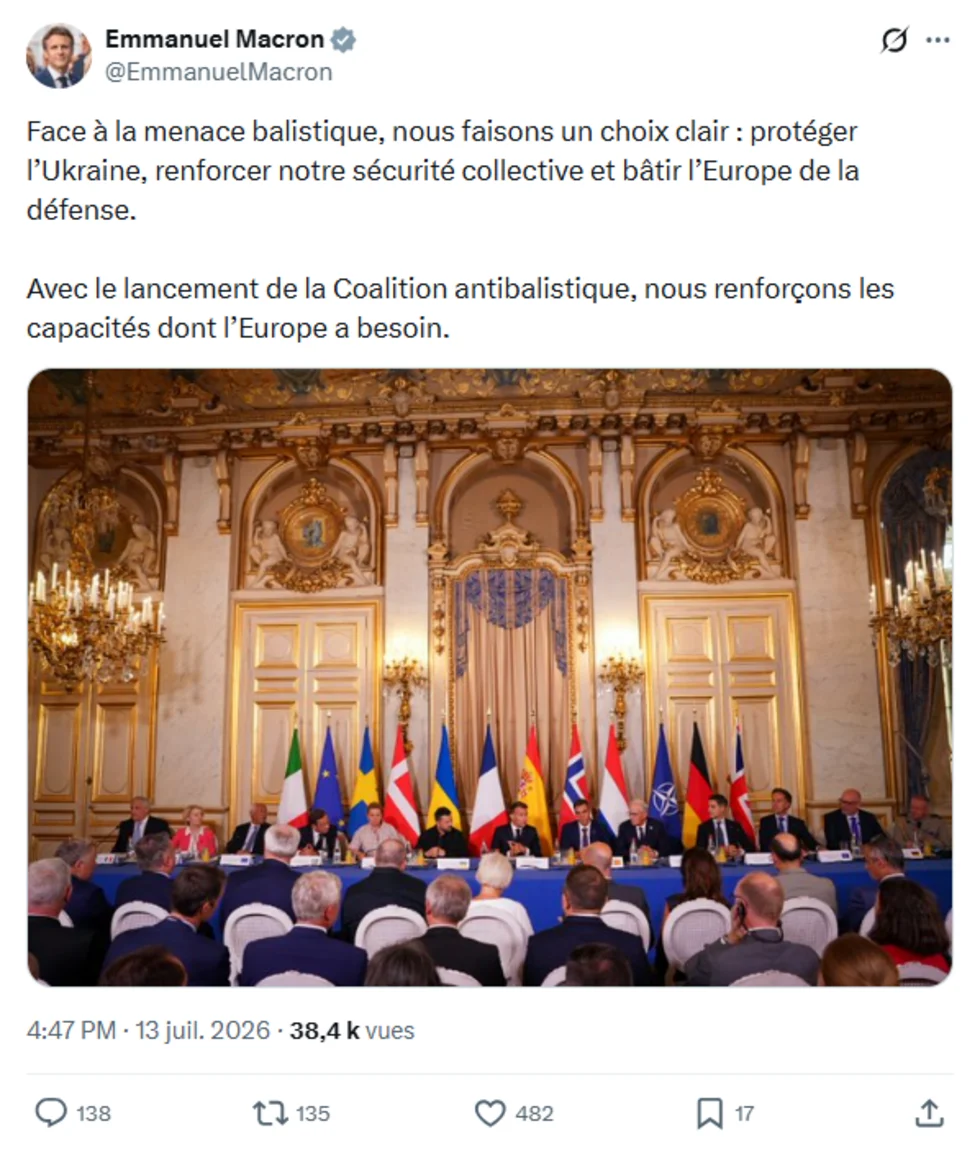
In a landmark move signaling a significant escalation in European collective security, nine nations have joined forces with Ukraine to establish a dedicated coalition aimed at developing "purely defensive" anti-ballistic capabilities. The initiative, announced in Paris on Monday, represents a direct response to the intensifying barrage of ballistic missile strikes that have plagued Ukrainian cities and infrastructure as the conflict, now entering its fifth year, shows no signs of abating.
The coalition—comprising Denmark, France, Germany, Italy, the Netherlands, Norway, Spain, Sweden, the United Kingdom, and Ukraine—has pledged to integrate their defense industrial bases, research capabilities, and operational intelligence. This "Integrated Missile Defence Architecture" is intended not merely as a temporary stopgap, but as a long-term strategic deterrent against the growing threat of sophisticated ballistic weaponry on the European continent.
The Strategic Imperative: Why Now?
The urgency behind the coalition’s formation stems from a grim tactical reality: the evolution of the war in Ukraine. In recent weeks, the intensity of Russian ballistic missile attacks has reached a fever pitch, overwhelming existing air defense inventories and exposing critical vulnerabilities in civilian infrastructure.
Ukrainian President Volodymyr Zelensky, who traveled to Paris for the summit, underscored the existential nature of this threat. "We believe that the protection of Europe requires a global solution of integrated missile defense architecture to deter and defeat future missile threats," Zelensky stated in the joint declaration. For Kyiv, the necessity is immediate; the country has struggled to intercept ballistic missiles—which travel at several times the speed of sound—leading to devastating casualties and structural damage.
Chronology of the Escalation
To understand the necessity of this new coalition, one must examine the progression of the conflict over the last several months:
- Early 2026: Increased frequency of Russian deep-strike campaigns targeting energy grids and urban centers.
- June 2026: Recorded as one of the most lethal months since the onset of the full-scale invasion, with ballistic missiles specifically targeting residential and civilian zones.
- July 8, 2026: A NATO summit in Washington concludes with broad promises of transatlantic unity, setting the stage for the specific security guarantees discussed in Paris.
- July 11, 2026: Diplomatic focus shifts to the viability of long-term investments, such as localized production of Patriot missile components in Ukraine.
- July 12, 2026: A wave of Russian missile and drone attacks claims eight lives, prompting an immediate outcry and accelerating the push for the Paris summit.
- July 13, 2026: The "Coalition of the Willing" officially convenes in Paris to formalize the anti-ballistic defense architecture.
The Technological Challenge: Bridging the Capability Gap
The core of the Paris summit focused on logistical and technological integration. French presidency officials highlighted that the coalition is not starting from scratch but is instead looking to bridge the gap between existing systems and future requirements.

The Arsenal of Defense
The coalition aims to harmonize the use of high-end interceptors currently available to the West:
- US-made Patriot Systems: The gold standard for ballistic defense, yet currently in short supply. The coalition is exploring ways to secure a more consistent pipeline of these interceptors for Ukraine.
- Franco-Italian SAMP-T Systems: A critical component of European air defense that the coalition plans to deploy more aggressively and effectively.
- Indigenous Development: Perhaps the most ambitious goal is the push for a new, collaborative anti-ballistic system that would allow Ukraine to play a significant role in production, potentially reducing dependence on foreign supply chains.
The strategy involves a "complementary" approach: using existing systems while simultaneously fostering an industrial environment where European and Ukrainian firms co-develop technology. This ensures that the defense architecture is not only effective in the short term but sustainable for the long-term defense of the European theater.
Official Responses: A Tale of Two Narratives
The formation of this coalition has been met with polar-opposite reactions from the international community and the Kremlin.
The European Perspective
French President Emmanuel Macron took to X (formerly Twitter) to praise the initiative, stating that the coalition is essential not just for Ukraine, but for strengthening the defense capabilities of the entire continent. The sentiment among the coalition partners is one of strategic necessity; as one official noted, "We do this not against any people, but in defence of our own."
The Kremlin’s Reaction
The Russian leadership was swift to condemn the move. Kremlin spokesman Dmitry Peskov labeled the group a "coalition of warmongers," arguing that the participants are actively prolonging the conflict. Moscow has indicated it will be watching the coalition’s movements "very closely," characterizing the collaboration as a "hostile action." This rhetoric underscores the growing divide between Russia and the West, as Moscow continues to frame its military actions as a defense against encroaching Western military infrastructure.
Implications for the War and Beyond
The establishment of this coalition carries profound implications for the trajectory of the war and the future of European security.

1. Changing the Tactical Landscape
By pooling research and industrial capacity, the coalition hopes to move from a defensive posture—reactive and reliant on dwindling stockpiles—to a more proactive, sustainable air defense. If successful, this could significantly degrade Russia’s ability to use ballistic missiles as a primary tool of terror against Ukrainian cities.
2. Economic Warfare and the "Shadow Fleet"
Beyond hardware, the summit also addressed the financial arteries of the war. Leaders discussed strategies to crimp Moscow’s revenue, with a specific focus on the "shadow fleet"—the opaque network of tankers used to evade international sanctions on Russian oil. By tightening the net on these revenue sources, the coalition hopes to limit the Kremlin’s economic capacity to sustain its expensive missile campaigns.
3. Deepening Ukrainian Integration
By involving Ukraine in the development and production of the anti-ballistic system, the coalition is effectively fast-tracking Ukraine’s integration into the European defense industrial base. This is a significant political signal, moving beyond simple aid to long-term partnership and shared security.
4. Deterrence as a Long-term Strategy
The declaration makes it clear that this architecture is designed to "deter and defeat future missile threats." This signals to the Kremlin that even if a peace deal is eventually reached, Europe is committed to maintaining a technological and military shield that ensures no future aggression can be carried out with the same level of impunity seen today.
Conclusion
The Paris announcement marks a transition from a reactive phase of the war to a more disciplined, collaborative effort to secure the European continent. While the challenges—ranging from production lead times to the complex technical requirements of integrating disparate missile systems—are substantial, the political will demonstrated by the participating nations suggests a turning point.
As the war enters its fifth year, the "Coalition of the Willing" has made its stance clear: the defense of Europe and the protection of Ukraine are now inextricably linked. The effectiveness of this new anti-ballistic shield will be tested on the battlefield, but the commitment to build it represents a fundamental shift in how Europe perceives and prepares for the security threats of the 21st century. Whether this coalition will serve as a definitive deterrent or merely another stage in the escalation of the conflict remains to be seen, but for now, the message from Paris is one of unity, resolve, and a determination to control the skies above a continent in crisis.