By International Affairs Desk
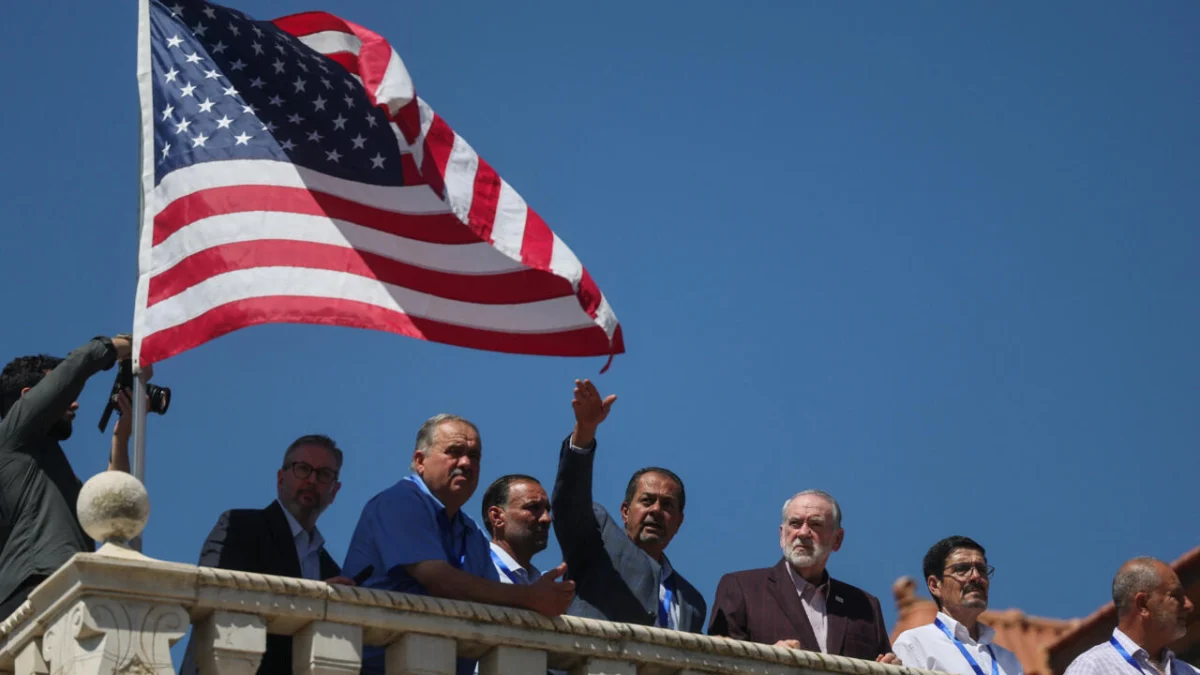
In a high-stakes diplomatic visit that underscored the growing friction between the United States and the volatile reality on the ground in the occupied West Bank, U.S. Ambassador to Israel Mike Huckabee traveled on Saturday to the Palestinian town of Turmus Ayya. The visit, characterized by both sides as "constructive" yet deeply polarized, brought the Ambassador face-to-face with Palestinian American families who have been directly impacted by the surge in violence perpetrated by Israeli settlers.
The meeting took place in a town where the majority of residents hold U.S. citizenship, serving as a poignant microcosm of the broader geopolitical struggle. As the Israeli government navigates a pre-election period marked by political instability and international scrutiny, the presence of an American official in the heart of the occupied territories highlights the limits of U.S. influence and the deepening humanitarian crisis facing Palestinians.
The Context: A Surge in Unrest and Inaction
The visit occurred against a backdrop of escalating settler violence that has drawn sharp criticism from the international community. For months, residents of the West Bank have reported a systematic pattern of harassment, ranging from the destruction of agricultural crops and livestock to the seizure of vital resources, such as water sources, often aimed at forcing Palestinian families off their ancestral lands.
While the government of Prime Minister Benjamin Netanyahu has formally condemned acts of "criminal violence," the reality on the ground—as reported by human rights organizations and residents—suggests a different story. Perpetrators of settler violence are rarely apprehended, and successful prosecutions remain statistically negligible. This perceived impunity has emboldened radical elements within the settler community, which now numbers approximately 750,000 individuals across the West Bank.
The current situation is exacerbated by the political makeup of the Israeli cabinet. Since the current coalition, the most right-wing in Israel’s history, assumed power in late 2022, the region has witnessed a curtailment of Palestinian freedoms and a sharp increase in military-backed settler incursions. With the October 27 elections approaching, the government has accelerated the approval of new settlement projects, which are considered illegal under international law, further complicating the prospects for a two-state solution.
A Chronology of Escalation
The recent history of the West Bank has been marked by a series of events that have led to the current state of emergency for many Palestinian families:
- Late 2022: The inauguration of the current Israeli coalition government signals a shift toward more aggressive settlement expansion policies.
- 2023: A period of heightened instability sees the death of multiple U.S. citizens in the region, including the husband of Hadeel Jabara, who was killed by settlers.
- January 2025: Following his return to the presidency, Donald Trump rescinds sanctions previously imposed by the Biden administration on far-right settler groups and specific individuals accused of inciting or committing violence.
- 2026 (Ongoing): The year has been defined by "unprecedented" levels of attacks. In mid-2026, international reports highlighted the seizure of Palestinian water sources for recreational settler use, sparking further outcry from France, Germany, the UK, and Italy.
- August 2026: Several incidents of violence involving both the Israeli military and settlers result in the deaths of multiple Palestinians, including minors, in separate shootings.
The Diplomatic Tightrope: Ambassador Huckabee’s Position
Ambassador Mike Huckabee, a Baptist minister and a long-standing proponent of Israeli settlements, has attempted to navigate a complex ideological path. During his visit to Turmus Ayya, he adopted a nuanced, albeit controversial, stance. He explicitly labeled the perpetrators of settler violence as "terrorists" and urged the Israeli government to take decisive action against what he described as a "tiny group of little marauders."
However, Huckabee’s rhetoric remains tempered by his broader political support for the settlement movement. He consistently refers to the West Bank by its biblical names, "Judea and Samaria," aligning his language with the Israeli government’s perspective rather than the established nomenclature of the U.S. State Department.
Furthermore, during the visit, Huckabee sought to manage expectations regarding the U.S. role. He informed the Palestinian American residents that the U.S. Embassy lacks the "power or authority" to intervene directly in legal matters or security enforcement. Instead, he framed the Embassy’s role as a platform to "influence and call attention to issues" that require correction.

Diverging Perspectives: The View from the Ground
The discrepancy between the Ambassador’s characterization of the violence and the lived experience of the residents was palpable. While Huckabee claimed that the violence is the work of a few hundred individuals, local voices tell a different story.
Yasser Alkam, a spokesperson for the Turmus Ayya municipality, flatly rejected the Ambassador’s "few hundred" estimate. "There are thousands, not hundreds," Alkam stated. He argued that the violence is not a series of isolated criminal acts, but a systematic campaign enabled by the state. Alkam challenged the U.S. stance of powerlessness, insisting that the United States possesses significant leverage to force the Israeli government to act.
"They can identify them, one by one, and arrest them, if they want to, with the right amount of pressure from the United States embassy and the United States administration," Alkam told reporters.
Among those in attendance was Hadeel Jabara, whose husband, Omar, was killed in 2023. For families like hers, the visit was less about political rhetoric and more about survival. She expressed a cautious hope that the meeting might lead to better protection for those living under constant threat, though her fear for the safety of her children remains the primary driver of her daily life.
Implications for U.S. Foreign Policy
The visit highlights the inherent contradictions in current U.S. policy toward the region. By maintaining a stance that seeks to support the state of Israel while simultaneously advocating for the protection of U.S. citizens in the occupied territories, the U.S. finds itself increasingly caught in the middle of a conflict it is reluctant to mediate aggressively.
The Role of International Pressure
The international community remains skeptical of the effectiveness of verbal condemnations. With the European Union and other major powers frequently slamming the expansion of settlements, the U.S. position—often seen as shielding Israel from tangible consequences—is under scrutiny. The rescinding of sanctions by the Trump administration in early 2025 has been interpreted by many observers as a signal that the U.S. will not use economic or legal tools to curb settler expansion, regardless of the violence.
Future Stability
The upcoming October 27 elections in Israel are expected to solidify the current trajectory. If the government continues its push for settlement expansion, the cycle of violence is likely to intensify. The demographic reality, with nearly 3 million Palestinians in the West Bank living alongside 750,000 settlers, creates a volatile environment where the lack of a clear legal framework for protection leaves millions vulnerable to radicalization and retaliatory violence.
Conclusion
Ambassador Huckabee’s visit to Turmus Ayya served as a stark reminder of the human cost of the ongoing occupation. While the Ambassador sought to distance the broader settler movement from those he categorized as "terrorists," the residents of the West Bank maintain that the violence is a systemic feature of the current political environment.
As the U.S. continues to balance its traditional alliances with the demands of international human rights, the families in towns like Turmus Ayya are left waiting for more than just "constructive meetings." The call for concrete action—arrests, prosecutions, and the cessation of settlement expansion—remains the central demand of those who feel that the current U.S. policy of quiet influence is insufficient to guarantee their safety or their future.
The coming months, leading up to the Israeli elections, will likely determine whether the U.S. will maintain its current posture or if the mounting pressure from the ground will force a reassessment of its role in the region. For now, the residents of the West Bank remain in a state of suspended animation, caught between the rhetoric of diplomats and the daily reality of a life under military occupation.