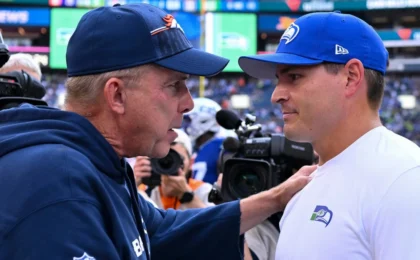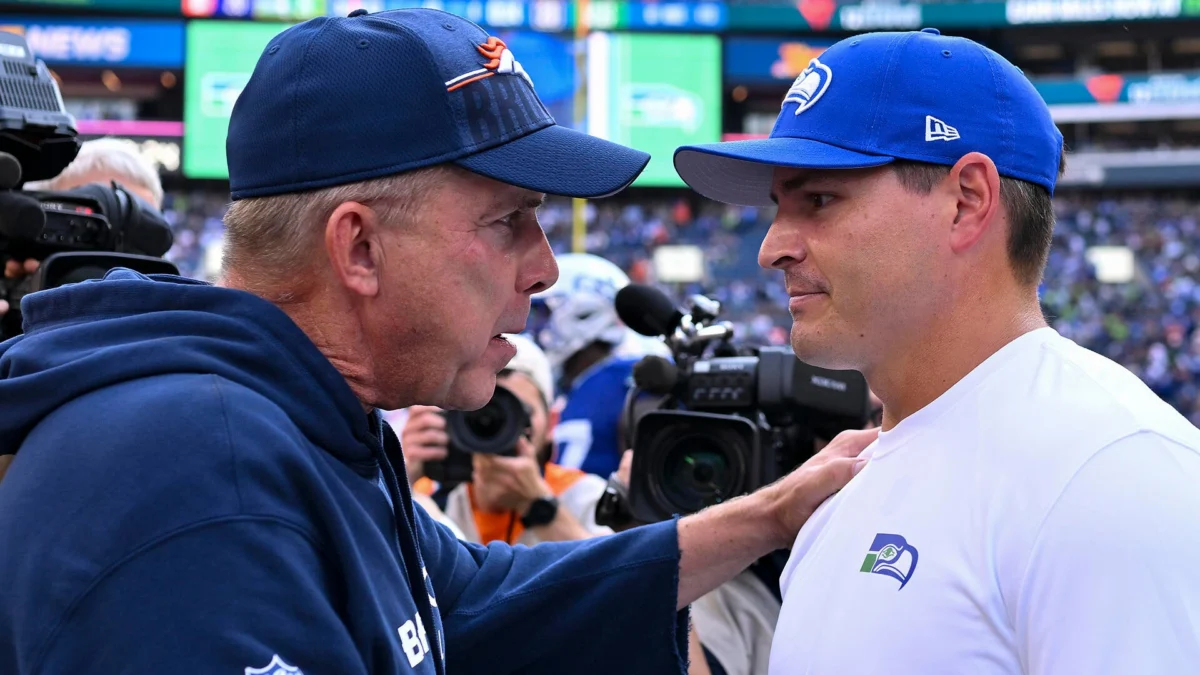
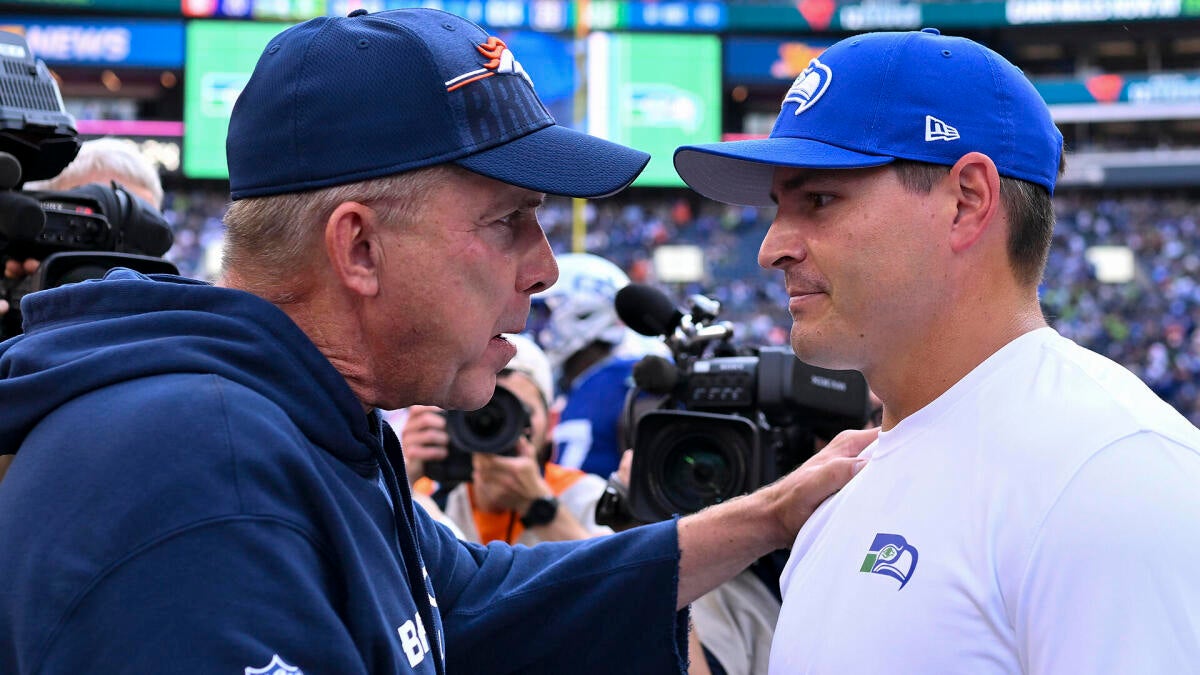
In the high-stakes, hyper-competitive world of the NFL, head coaches are known for their obsession with detail and their paranoia regarding competitive integrity. However, few stories capture the modern intersection of digital-age scouting and old-school coaching ego quite like the 2024 showdown between Denver Broncos head coach Sean Payton and then-rookie Seattle Seahawks coach Mike Macdonald.
What began as a standard Week 1 game preparation evolved into a clandestine digital investigation, a threat of legal action, and a permanent change to how the Denver Broncos operate their training camp. As details finally emerge, it is clear that the tension between these two tactical minds—one a veteran play-caller, the other a rising defensive genius—nearly boiled over into a full-blown public scandal that would have rocked the league to its core.
The Genesis of the Conflict: A Rookie’s Resourcefulness
The friction traces back to September 2024, during the opening week of the NFL season. For Mike Macdonald, this was his maiden voyage as a head coach. Tasked with leading the Seattle Seahawks into a hostile road environment against a veteran-led Denver Broncos squad, Macdonald faced the perennial problem of early-season coaching: a lack of fresh game tape.
With no preseason footage that accurately reflected the Broncos’ regular-season playbook, Macdonald turned to a resource often overlooked by traditionalists but mastered by digital natives: social media. Recognizing that fans and local media members frequently record and post snippets of training camp practices to platforms like X (formerly Twitter), the Seahawks’ defensive staff initiated a deep dive into the public record.
According to Macdonald, the Seahawks’ analysts spent hours scrubbing social media feeds, eventually curating a collection of approximately 100 plays captured by fans during Denver’s training camp. To the Seahawks, this was simply "public knowledge"—a modern evolution of scouting that fell strictly within the gray areas of league rules. To Sean Payton, however, it was an egregious violation of competitive norms.
Chronology of a Coaching Cold War
The confrontation unfolded in three distinct phases: the game, the accusation, and the standoff.
Phase 1: The Tactical Ambush
During the game, the Seahawks’ defense appeared unnervingly prepared for everything Denver threw at them. Seattle forced three turnovers and stifled the Broncos’ offense, holding them to a mere 231 yards in a 26-20 victory. It was a baptism by fire for the Broncos, but for Payton, the lopsided defensive performance felt less like good coaching and more like a breach of security.
Phase 2: The Accusation
Following the game, word filtered back to the Broncos’ facility regarding the Seahawks’ social media scouting operation. Payton, known for his fiery temperament and protective nature over his offensive schemes, reportedly reached out to Seahawks General Manager John Schneider.
The conversation was not a congratulatory post-game pleasantry. Instead, Payton allegedly accused the Seahawks of espionage, comparing the incident to the infamous "Spygate" scandal that plagued the New England Patriots in the mid-2000s. Payton’s fear was that the Seahawks had utilized a "plant"—an undercover operative physically present at the Denver facility to record plays, which would be a direct violation of NFL bylaws.
Phase 3: The Legal Standoff
When faced with the threat of a formal complaint to the NFL, the Seahawks did not retreat. Confident that their research was strictly limited to publicly available social media content, Seattle’s leadership took an aggressive stance. They reportedly informed the Broncos that any public accusation of cheating would be met with a defamation lawsuit. Facing the prospect of a legal battle over what was essentially a digital intelligence-gathering effort, the tension eventually subsided, and the matter was buried—until now.
The Gray Area of NFL Scouting
The controversy highlights a growing friction point in the modern NFL: the blurred lines between fan engagement and competitive security. With every smartphone in the stands acting as a potential high-definition surveillance camera, NFL teams are struggling to keep their playbooks private.
This issue is not isolated to Denver. Jeff Hafley, now the head coach of the Miami Dolphins, recently shared his own experience from his time as the Green Bay Packers’ defensive coordinator. Hafley recounted a game against the Philadelphia Eagles where the opposing coaching staff knew a specific pressure package he had installed. When asked how they knew, the Eagles staff allegedly cited a video snippet they had stumbled upon on social media.
This creates a paradox for the league: teams want the publicity and fan connection that comes with open training camps, but they are increasingly terrified that their proprietary schemes are being broadcast to future opponents in real-time.
Implications: The End of Open Access
The fallout from the Payton-Macdonald feud has been tangible. The Denver Broncos have since implemented some of the most stringent training camp policies in the league. As of the 2026 season, fans are strictly prohibited from filming practices. The facility is plastered with warning signage, and the organization has shown a willingness to eject patrons who violate these policies.
This represents a broader trend across the NFL. Teams are moving toward "closed-door" environments, prioritizing the integrity of their playbooks over the fan experience. The "Twitter Scouting" era, where a clever intern could potentially gain a competitive advantage by scrolling through fan accounts, is rapidly coming to an end. Organizations are now treating their practice fields like high-security zones, recognizing that in a league defined by inches, a single leaked video clip can be the difference between a victory and a loss.
Legacy and Professional Fallout
Despite the intensity of the confrontation, the fallout was eventually contained. Sean Payton, a veteran of the NFL’s political landscape, ultimately chose to move past the incident. For Mike Macdonald, the episode has become a humorous anecdote in what has been a meteoric rise to coaching stardom.
Since that Week 1 victory, Macdonald’s trajectory has been nothing short of legendary. In just his second season, he led the Seahawks to a Super Bowl LX victory, cementing his reputation as one of the most innovative defensive minds of his generation. Conversely, the Broncos’ 2024 season was defined by the "what-ifs" of their narrow exit in the AFC Championship game.
The feud serves as a reminder that the NFL is as much a game of information warfare as it is a physical sport. While the league continues to evolve, the "Payton-Macdonald incident" will remain a case study in the dangers of the digital age. Coaches are now forced to operate under the assumption that anything they do in the presence of a fan with a smartphone is fair game for their opponents. As the league looks toward the future, the primary challenge for the NFL will be balancing the transparency that fans demand with the absolute secrecy that head coaches require to maintain a competitive edge.
For now, the lesson is clear: in the modern NFL, even the most private practice can become a public matter in the blink of a Twitter refresh.