For over 30 years, Rabbiatu Kuyateh built her life in the United States. A nurse by trade and a mother by devotion, she navigated the complexities of American immigration, adhering to the requirements of her renewable work permits while paying her taxes and contributing to the healthcare system. Having fled the civil war in Sierra Leone in the 1990s, she considered the U.S. her only true home.
That life was dismantled in a single morning in July 2025, during a routine appointment with Immigration and Customs Enforcement (ICE) in Baltimore. Four months later, after being held in detention, Kuyateh was not returned to her homeland, nor was she granted asylum. Instead, she was placed on a flight to Ghana—a nation she had only ever seen on a map, located more than 1,000 kilometers from her country of origin.
"I said, ‘Ghana? I’m not from Ghana; what am I going to do there?’" she told a consortium of international journalists. Her story is not an outlier; it is a feature of a sprawling, opaque, and highly controversial migration strategy adopted by the Trump administration.
The Architecture of "Third-Country Removals"
Since President Donald Trump took office in January 2025, the U.S. government has fundamentally shifted its approach to immigration enforcement. Under the banner of mass deportation, the administration has implemented a policy of "third-country removals." According to an investigation led by the non-profit Forbidden Stories and involving 26 international media outlets, more than 25,000 individuals have been deported to countries with which they have no personal, cultural, or familial ties.
While 20,000 of these individuals were removed to Mexico via land routes, at least 5,447 others—hailing from 89 different nations—have been transported via a global network of deportation flights. These agreements, often negotiated behind closed doors, have turned the U.S. deportation apparatus into a global logistical enterprise.
A Chronology of Escalation
- January 2025: The Trump administration initiates an aggressive, broad-spectrum deportation policy.
- June 2025: The Department of Homeland Security (DHS) publicly frames the policy as a targeted measure against "uniquely barbaric" individuals, including convicted violent criminals.
- August 2025: DHS officials signal that deportation is being used as a tool to deter migration, explicitly naming remote or politically volatile locations as potential landing sites.
- September 2026: A U.S. federal appeals court rules that removing individuals without a meaningful opportunity to contest their removal due to fears of torture or persecution is illegal. The administration signals its intent to challenge the ruling in the Supreme Court.
Data and Disparity: The Geography of Exile
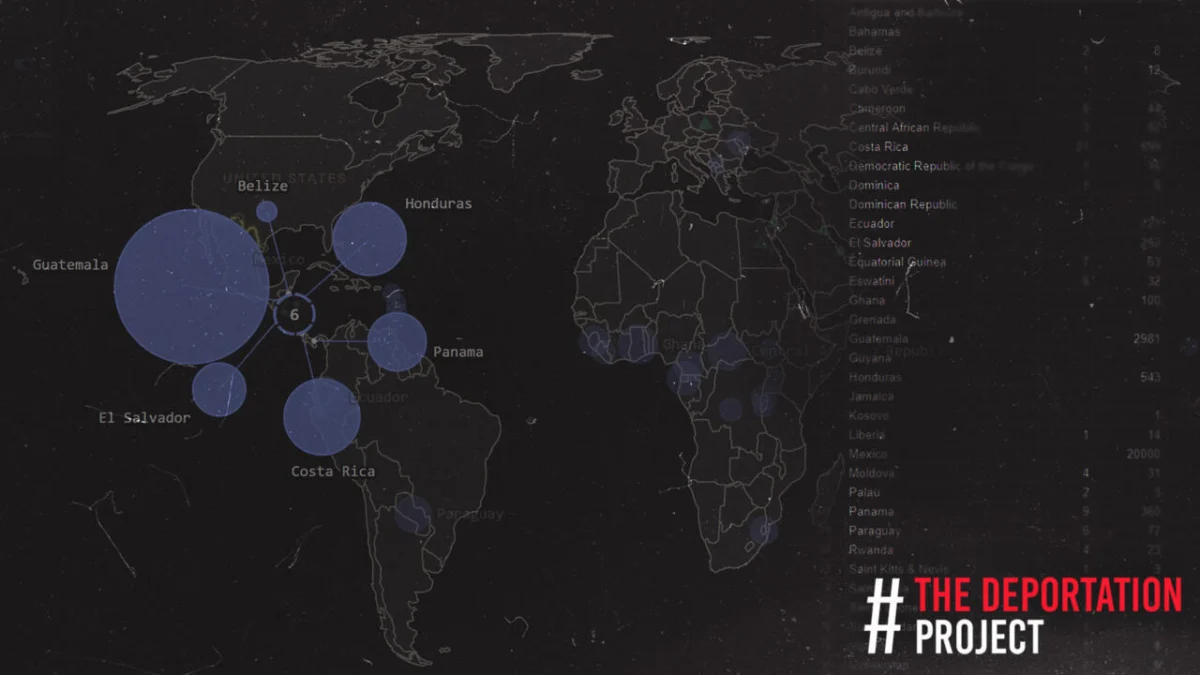
The scale of this operation is unprecedented. By August 31, 2026, the U.S. had established deportation agreements with 35 countries across six continents. This shift has taken the burden of migration management far beyond the U.S.-Mexico border.
Central American nations have served as the primary regional hubs. Guatemala has received nearly 3,000 people, though the majority are Mexican nationals. Costa Rica, Honduras, Panama, and El Salvador have each accepted significant numbers of third-country deportees, often into facilities that human rights organizations describe as inhumane.
However, the policy’s reach into Africa is perhaps its most striking evolution. Thirteen African nations have entered into agreements with the U.S. to accept third-country nationals. Ghana has become a primary hub, hosting over 100 deportees, while countries such as the Central African Republic, Equatorial Guinea, Cameroon, Sierra Leone, and Eswatini have each accepted dozens.
The "Quid Pro Quo": Financial and Political Leverage
The mechanics of these agreements remain largely shrouded in mystery, but leaked documents and public records reveal a clear pattern of transactional diplomacy. The United States has pledged more than $81 million in assistance to 13 governments tied to these deportation agreements.
For many of these nations, the trade-off involves more than just direct financial aid. In the case of Ghana, the U.S. lifted five-year-old visa restrictions just days after the deportation agreement was finalized. Observers argue that the U.S. is using deportation as a coercive bargaining chip, threatening tariffs, visa bans, or cuts to humanitarian assistance to force countries to accept migrants they might otherwise refuse.
"It seems like the goal for the United States is the deal," says Savi Arvey, director of Policy, Refugee & Immigrant Rights at Human Rights First. "The profile of the country, its human rights record—that doesn’t matter at all."
Human Rights and the Principle of Non-Refoulement
The core of the legal and moral opposition to these removals lies in the international law principle of non-refoulement, which forbids the return of individuals to a country where they face a risk of persecution or torture.
Many of those deported, such as "Malick," a Senegalese national who had obtained "withholding of removal" status, were theoretically protected from being sent back to their home countries. By sending them to a third country instead, the U.S. is accused of engaging in an "indirect form of return to harm."
The risk is not merely theoretical. There have been documented cases of "chain refoulement," where a deportee is sent from the U.S. to a third country, only to be subsequently deported by that host nation back to their country of origin—the very place they were fleeing.
Isatou, a Guinean woman who fled a forced marriage, was sent to Ghana and subsequently returned to Guinea. "I don’t go out anymore; I’m scared of coming across my family," she shared. "They ruined my life."
Official Responses and the Judicial Conflict
The Trump administration maintains that its actions are legal and necessary. DHS spokespeople have stated that the government will use "all legal means" to remove individuals who lack the legal right to remain in the United States.
When asked about the lack of transparency regarding these agreements, the State Department declined to comment on "private diplomatic communications." Meanwhile, the governments of the receiving nations have offered varying responses; some, like Mexico, insist they are accepting these individuals on "humanitarian grounds," while others have denied the existence of any formal agreement at all.
The legal landscape, however, is shifting. On September 18, 2026, a U.S. federal appeals court dealt a blow to the administration’s policy, ruling that the government cannot bypass the right of detainees to express fear of persecution.
Despite this, DHS General Counsel James Percival suggested the policy would continue, asserting, "If you claim fear in your home country, DHS has the right to send you elsewhere." Legal advocates like Trina Realmuto of the National Immigration Litigation Alliance argue that the ruling is immediately effective, though they anticipate a protracted battle reaching the Supreme Court.
The Chilling Effect: A Strategy of Deterrence
Beyond the numbers and the legal arguments, the policy serves as a powerful psychological tool. By creating the threat that a migrant could be dropped in the middle of nowhere—from the high-security prisons of El Salvador to the unfamiliar territories of Eswatini or South Sudan—the administration aims to encourage "self-deportation."
For victims like Rabbiatu Kuyateh, the human cost is immeasurable. Stripped of the life she spent decades building, she now navigates a reality she never chose. The "third-country" policy has transformed the lives of thousands into pawns in a geopolitical game, raising fundamental questions about the limits of state power and the global obligations of the United States toward those who once sought its protection.
As investigations continue, the secrecy surrounding these deals suggests that the administration intends to maintain this global deportation network for the foreseeable future, prioritizing political leverage over the lives and safety of the individuals caught in its wake.