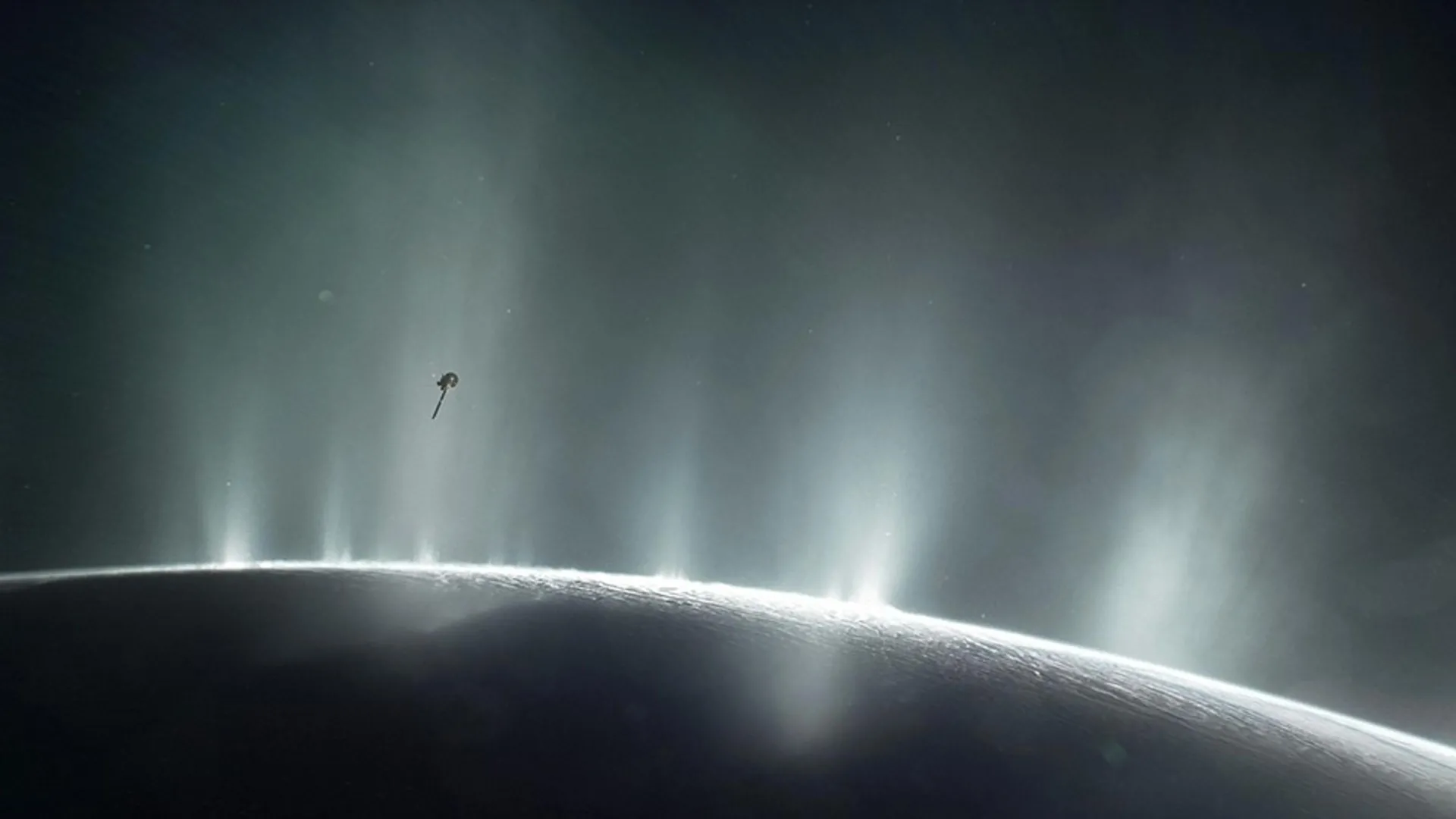
Beneath the jagged, frozen crust of Enceladus—a small, icy moon orbiting Saturn—lies a hidden world that has captivated astrobiologists for decades. While the moon’s surface is a desolate landscape of ice, its southern pole tells a more dynamic story: massive fractures, often called "tiger stripes," periodically erupt, venting plumes of water vapor and ice particles deep into space. These eruptions act as a natural laboratory, offering scientists a rare opportunity to study a subterranean, alien ocean without the monumental challenge of drilling through kilometers of ice.
New research involving an international team from the Earth-Life Science Institute (ELSI) at the Institute of Science Tokyo and Freie Universität Berlin has provided a groundbreaking explanation for the chemical mysteries found within these plumes. By simulating the freezing processes of Enceladus’ ocean water in a laboratory setting, researchers have discovered that the moon’s icy crust may be performing a complex "sample preparation" process, effectively sorting and concentrating chemicals before they are ejected into the cosmos.
The Cassini Enigma: A Puzzle of Diversity
Between 2004 and 2017, NASA’s Cassini spacecraft conducted a historic survey of the Saturnian system. Among its most significant contributions was the analysis of the E-ring—a diffuse ring of dust and ice that is continuously replenished by the material spewed from Enceladus’ south pole.
Equipped with the Cosmic Dust Analyzer, Cassini sampled individual ice particles as it flew through the ring. When a team led by Professor Frank Postberg analyzed 961 mass spectra of salt-rich "Type 3" grains, they expected a uniform chemical signature. After all, if these particles were mere droplets of a singular, homogeneous global ocean, one would assume their chemical makeup would be relatively consistent.
The data, however, revealed a starkly different reality: the grains were remarkably diverse. Some were saturated with sodium chloride, while others were rich in carbonates, phosphates, or potassium chloride. Most puzzling was the observation that chloride and carbonate rarely appeared together in the same sodium-rich particle. This chemical segregation posed a fundamental question: if all the material originated from the same reservoir, why were the particles so chemically distinct?
Recreating the Alien Ocean in the Lab
To solve this, Professor Yasuhito Sekine and his team at ELSI embarked on an ambitious series of experiments. They sought to replicate the conditions of Enceladus’ ocean by creating laboratory droplets infused with the major salts known to exist within the moon’s hidden sea.
The team subjected these droplets to varying cooling conditions to observe how chemical elements behaved during the transition from liquid to solid. The results were revelatory: the speed of freezing is the primary driver of chemical distribution.
When droplets approximately 200 micrometers in diameter were frozen slowly—at a rate of 10 Kelvin per minute or less—the salts underwent a process of fractional crystallization. They separated into distinct regions within the droplet. Conversely, when the droplets were flash-frozen, the ingredients remained evenly mixed.
"What surprised us was that the diversity seen by Cassini could emerge from droplets originating from essentially the same ocean water," Professor Sekine explained. "Our experiments show that when relatively large ocean droplets freeze slowly, different salts can separate within them. If those frozen droplets are later broken apart, they can produce much smaller ice grains, each with very different chemical compositions."
A Slower Journey: Rewriting the Model of Eruptions
This discovery fundamentally challenges the long-held assumption that Enceladus’ ocean spray freezes rapidly and is ejected into space almost immediately upon leaving the ocean.
Previously, models suggested that seawater erupted from the vents and transitioned to ice in a rapid, near-instantaneous process. The new data suggests a far more labyrinthine journey. Researchers now propose that ocean spray forms droplets ranging from tens to hundreds of micrometers in size, which then embark on a slow, protracted transit through the moon’s underground vent system.
As these droplets navigate the complex, fractured pathways of the icy crust, they experience gradual cooling. This slow-freeze allows salts and organic compounds to migrate and concentrate in specific regions of the ice. As they approach the surface, the droplets encounter narrower channels where gas pressures increase, accelerating the flow. The droplets, now partially or fully frozen, likely collide with the walls of these icy vents at high velocities. These violent impacts shatter the larger droplets into the microscopic fragments detected by Cassini.
Because each fragment originates from a different salt-rich pocket of the original, larger droplet, the resulting ice grains exhibit the extreme chemical diversity observed by the spacecraft.
The Benefits of Natural Concentration
This discovery is not merely an academic exercise in planetary science; it is a vital finding for the future of space exploration.
On Earth, analytical chemistry often requires significant effort—centrifugation, extraction, and concentration—to prepare samples for mass spectrometry. Scientists must isolate trace compounds from a complex matrix to detect them effectively. Remarkably, Enceladus appears to perform these essential steps naturally.
By separating and concentrating salts and, crucially, organic compounds, the moon’s vent system effectively "pre-packages" evidence of the ocean’s chemical environment. Compounds that might exist in trace, hard-to-detect quantities within the bulk ocean may be significantly concentrated within specific ice grains. For future missions, this means that a spacecraft carrying a high-resolution mass spectrometer might not need to detect a "needle in a haystack," but rather a grain that has been naturally enriched with the very molecules scientists are hunting for.
Implications for Prebiotic Chemistry
Beyond the logistics of sample analysis, the research has profound implications for the potential habitability of Enceladus. The process of slow freezing does more than just separate salts; it creates micro-environments.
As ice crystals grow within a droplet, small pockets of liquid brine remain trapped between the crystals. Within these tiny, concentrated pockets, organic molecules and salts are forced into close proximity. In the field of prebiotic chemistry—the study of how life-building molecules emerge from non-living precursors—the greatest hurdle is often the dilution of those molecules in a vast ocean.
The mechanisms identified by the ELSI team suggest that Enceladus might be a natural incubator. Because much of the material erupted from the plumes eventually falls back onto the surface, this cycle of freezing, concentration, and recycling could occur repeatedly. This persistent concentration of chemical building blocks could be the key to facilitating complex, life-precursor chemical reactions.
Looking Toward the Future
The collaboration between ELSI and Freie Universität Berlin represents a significant leap forward in our understanding of ocean worlds. By bridging the gap between remote spacecraft observations and controlled laboratory simulations, the team has turned a confusing dataset into a coherent, evidence-based model of lunar geology.
As space agencies look toward the next generation of missions to the outer solar system—such as the potential Enceladus Orbilander—these findings provide a roadmap for what we should expect to find. We now know that the plumes are not just simple sprays of ocean water; they are sophisticated messengers, carrying information about the chemistry, temperature, and potentially the habitability of an alien sea.
The "enigmatic diversity" once seen as a hurdle has become a tool. By understanding the physics of these tiny ice grains, we are better equipped to interpret the samples we collect. As we peer into the plumes of Enceladus, we are no longer just looking at ice; we are looking at a meticulously prepared sample, waiting to tell us whether the conditions for life exist beneath the ice of one of Saturn’s most captivating moons.