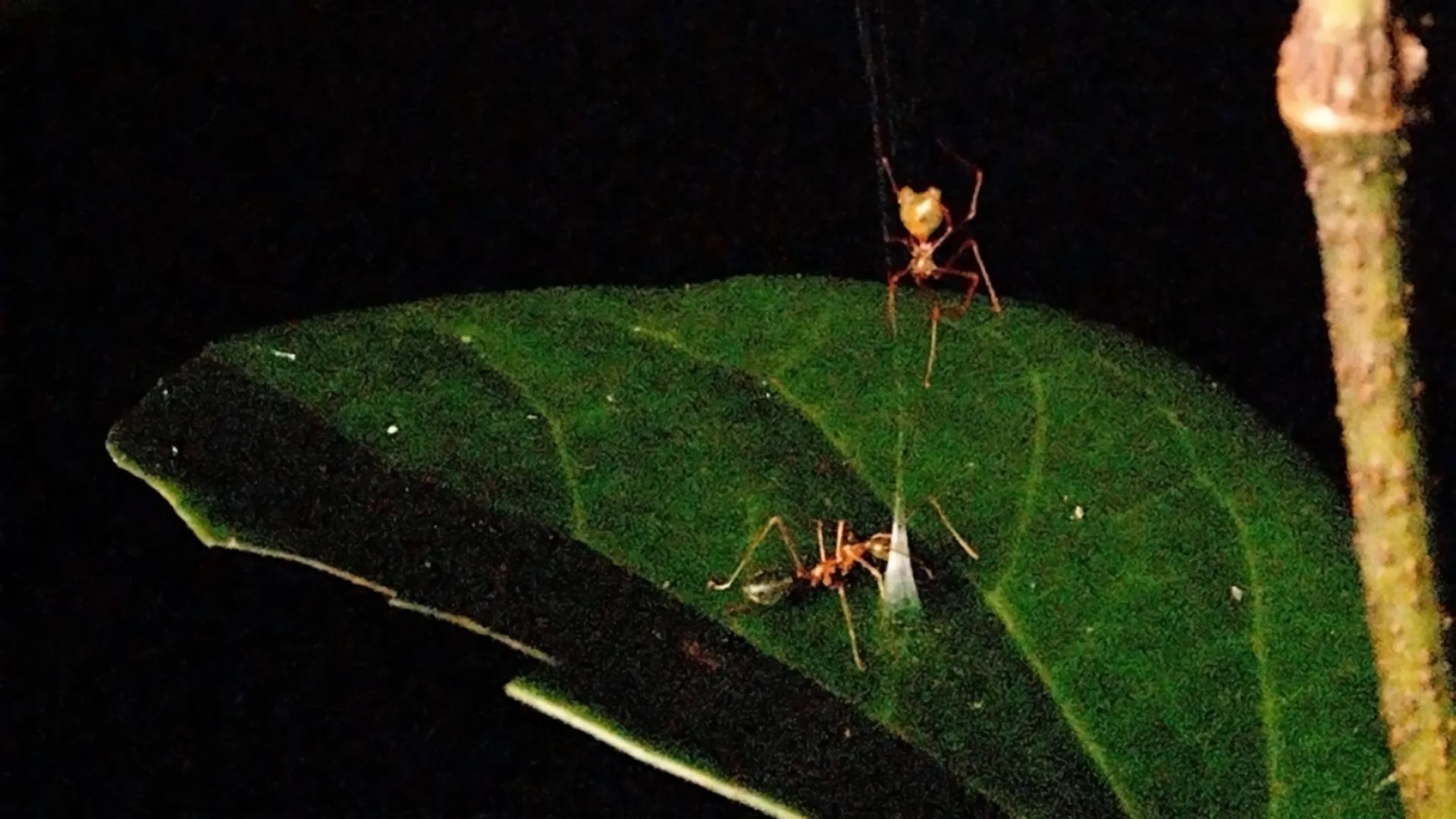
In the dense, humid rainforests near Cooktown, Queensland, a biological arms race has reached a pinnacle of evolutionary innovation. Deep within the canopy, a newly identified, yet-to-be-named arachnid of the genus Propostira has mastered a hunting technique so precise and mechanically advanced that researchers have likened it to the siege warfare of antiquity. Dubbed the “ballista spider,” this nocturnal hunter has eschewed the traditional web-trapping methods of its kin in favor of a spring-loaded, tension-based catapult system designed for one singular purpose: the capture of the formidable green tree ant (Oecophylla smaragdina).
The discovery, recently detailed in the journal Current Biology, marks a paradigm shift in our understanding of spider behavior. By deploying a trap that is triggered not by the spider, but by the defensive aggression of its prey, the ballista spider has achieved what researchers call “the ultimate specialization.”
The Discovery: A Serendipitous Encounter
The existence of the ballista spider remained hidden from science until a chance encounter by Professor Greg Anderson. An accomplished biomedical researcher, spider taxonomist, and professional photographer, Anderson’s keen eye caught a glimpse of the spider’s unusual architecture. His initial observations hinted at a behavior that defied standard arachnid biology, prompting a more formal investigation.
Following this sighting, a research team from Macquarie University, spearheaded by Professor Ajay Narendra and postgraduate researcher Pranav Joshi, launched a 10-day expedition into the remote rainforests of northern Queensland. Armed with high-speed, high-resolution infrared cameras and the patience of seasoned field biologists, the team spent their nights documenting the spider’s laborious construction process and its violent, lightning-fast hunting strikes.
The resulting data provided the first comprehensive look at a species that functions more like a mechanical engineer than a traditional predator.
Chronology of the Hunt: A Four-Hour Construction
The ballista spider’s hunting cycle is a testament to meticulous preparation. Unlike orb-weavers that may spin their webs in minutes, the ballista spider operates on a deliberate, time-intensive schedule.
The Daytime Vigil
During the daylight hours, when green tree ants are at their most active and aggressive, the spider remains in a state of suspended animation, hiding under a leaf directly above the bustling ant trails. This positioning is not random; it is a calculated risk, placing the spider in immediate proximity to a prey species that is notoriously dangerous.
The Nightly Architecture
As darkness falls, the spider descends more than 50 centimeters to the forest floor or a lower branch to begin its work. The construction of the trap is a labor-intensive, four-hour ordeal. The spider spins 15 to 60 individual silk strands, bundling them together into a cone-shaped tension trap. This structure is anchored firmly, acting as a potential energy reservoir.
Once the cone is set, the spider coats it with a thinner, secondary layer of silk and retreats to the safety of its main web, situated well above the trap. The trap is now "cocked," waiting for the arrival of a green tree ant.
The Mechanics of the Snare: Physics in Action
The "ballista" mechanism is a masterclass in biomechanics. When a foraging green tree ant encounters the silk cone, the spider’s strategy relies on exploiting the ant’s natural defensive behavior.
The Trigger
Researchers suspect that the spider applies a specific pheromone to the trap—a chemical lure that acts as a red flag to the ants. Upon detecting the scent, the ant reacts with characteristic aggression, biting the cone. This bite acts as the "trigger," causing the ant to accidentally detach the structure from its anchor point.
The Kinetic Launch
The moment the anchor is severed, the stored elastic energy in the bundled silk strands is released instantaneously. The ant is launched vertically with a staggering acceleration exceeding 1300 meters per second squared—a force that propels the insect more than 30 centimeters into the air, directly into the spider’s waiting web.
The physics behind this launch is complex. The ant possesses adhesive pads on its feet, allowing it to grip surfaces with significant force. To lift the ant, the silk snare must overcome not only the ant’s body weight but also the suction of its feet against the substrate. The rapid contraction of the silk bundle provides this instantaneous power density, effectively "picking off" the prey before the ant can signal for its colony’s reinforcements.
Supporting Data: Biomechanical Insights
To understand how a spider could evolve such a high-tech solution, the research team collaborated with Dr. Jonas Wolff, an expert in the biomechanical properties of silk at the University of Greifswald in Germany.
Back in the laboratory, Dr. Wolff subjected samples of the ballista spider’s silk to scanning electron microscopy. The findings confirmed that the silk is not merely a sticky thread, but a highly engineered material capable of storing and releasing elastic energy with greater efficiency than any other known biological catapult.
“The snare mechanism is bioengineered to store elastic energy and release it with incredible instantaneous power,” said Professor Narendra. “It is a highly specialized evolutionary solution to a life-or-death problem: how to eat an ant that is effectively an army.”
Official Responses and Expert Commentary
The scientific community has lauded the study for its unique insights into behavioral ecology. Professor Narendra, who led the Macquarie University team, emphasized the rarity of this hunting strategy.
“It is very unusual for a spider to feed on ants because they are notoriously dangerous,” Narendra explained. “They have a range of chemical defenses, including the ability to sting, and they use alarm signals to recruit thousands of other ants. Finding a spider that eats only one particular species of ant, and does so using a triggerable, spring-loaded trap, is truly bizarre.”
Dr. Wolff added that the evolution of this mechanism suggests a long-term "arms race" between the spider and the ant. “The mechanism seems to have evolved as a way of allowing the spider to safely remove prey from the immediate vicinity of the ant trails and nests. By keeping the prey at a distance, the spider avoids being swarmed by the rest of the colony.”
Implications: A New Chapter in Arachnology
The discovery of the ballista spider challenges long-held assumptions about spider intelligence and evolutionary specialization. For years, biologists believed that webs were largely passive structures, serving as stationary traps. The ballista spider proves that, in the right environment, a web can be a dynamic, kinetic, and highly specialized tool.
Evolutionary Specialization
The most profound implication of this study is the extreme nature of the spider’s specialization. Most spiders are generalists, eating whatever happens to fly or crawl into their webs. The ballista spider, by contrast, has narrowed its diet to a single, dangerous species and developed a toolset that works only for that specific prey. This suggests that in the competitive landscape of the Australian rainforest, the rewards for hunting the abundant green tree ant outweighed the massive metabolic and structural costs of evolving such a complex trap.
Future Research
While the species remains formally unnamed, the research team is continuing its study to determine if other spiders in the genus Propostira exhibit similar traits. Furthermore, the biomechanical properties of the ballista silk are of great interest to materials scientists. The way the silk bundles and releases energy could provide a blueprint for synthetic materials that require high-speed, controlled kinetic release.
As researchers continue to monitor the forests near Cooktown, the ballista spider stands as a vivid reminder of the complexity hidden within our natural world. It is a creature that has turned the forest floor into a battlefield, proving that even the smallest organisms can become masters of physics, engineering, and tactical warfare.
In the final analysis, the ballista spider is more than just a biological curiosity; it is a testament to the power of evolution to solve the most difficult problems through ingenuity, patience, and the perfect application of force. Whether it is the chemical lure, the precisely tensioned silk, or the high-speed launch, every aspect of the spider’s hunting cycle represents a pinnacle of natural design—one that continues to captivate the scientific world.