Deep beneath the vast, rugged landscapes of East Africa, a colossal geological transformation is unfolding. The East African Rift System (EARS)—the largest active continental rift zone on the planet—has long served as a primary "natural laboratory" for geophysicists studying how continents fracture and eventually drift apart. However, recent scientific inquiry has uncovered a baffling anomaly: the earth here is not just pulling apart as expected; it is sliding in directions that defy conventional tectonic wisdom.
New research, utilizing advanced 3D thermomechanical modeling, suggests that the culprit is the "African Superplume," a gargantuan upwelling of hot, buoyant mantle material rising from the core-mantle boundary. This discovery provides the missing link in a decades-old puzzle, reconciling surface GPS measurements with deep-seated seismic patterns.
The Mechanics of a Continental Breakup
To understand the magnitude of this discovery, one must first grasp the nature of continental rifting. A rift occurs when the Earth’s lithosphere—the rigid outer shell comprising the crust and the uppermost mantle—is subjected to extreme extensional stress. As the continent is pulled apart, it undergoes a process of thinning and fracture.
Geophysicist D. Sarah Stamps, an associate professor in the Department of Geosciences at Virginia Tech, utilizes an evocative analogy to explain the dual nature of the lithosphere. "If you hit Silly Putty with a hammer, it can actually crack and break," Stamps explains. "But if you slowly pull it apart, the Silly Putty stretches. So, on different time scales, Earth’s lithosphere behaves in different ways."
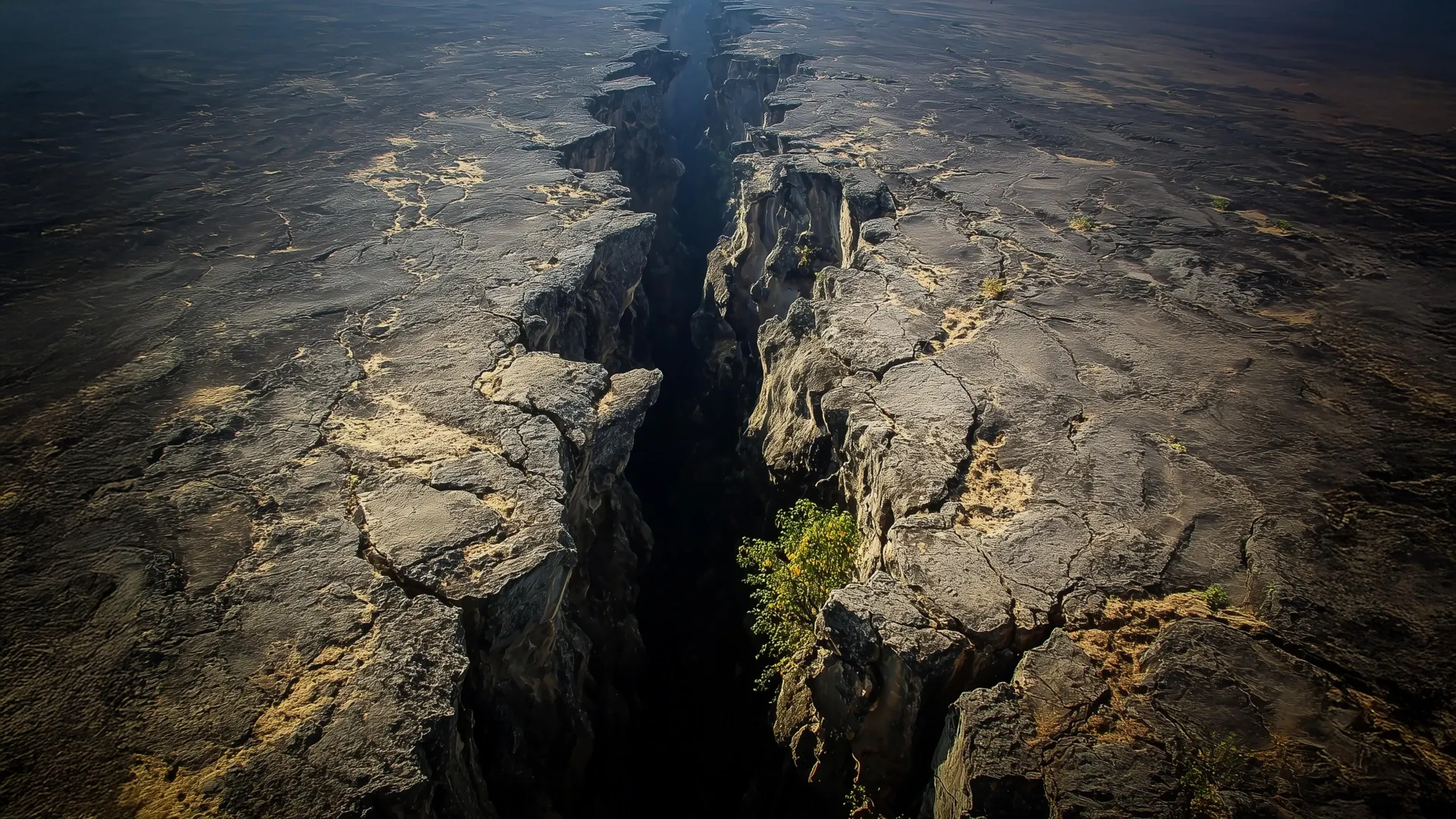
In the upper crust, the brittle lithosphere responds to stress by fracturing, creating the faults and earthquakes that define the rift landscape. At greater depths, however, the material is hot and ductile, allowing for gradual, plastic deformation. In a standard rift scenario, the movement is predictable: the land moves perpendicularly away from the rift axis, effectively "opening" the continent like a book. While the EARS does exhibit this classic behavior, Dr. Stamps’s team identified an unsettling outlier: significant, persistent movement running parallel to the rift, a phenomenon that should not exist under traditional tectonic models.
A Chronology of Discovery: Twelve Years of Precision
The journey to this discovery began more than a decade ago. Dr. Stamps and her colleagues at the Geodesy and Tectonophysics Lab at Virginia Tech set out to map the subtle shifts in the African continent with unprecedented precision.
- 2010–2020: The team deployed and monitored a dense network of GPS stations across East Africa. By tapping into signals from over 30 satellites orbiting 25,000 kilometers above the Earth, they were able to track surface movements at the millimeter scale.
- 2021: A landmark study published by the team utilized 3D computational simulations to test the interaction between lithospheric buoyancy (surface-level forces) and mantle traction (deep-seated forces). The study confirmed that while buoyancy forces explained the east-west stretching, they failed to account for the northward, rift-parallel motion.
- 2024: Building on this foundation, lead author Tahiry Rajaonarison—a postdoctoral researcher at New Mexico Tech and a former doctoral student under Stamps—spearheaded a new study published in the Journal of Geophysical Research. By employing 3D thermomechanical modeling, the team successfully simulated how the African Superplume influences the surface, finally providing a mechanism for the anomalous parallel movement.
Supporting Data: The Role of the African Superplume
The African Superplume is one of the most significant features of the Earth’s mantle. It is an enormous, slow-rising column of thermal energy that originates deep beneath southwest Africa and extends diagonally across the continent, becoming shallower as it tracks northeastward.
The modeling conducted by Rajaonarison suggests that as this massive volume of material rises and flows, it exerts "mantle traction" on the base of the lithosphere. This is not merely a theoretical construct; it is corroborated by seismic anisotropy data. Seismic anisotropy occurs when seismic waves traveling through the Earth are polarized or slowed in specific directions due to the alignment of minerals and rock structures.
In the EARS region, the orientation of these rock structures aligns perfectly with the northward flow of the mantle identified in the models. "The mantle flow is not driving the east-west, rift-perpendicular direction of some of the deformations," Rajaonarison noted, "but it may be causing the anomalous northward deformation parallel to the rift." This dual-mechanism model explains why the region exhibits both expected rift-perpendicular movement and the puzzling, rift-parallel drift.
The Debate: Buoyancy vs. Traction
For years, the scientific community has been divided over the primary drivers of the East African Rift. The debate has largely pitted two schools of thought against each other:
- Lithospheric Buoyancy: Proponents argue that the rift is driven by surface-level forces. The "African Superswell"—a region of anomalously high topography—creates gravitational potential energy. Because the area is elevated and less dense, the lithosphere naturally wants to spread outward, causing the crust to thin and stretch.
- Mantle Traction: This theory posits that the movement is dictated by the viscous flow of the mantle beneath the plate. The mantle acts like a conveyor belt, dragging the lithosphere along with it.
The recent findings from the Virginia Tech and New Mexico Tech teams suggest that the binary nature of this debate was perhaps misplaced. The evidence indicates that the EARS is not driven by one force or the other, but by a complex, layered interaction. The "classic" stretching is a result of surface-level buoyancy, while the "anomalous" shifting is a direct consequence of deep-mantle traction.
Implications for Global Tectonics
The implications of this study extend far beyond the borders of East Africa. By proving that deep-seated mantle flow can significantly alter the surface trajectory of a continent, the research challenges geologists to re-evaluate their models of tectonic plate motion globally.
Understanding Continental Breakup
The East African Rift serves as a template for how continents break apart to form new ocean basins. By documenting the full chain of causality—from the deep-mantle plumes to the shallow crustal fractures—scientists are gaining a clearer picture of the life cycle of a continent. If the mantle flow plays a more active role in "steering" the rift than previously thought, it may change our understanding of how tectonic plates will reorganize in the coming millions of years.
Enhancing Seismic Hazard Assessment
While the focus of this study was on deep-mantle dynamics, the findings have practical applications for seismic monitoring. Understanding the forces that drive the movement of the crust allows researchers to better characterize the stress regimes of active fault lines. As the lithosphere stretches, the accumulated stress is released in the form of earthquakes; knowing the precise direction and magnitude of these forces is essential for long-term regional stability planning.
A New Computational Frontier
The use of 3D thermomechanical modeling in this study represents a shift toward more holistic, multidisciplinary geophysics. By integrating satellite-based GPS data with seismic wave analysis and advanced computer simulations, the team has set a new standard for how we investigate the inaccessible depths of our planet.
Conclusion: A Living, Moving Continent
The work of Dr. Stamps and Dr. Rajaonarison serves as a powerful reminder that the Earth is a dynamic, multi-layered machine. The "Silly Putty" analogy used by Dr. Stamps perfectly encapsulates the complexity of our planet: it is rigid enough to hold mountains and oceans, yet malleable enough to respond to the slow, relentless churning of the mantle thousands of miles beneath our feet.
As the African Superplume continues its slow-motion dance beneath the continent, it continues to reshape the landscape in ways that are both expected and profound. Through the marriage of cutting-edge technology and decades of observational persistence, scientists are finally peeling back the layers of the Earth to reveal the hidden forces that shape our world. The mystery of the East African Rift is far from solved, but with every millimeter of data collected, we move one step closer to understanding the violent, creative, and ongoing process of continental evolution.