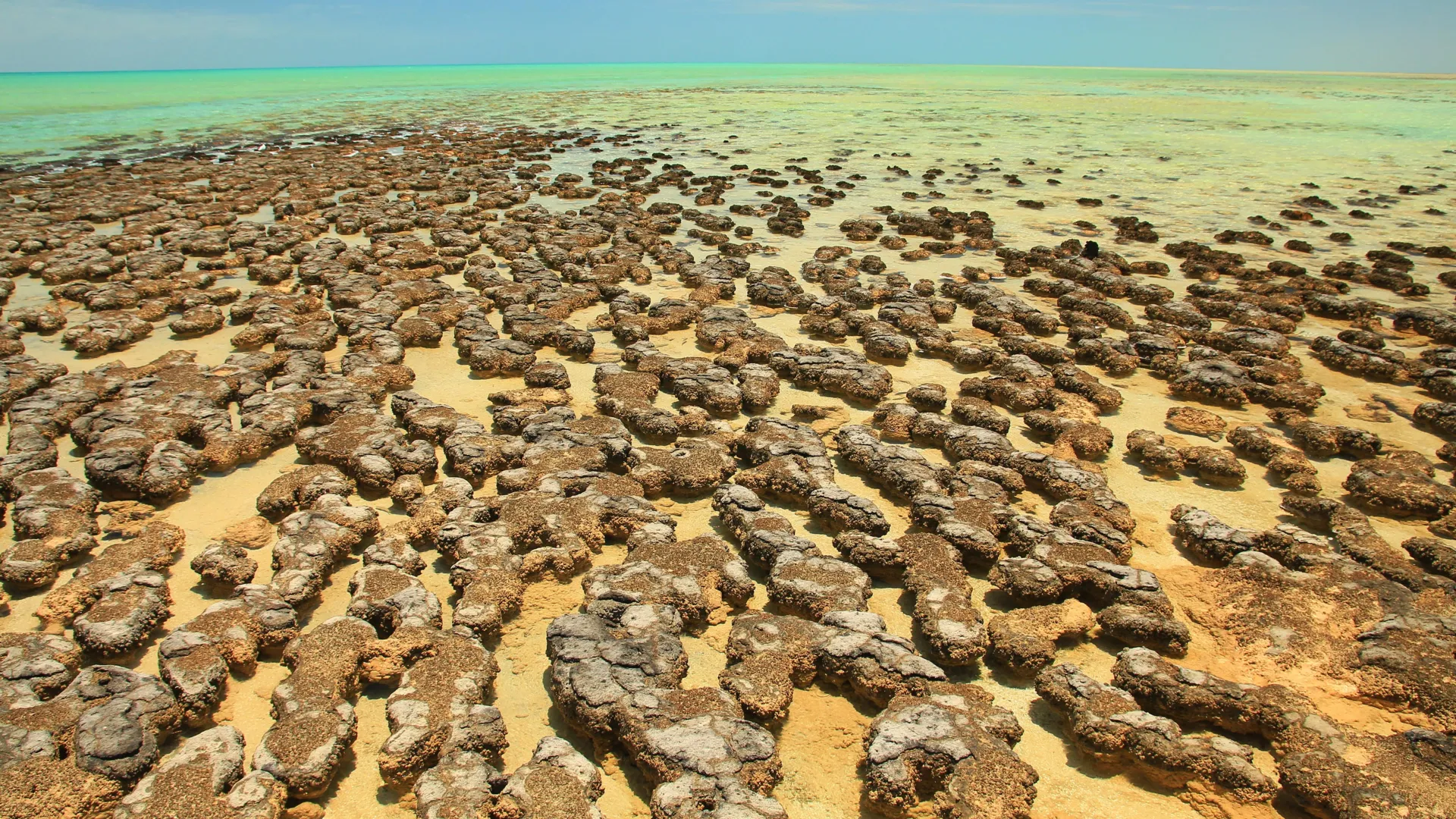
At first glance, the stromatolites of Western Australia’s Shark Bay appear as little more than unremarkable, jagged mounds of dark stone protruding from the shallows. They are silent sentinels of a bygone era, looking like ancient, calcified sponges. Yet, to an evolutionary biologist, these structures represent one of the most sophisticated "living fossils" on the planet. They are not rocks at all, but densely packed, layered microbial cathedrals—meticulously constructed by billions of microorganisms over aeons.
For decades, scientists have looked to these structures to understand how Earth’s atmosphere became oxygenated billions of years ago. Now, a groundbreaking study published in Current Biology suggests that these microbial mats hold the keys to an even deeper mystery: the transition from simple, single-celled life to the complex, eukaryotic organisms that eventually evolved into plants, animals, and humans.
The Evolutionary Enigma: Bridging the Gap
The central question of evolutionary biology is the "Eukaryotic Gap." How did life jump from simple, solitary cells (prokaryotes) to complex cells with nuclei and specialized organelles (eukaryotes)? The prevailing theory, known as the endosymbiotic hypothesis, suggests that this leap was not a gradual, independent evolution, but a radical act of partnership. It posits that a primitive archaeon engulfed a bacterium, and instead of being digested, the bacterium took up residence inside, eventually evolving into the mitochondria—the "powerhouse" of the cell.
Until now, this theory has relied heavily on genetic inference and fossil records that lack the granular detail of active, living systems. However, a multi-institutional team led by Associate Professor Brendan Burns of UNSW Sydney, in collaboration with the University of Technology Sydney and The University of Melbourne, has captured the first visual, physical evidence of what such a primordial partnership might look like.
Chronology of Discovery: From Shadow to Structure
The path to this discovery was neither quick nor simple. The journey began in the hypersaline, sun-drenched waters of Shark Bay—a World Heritage site that serves as one of the few places on Earth where stromatolites continue to thrive as they did in the Proterozoic Eon.
Phase 1: The Genetic Hunt (2018–2020)
The team began by performing metagenomic sequencing on samples collected from the Shark Bay microbial mats. The data revealed the presence of Asgard archaea—a mysterious group of microbes long considered the closest living relatives to the common ancestor of all eukaryotes. However, knowing the DNA was present was only the first step. The researchers faced a monumental wall: they could not isolate the organisms in a lab.
Phase 2: The "Shadow" Years (2020–2023)
For nearly five years, A/Prof. Burns and his colleagues struggled to coax the archaea into a pure culture. "It took four or five years in the lab," says Burns. "A lot of time, optimizing and chasing different shadows." The team eventually realized that the failure to grow the organism in isolation was not a technical shortcoming, but a biological clue: the archaea were physiologically incapable of surviving alone. They were obligate partners, entirely dependent on a symbiotic relationship with surrounding bacteria.
Phase 3: High-Resolution Imaging (2023–2024)
Using electron cryotomography—a sophisticated 3D imaging technique capable of capturing structures at the scale of a millionth of a millimeter—the team finally witnessed the unseen. They observed the archaeon physically tethered to a bacterium via thin, microscopic nanotubes. This was the "smoking gun" of early cellular cooperation, a visual manifestation of a metabolic exchange that has persisted for billions of years.
Supporting Data: The Anatomy of a Partnership
The study’s findings provide a wealth of data on how these microbial communities function as a single, integrated unit.
The Nanotube Connection
The electron cryotomography revealed that the archaeon and the bacterium were not merely existing in proximity; they were physically linked. These nanotubes serve as a conduit, allowing for the direct transfer of nutrients, hydrogen, and essential vitamins. This "cross-feeding" ensures that even in the harsh, high-UV environments of the intertidal zone, both organisms thrive.
Deep Learning and Ancient Proteins
To further validate their findings, the team utilized deep learning algorithms to predict the structure of proteins found within the archaeon. Coauthor A/Prof. Kate Mitchie of UNSW noted that this computational approach allowed them to reconstruct the ancient cellular machinery. "We can start to see ancient versions of the cellular machinery that later became central to complex life," Mitchie explained. The data suggests that the proteins used by these organisms to build their structures and maintain their tethers are direct precursors to those found in the sophisticated cells of modern humans.
Official Perspectives and Scientific Implications
The discovery has sent ripples through the scientific community, offering a tangible model for the origins of complexity.
"This discovery brings us a few steps closer towards understanding how complex cells evolved from relatively simpler microbial life forms," says coauthor Associate Professor Debnath Ghosal of The University of Melbourne. The ability to see these organisms in their native, albeit lab-simulated, state provides a vital link between the theoretical models of the past and the biological reality of the present.
For A/Prof. Brendan Burns, the implications are profound. "Stromatolites could be more than ‘just’ a cradle of life where early microbial life flourished. They could also tell us how complex life first emerged." He describes the archaea as "companions," emphasizing that the survival of life on Earth was never a solitary endeavor, but a story of constant, layered cooperation.
Associate Professor Iain Duggin of the University of Technology Sydney captures the emotional and philosophical weight of the find: "It’s as if we have slowly arisen from the bottom of the sea." By witnessing these persistent, ancient partnerships, researchers are effectively peering back through a window into the infancy of the planet.
Honoring Heritage: Naming Nerearchaeum marumarumayae
The naming of the newly identified archaeon, Nerearchaeum marumarumayae, was a process steeped in both scientific rigor and deep cultural respect. The name draws from Nereus, the Greek god of the sea, and marumarumayae, a word from the Malgana language meaning "ancient home."
The Malgana people, the Traditional Owners of the Shark Bay region, have a history in the area dating back 30,000 years. A/Prof. Burns and his team engaged in extensive consultations with Kymberly Oakley, a renowned Malgana language expert, and local elders to ensure that the nomenclature was respectful and accurate. The inclusion of the Malgana word is more than a gesture; it acknowledges that the environment where these "living fossils" thrive is a living cultural heritage that has been protected by Indigenous custodians for millennia.
A Legacy of Cooperation
The research concludes on a sobering note regarding the fragility of these environments. As climate change and human activity threaten the coastal ecosystems of Shark Bay, the "primordial soup" that these microbes call home is under pressure.
A/Prof. Burns views the study as a call to action—not just for science, but for a broader understanding of interconnectedness. "It’s not just about the organisms," he says. "It’s about people as well. A huge collaborative effort across disciplines with many graduate students being instrumental in building this story."
As the research team looks to expand their study of these microbial partnerships, the message remains clear: the history of life on Earth is a history of interdependence. The discovery of Nerearchaeum marumarumayae is a testament to the fact that even the smallest, most elusive partners can leave the deepest, most permanent marks on the trajectory of life. Through the lens of these ancient microbes, we see not only our origins but a mirror reflecting the fundamental importance of cooperation in the survival of all species—a lesson that remains as relevant today as it was billions of years ago.