In the pantheon of comic strip history, few characters occupy a space as paradoxical as Calvin’s father. He is a man of few documented virtues, often portrayed as a curmudgeonly cyclist, a purveyor of tall tales, and the long-suffering foil to his six-year-old son’s imaginative anarchy. Yet, as time passes—well into the mid-2020s—it has become increasingly clear that Bill Watterson’s creation was never intended to be a simple caricature of suburban frustration. Instead, he serves as a surprisingly prescient, if reluctant, philosopher.
According to Watterson’s own reflections in the 10th Anniversary Collection, the decision to leave Calvin’s parents unnamed was a deliberate structural choice. In the world of the strip, their identities are secondary to their function. They are "Mom" and "Dad," defined entirely by their relationship to the protagonist. However, this anonymity serves a deeper narrative purpose: it allows them to represent the universal, often baffling experience of parenthood. By stripping away their formal identities, Watterson ensured they remained archetypes of authority and confusion, navigating a world that—much like their son—they often find entirely incomprehensible.
The Architecture of Anonymity: A Narrative Choice
Watterson was meticulous in his construction of the suburban household. By refusing to name the parents, he grounded the strip in a perspective that was distinctly Calvin’s. A six-year-old rarely perceives his parents as individuals with rich histories, political opinions, or legal names; they are simply the fixtures of his environment.
This creative limitation paid off in dividends. It forced the reader to focus on the dynamic of the household rather than the biographies of the adults. We know they have careers, we know they value their sleep, and we know they share a quiet, cynical bond. But beyond these traits, their lives remain intentionally opaque, serving as a blank canvas upon which Watterson could project his own musings on the state of modern life.
Chronology of a Curmudgeon’s Wisdom
While Calvin’s father is frequently the butt of the joke—often seen struggling with a flat tire or losing a battle of wits against a sentient tiger—there are moments where the mask slips. Watterson used these instances to inject a layer of existential depth into the strip.
The 1989 Burglary Arc: The Myth of the Adult Plan
One of the most poignant moments in the series occurred in May 1989. Following a narrative arc in which the family returns home to find their house burglarized, the tone shifts from slapstick to somber reflection. Amidst the chaos of lost electronics and violated privacy, the parents share a rare, candid exchange about the nature of adulthood.
The core of this revelation is the acknowledgment that adulthood is, in many ways, an improvisational act. While society demands that adults operate with a clear, coherent, and authoritative plan, the reality is often far more fragile. The burglary serves as a catalyst for a moment of profound vulnerability, reminding the reader that even the most "in-charge" adults are simply making it up as they go along.
The 1993 Critique: The Shadow of the Data Age
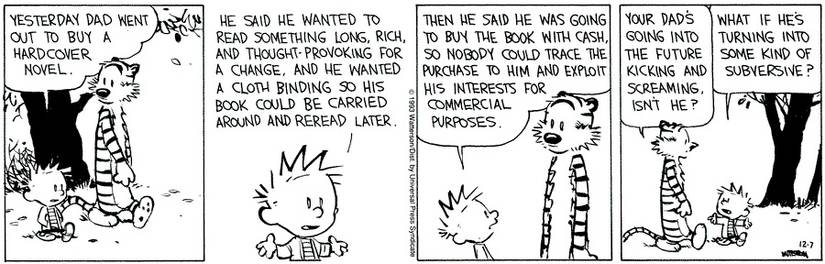
Perhaps the most striking example of Watterson’s foresight occurred on December 7, 1993. In a strip that reads like a warning shot against the impending digital age, Calvin’s father critiques the relentless pace and transparency of modern life.
While critics at the time might have dismissed his complaints as the typical grumblings of a "boomer," in 2026, the sentiment feels remarkably prophetic. In an era where data-gathering systems, surveillance capitalism, and the constant digital "shadow" have become the norm, his desire to disconnect—to favor the tangible over the virtual—feels like a revolutionary act of rebellion. Watterson was not just writing a comic; he was articulating a growing discomfort with the erosion of privacy that would come to define the next three decades.
Supporting Data: The "Bad" Parenting Paradox
It is a common observation among fans that Calvin’s parents are not particularly "good" in the traditional sitcom sense. They are often sarcastic, impatient, and prone to telling Calvin absurd lies—such as the claim that ATMs contain a small man with a printing press who writes out your receipts.

However, this is not merely a sign of bad parenting; it is a pedagogical strategy of sorts. By feeding Calvin’s natural skepticism and his tendency toward the surreal, the father encourages the very imagination that allows Calvin to survive his mundane school life. Some parents get the child they deserve, but in this case, the parents and child exist in a symbiotic loop of cynicism and wonder. The "absurd" lessons taught by the father are, in their own way, a preparation for a world that is inherently irrational.
Official Responses and Literary Analysis
Literary scholars and comic historians have often noted that Watterson’s work operates on two distinct levels. On the surface, it is a slapstick comedy about a boy and his stuffed toy. Below the surface, it is a treatise on the human condition.
Watterson himself, in his rare public statements, has emphasized that he sought to create a "serious" strip that utilized the medium of comics to explore themes usually reserved for novels or essays. The "official" consensus among critics is that by keeping the parents as secondary characters, Watterson preserved the integrity of the strip’s tone. If the parents were fully realized protagonists, the tension between the fantasy of the world and the reality of the home would collapse.
Implications for the Modern Reader
Why do these strips resonate so deeply in 2026? Perhaps it is because we are living in the world that Calvin’s father feared. We are increasingly aware of our data shadows, and we are increasingly cognizant of the fact that the institutions we rely on are, to borrow a phrase from the 1989 arc, "making it up as they go along."
The implications are clear: the search for authenticity in an age of artificiality is not a new struggle. It was present in the late 80s and early 90s, hidden in the margins of a daily newspaper comic. Calvin’s father reminds us that while we cannot stop the world from spinning, we can choose how we engage with it. Whether it is by fixing a bike, reading a physical book, or simply refusing to participate in the charade of absolute authority, there is a quiet power in maintaining one’s own sense of reality.
The Legacy of the "Strong Point"
As we look back at the nearly 3,000 strips of Calvin and Hobbes, it is easy to fixate on the tiger, the sled, or the cardboard box. But the true legacy of the strip may lie in the moments of quiet, uncomfortable truth delivered by two parents who were never given names. They remind us that the world is absurd, that adulthood is a performative art, and that sometimes, the best way to handle the chaos is to step back, take a breath, and tell a story—even if it’s not entirely true.
In the end, Calvin’s dad was not just a mouthpiece for Watterson’s complaints. He was a vessel for the universal anxiety of the human experience. He was a reminder that even when we are wrong, even when we are overwhelmed, we are still the stewards of our own lives. And in that, there is a profound, if quiet, comfort.