We are socialized from birth to believe in the "Game of Life." It is a ubiquitous metaphor—an invisible board game with unspoken rules, societal markers of success, and a finish line that supposedly separates the winners from the losers. From the iconic Milton Bradley board game first released in 1860 to the relentless pursuit of social status in the digital age, we have collectively internalized the idea that life is an arena where one must triumph over others to validate their existence.
However, a growing chorus of philosophers, sociologists, and psychologists is challenging this narrative. Their conclusion is stark: Life is not a game, and attempting to play it as one is a fundamental error that leads to chronic dissatisfaction, fractured relationships, and a profound loss of personal autonomy.
The Architecture of the "Game"
The Origins of the Competitive Metaphor
The cultural persistence of the "Game of Life" is no accident. Since the Victorian era, society has sought to quantify progress. The original Milton Bradley board game—which was significantly darker and more moralistic in its 19th-century inception than its modern iterations—laid the groundwork for the American Dream. It taught that if one followed the "right" path—education, career, marriage, and accumulation—one would reach "Happy Old Age."
Today, this framework has migrated from the cardboard board to the boardroom and the living room. We track our progress through external metrics: the brand of our car, the square footage of our home, the prestige of our employer, and the university acceptance letters of our children. These metrics are the "score" of the game.
Defining the Game Structure
A game, by definition, is a finite activity characterized by three elements:
- Competition: You must win, which necessitates that others lose.
- Arbitrary Rules: The parameters (such as earning potential or social standing) are set by external structures, not by the individual.
- Intrinsic Triviality: The goal of the game (putting a ball in a hoop or reaching a specific tile on a board) has no objective value outside the context of the game itself.
When we apply this framework to human existence, we treat our careers, our families, and our personal growth as points to be scored. But unlike a game of chess or basketball, there is no referee in the "Game of Life," and the rules are constantly shifting, leaving most participants in a state of perpetual anxiety.
The Mirage of Objective Success
Why Meaning Cannot Be Measured
The primary flaw in the "Game of Life" is that it forces us to prioritize measurable success over meaningful success. Important facets of a well-lived life—such as the strength of a marriage, the depth of one’s ethical convictions, or the internal sense of fulfillment in one’s vocation—are inherently qualitative.
Because these cannot be quantified or placed on a leaderboard, they are often discarded in favor of tangible, objective status symbols. We can easily compare salaries; we cannot easily compare the quality of a person’s inner peace. When we prioritize the competitive framework, we systematically subordinate the profound, subjective experiences that define a "good life" to the petty prizes of status.
The Pyrrhic Victory of Social Comparison
The implications of this are devastating. If life is a competition, every interaction with a peer becomes a data point for comparison. If a colleague receives a promotion, it is not just their success; it is a "loss" for you. This competitive mindset effectively poisons the well of human connection.
True, healthy relationships are built on mutual celebration. When we view others as competitors, we develop a subconscious desire for them to fail—or at the very least, to remain slightly beneath us. This creates a barrier to intimacy, as we are constantly measuring our trajectory against those we are supposed to love and support.
Implications for the Individual
The Loss of Personal Autonomy
When you enter the "Game of Life," you surrender your ability to define your own existence. You are no longer pursuing what makes you happy; you are pursuing what the culture deems "winning."
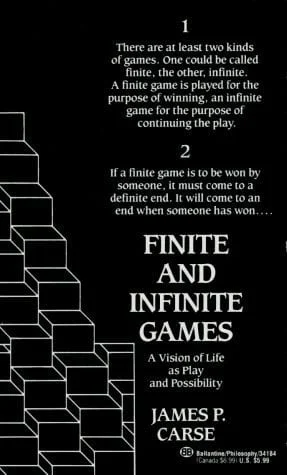
As noted by James Carse in his seminal work Finite and Infinite Games, the individual who plays a finite game is playing by rules they did not create. By contrast, an "infinite player" plays to keep the game going, focusing on growth and transformation rather than the final score. When you play by society’s rules, you are essentially outsourcing your life’s purpose to the collective consensus of a crowd that is, itself, lost.
The Burden of Inevitable Failure
Statistics dictate that in any game with winners and losers, the vast majority of people will not reach the top. If the goal is to be the "most" successful, the most affluent, or the most prestigious, then 99.9% of the population is destined to "lose."
This creates a pervasive sense of shame. When we experience the inevitable setbacks of life—a job loss, a personal mistake, or a slower pace of professional progress—we interpret these as failure. We feel the sting of public defeat, even when that "defeat" is entirely a figment of our own competitive imagination. This makes life a terrifying ordeal, defined by the constant specter of being "outplayed" by our peers.
A Re-evaluation: Escaping the Arena
The Shift to Infinite Value
Escaping the game requires a radical shift in perspective. It means recognizing that the things which are truly important—the ability to act with integrity, the time to cultivate friendships, and the pursuit of work that provides a sense of contribution—are not resources that need to be hoarded. They are, in fact, non-zero-sum. One person’s happiness does not diminish the supply of happiness available to another.
The Role of Competition in Its Proper Place
It is important to clarify that competition is not inherently evil. Sports, board games, and professional challenges are wonderful activities. They offer a structured way to test our limits, foster teamwork, and enjoy the thrill of a challenge. The tragedy occurs only when we confuse the activity of the game with the substance of life.
When you play a sport, you play to win. When the game ends, you shake hands, go home, and focus on what actually matters. The error of the modern age is failing to stop the game when we leave the arena.
Conclusion: Toward a Life Well-Lived
If we are to move past the anxiety of the "Game of Life," we must practice the radical act of defining success on our own terms. This involves:
- Identifying Core Values: Moving away from the "what" (salary, title, status) and toward the "why" (contribution, connection, contentment).
- Rejecting External Scoreboards: Consciously choosing to ignore the comparative metrics that society thrusts upon us.
- Cultivating Generosity: Shifting from a mindset of "winning" against others to a mindset of "lifting" others.
Life is not a competition to be won; it is a reality to be experienced. By abandoning the scoreboard, we do not lose our motivation or our drive; rather, we reclaim the freedom to live in a way that is authentic, sustainable, and deeply, inherently our own. When we stop playing the game, we finally begin to live.