
COLLETON COUNTY, S.C. — In a dramatic escalation of legal maneuvering ahead of one of the most anticipated retrials in modern American history, defense attorneys for convicted-turned-appellant Alex Murdaugh have launched a aggressive bid to compel South Carolina prosecutors to hand over critical forensic evidence.
In a comprehensive 93-page motion filed in state court, Murdaugh’s defense team, led by prominent attorney Dick Harpootlian, accused the state of deliberate foot-dragging. The defense claims that South Carolina authorities are withholding pivotal biological, ballistics, and digital evidence—including unidentified male DNA found under the fingernails of Murdaugh’s slain wife, Maggie—which could hold the key to proving his innocence.
The motion represents a critical opening salvo in the lead-up to Murdaugh’s second double-murder trial, currently scheduled to begin on April 5, 2027. With the stakes higher than ever, the defense is accusing the state of South Carolina of monopolizing physical evidence for over five years while actively preventing independent forensic evaluation that could point to alternative suspects.
Main Facts
At the heart of the defense’s 93-page motion is a demand for the immediate release of several items of physical evidence that have remained in the sole custody of the South Carolina Law Enforcement Division (SLED) and state prosecutors.
The primary items sought by Murdaugh’s defense team include:
- Unidentified Male DNA: The defense is demanding access to DNA evidence recovered from underneath the fingernails of Maggie Murdaugh. According to the filing, the state crime lab detected a partial male DNA profile but failed to fully test or pursue it.
- Mobile Phone Swabs: The defense is requesting the raw data and physical swabs taken from Maggie Murdaugh’s mobile phone, which also reportedly yielded a partial DNA profile.
- Raw 3D Laser Scan Data: SLED investigators conducted a state-of-the-art 3D laser scan of the Moselle crime scene in 2022. While prosecutors provided a "read-only" viewer file to the defense during the initial trial discovery, the defense insists it requires the raw, unedited spatial data to perform its own independent crime scene reconstruction.
- Regional Ballistics Records: The defense is demanding a comprehensive registry of every shooting incident in the counties surrounding Colleton County where .300 Blackout ammunition cases or projectiles were recovered, alongside the investigative details of those crimes.
The defense argues that the state’s continued withholding of these materials is a tactical maneuver designed to shorten the defense’s preparation window.

"Every week the State withholds this material is a week taken from the preparation of the defense, and if the delay continues the defense may be forced to seek a continuance that Mr. Murdaugh does not want and that the Court has said it will not grant," the motion states. "The State should not be permitted to create, through inaction, the very delay it would then oppose."
Chronology
The legal saga of Alex Murdaugh—once a member of a prominent legal dynasty that ruled the South Carolina Lowcountry for nearly a century—is marked by a complex timeline of violence, financial ruin, and unprecedented courtroom drama.
[June 7, 2021] ------------------> [March 2023] ------------------> [Early 2024] ------------------> [June-Aug 2026] --------------> [April 5, 2027]
Maggie & Paul Murdaugh             Alex Murdaugh convicted;          S.C. Supreme Court             Pretrial hearings held;       Retrial scheduled
murdered at Moselle estate.        sentenced to life in prison.      overturns convictions due      Defense files 93-page         to begin.
                                                                     to Becky Hill jury tampering.   motion to compel evidence.
The Moselle Murders and First Trial
- June 7, 2021: Maggie Murdaugh, 52, and her son, Paul, 22, are found shot to death near the outdoor dog kennels of the family’s sprawling 1,700-acre estate, known as Moselle, in Colleton County, South Carolina. Alex Murdaugh claims to have discovered the bodies.
- July 2022: After a year-long investigation, SLED officially charges Alex Murdaugh with two counts of murder and possession of a weapon during the commission of a violent crime.
- January – March 2023: A sensational six-week trial captivates the nation. Prosecutors paint Murdaugh as a desperate man who slaughtered his family to divert attention from his cascading financial crimes. On March 2, 2023, the jury finds Murdaugh guilty on all counts, and he is subsequently sentenced to consecutive life terms.
The Becky Hill Scandal and the Overturned Verdict
- Fall 2023: The defense files a motion for a new trial, presenting explosive allegations that Colleton County Clerk of Court Becky Hill improperly influenced the jury. Hill is accused of telling jurors not to be "fooled" by Murdaugh’s testimony and pressure them into a quick verdict to secure a lucrative book deal for herself.
- Early 2024: Following evidentiary hearings detailing the clerk’s misconduct, the South Carolina Supreme Court unanimously vacates Alex Murdaugh’s double-murder convictions, ordering a complete retrial.
The Path to the Retrial
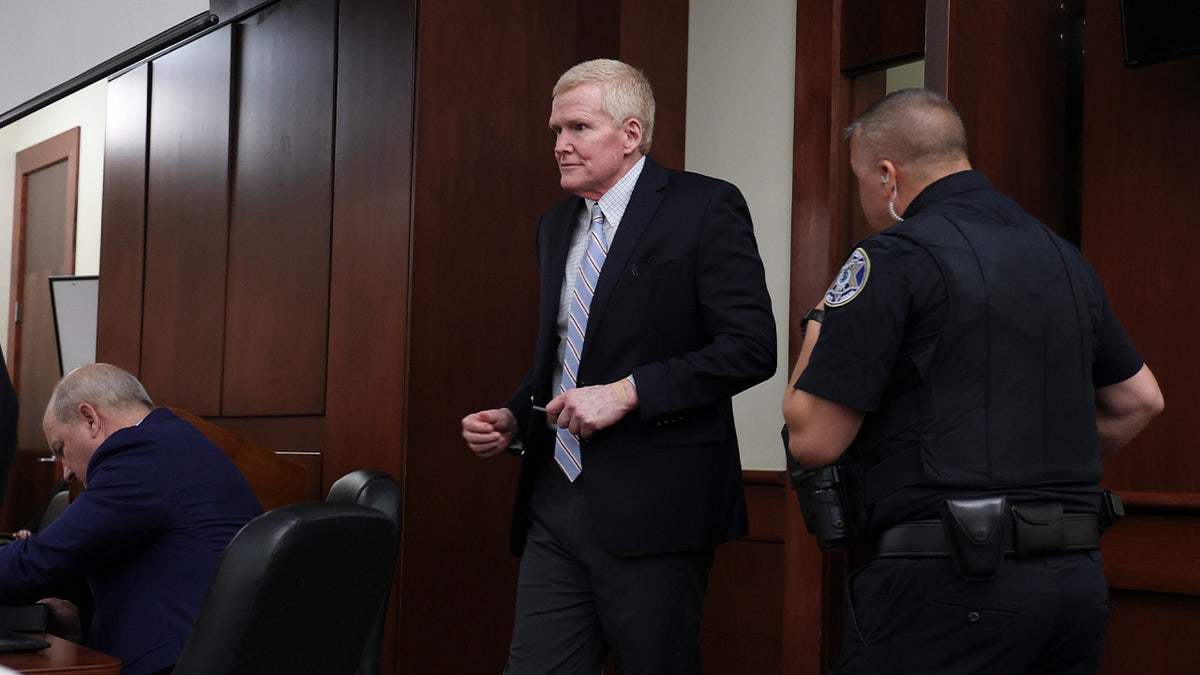
- June 29, 2026: Defense attorney Dick Harpootlian represents Murdaugh at a critical status hearing at the Marc H. Westbrook Judicial Center in Lexington, South Carolina, establishing the preliminary framework for the defense’s evidentiary requests.
- August 14, 2026: Murdaugh appears in a Lexington County courtroom for pretrial hearings. Photographs show a noticeably aged Murdaugh in a yellow prison jumpsuit, listening intently to his legal team.
- Late 2026: The defense officially files its 93-page motion to compel evidence, accusing the state of exploiting its "exclusive custody" of the crime scene materials.
- April 5, 2027: The retrial of Alex Murdaugh is officially scheduled to commence, setting the stage for a second high-stakes courtroom battle.
Supporting Data and Forensic Disputes
The defense’s motion exposes deep scientific disagreements between state forensic analysts and independent experts. The dispute centers on three main pillars of physical evidence: DNA sequencing, crime scene reconstruction, and ballistics.
The Battle Over DNA: Othram, Inc.
In their motion, Murdaugh’s lawyers revealed they had previously succeeded in getting a portion of the DNA evidence recovered from Maggie’s fingernails sent to Othram, Inc., a private, highly specialized forensic sequencing laboratory based in Texas. Othram is renowned for its work in cold cases, utilizing advanced forensic genetic genealogy to build comprehensive profiles from highly degraded or minuscule biological samples.
+-----------------------------------------------------------------------------+
|                         THE DNA EVIDENCE IN DISPUTE                         |
+------------------------------------+----------------------------------------+
| Evidence Source                    | Defense Assertion / Testing Status     |
+------------------------------------+----------------------------------------+
| Maggie Murdaugh's Fingernails      | Partial male DNA profile detected by   |
|                                    | SLED but never fully developed.        |
+------------------------------------+----------------------------------------+
| Maggie Murdaugh's Mobile Phone     | Swabs yielded a partial DNA profile;   |
|                                    | defense demands raw sequencing data.   |
+------------------------------------+----------------------------------------+
The defense contends that while SLED’s state crime lab initially identified the presence of unknown male DNA, they chose not to pursue more advanced testing, presumably because the finding did not fit their theory of the crime. The defense argues that further sequencing by Othram could identify an unknown third party, effectively clearing Murdaugh of the killings.
The Ballistics Shift: The .300 Blackout Cartridge
The defense has also accused the prosecution of shifting its narrative regarding the weapon used to kill Maggie Murdaugh. Maggie was killed with a rifle chambered in .300 Blackout, a distinct and powerful intermediate cartridge typically used in AR-15-style firearms.
   PROSECUTION BALLISTICS NARRATIVE SHIFT:

   2023 Trial:
   "The .300 Blackout rifle is highly uncommon in this region,
   pointing directly to the custom weapons owned by the Murdaugh family."

   2026 Pretrial:
   "The .300 Blackout is one of the most popular and widely
   distributed AR cartridges in the United States."
During the 2023 trial, the state argued that the .300 Blackout rifle was an unusual and highly specific firearm in the local area, which allowed them to point the finger at a missing family gun. However, in the lead-up to the 2027 trial, the state has reportedly characterized the caliber as "one of the most popular AR cartridges in the country."
To counter this, the defense is demanding SLED records of all regional crimes involving .300 Blackout ammunition. They hope to prove that weapons firing this cartridge were prevalent among local criminal elements, supporting the theory that outside intruders committed the murders.
Official Responses and Legal Analysis
Following the filing of the 93-page motion, SLED and South Carolina Attorney General Alan Wilson’s office declined to comment immediately on the pending litigation. Historically, the state has maintained that its forensic processes were sound, objective, and conducted in accordance with established law enforcement protocols.
The Defense’s Legal Position
Harpootlian and his co-counsel, Jim Griffin, argue that the state’s monopoly on the evidence violates Murdaugh’s constitutional right to a fair trial and adequate defense preparation.
"The State has had continuous and exclusive custody of every item of physical evidence in this case… for more than five years," the defense wrote. "It has tested what it wished to test, in the sequence it wished to test it, without notice to the defense and without the defense’s consent. It now proposes that the defense may not do the same."
Expert Commentary: A Double-Edged Sword?
While the defense views the DNA testing as a vital pathway to exoneration, independent legal analysts warn that demanding advanced testing on the unidentified male DNA is a high-risk gamble.

Joshua Ritter, a prominent criminal defense attorney, former prosecutor, and contributor to Fox News, expressed skepticism about the defense’s strategy. He suggested that forcing the state to test the DNA could dismantle the defense’s best argument.
"I think it’s probably better left alone by the defense so that they can make that argument about this unknown male," Ritter explained. "’Who is that? Why didn’t the prosecution test it? Why didn’t they do anything about it?’"
According to Ritter, by leaving the DNA untested, the defense can safely leverage the "mystery man" theory to sow reasonable doubt in the minds of the jurors. If the court orders the testing and the results come back matching Alex Murdaugh, a close associate, or an innocent first responder, the defense’s alternative-suspect theory will collapse.
"Maybe they’re concerned that the prosecution could point the finger right back at them and say, ‘Well, you guys didn’t test it either, you had it for as much time as we did,’" Ritter added, noting that the motion may be as much about shifting the narrative of prosecutorial laziness as it is about the actual biological results.
Implications for the 2027 Retrial
The outcome of this motion will heavily influence the trajectory of the April 2027 retrial. If the presiding judge grants the defense’s motion to compel, it will trigger a flurry of independent testing and reconstruction efforts.
Scenario A: The Motion is Granted
- Independent Analysis: Private labs like Othram will receive the fingernail DNA and phone swabs, potentially identifying a new male profile.
- Scene Reconstruction: Defense experts will use raw 3D laser data to construct a virtual model of the Moselle kennels, attempting to prove the physical impossibility of the state’s timeline.
- Potential Delay: The sheer volume of raw data and physical testing could force the defense to request a trial continuance, despite their current assertions to the contrary.
Scenario B: The Motion is Denied
- Preserved Appeal Issues: If the judge denies the motion, the defense will immediately preserve the ruling for future appeals should Murdaugh be convicted a second time.
- Focus on Reasonable Doubt: Without new scientific data, the defense will rely heavily on cross-examining SLED agents, emphasizing the state’s refusal to share raw data as a sign of a flawed, biased investigation.
Ultimately, the battle over the 93-page motion highlights the changing landscape of forensic technology in high-profile criminal trials. As both sides prepare for the April 2027 retrial, the legal community and the public remain focused on South Carolina, where the final chapter of the Murdaugh family tragedy has yet to be written.