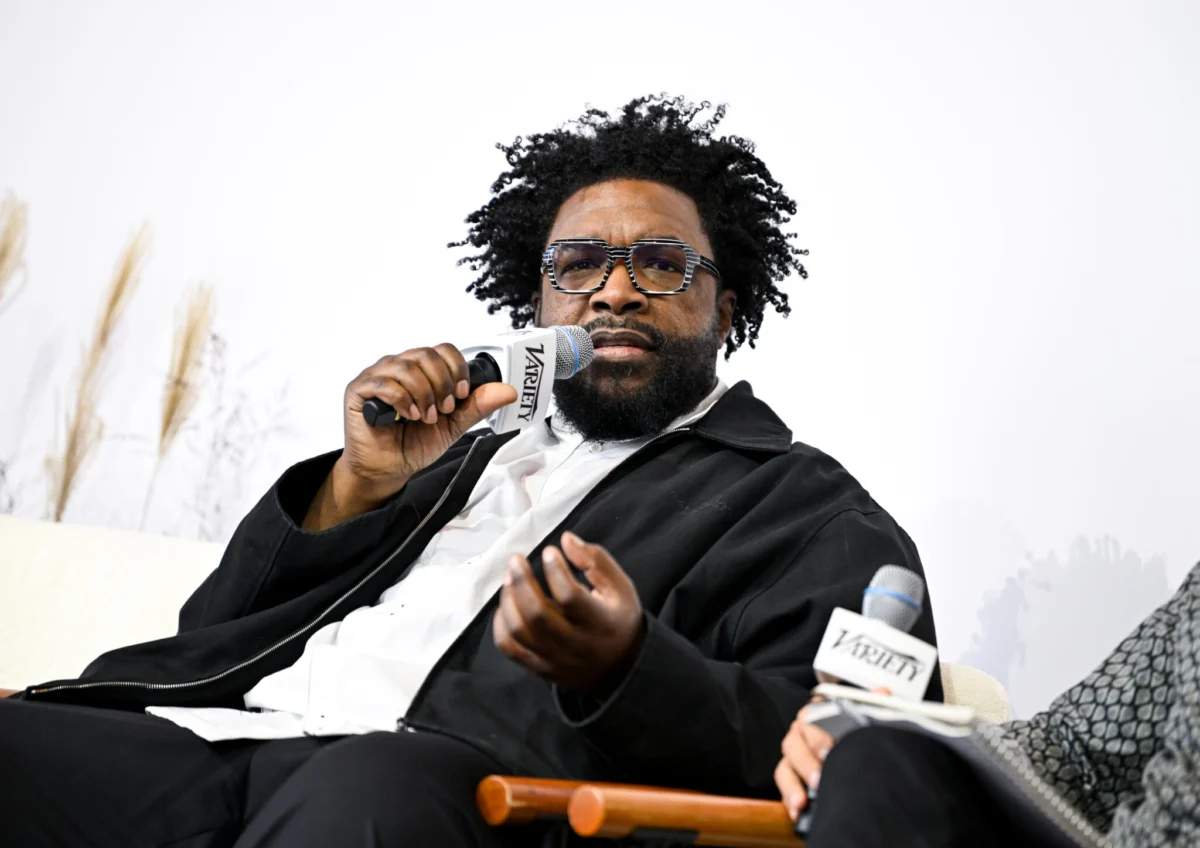
More than three decades into a storied career that has seen him transcend the boundaries of hip-hop to become a cultural institution, Questlove—born Ahmir Thompson—remains a man in constant, deliberate evolution. Whether as the rhythmic heartbeat of The Roots, a Grammy-winning producer, an NYU adjunct professor, or a prolific author, Thompson has consistently defied categorization. Yet, in recent years, he has unlocked a new dimension of his creative persona: the documentarian.
At the Variety Experience and Culture Summit: The IRL Advantage, presented by OUTFRONT, Thompson sat down with Variety’s Jem Aswad to discuss his latest chapter, a period he jokingly refers to as "Questlove 3.0." It is a phase defined not by the accolades of the past, but by a newfound commitment to vulnerability, historical excavation, and the urgent necessity of emotional literacy in a fractured world.
The Chronology of a Polymath: From Drum Kit to Director’s Chair
To understand the trajectory of Questlove 3.0, one must look at the foundation laid by Questlove 1.0 and 2.0. Rising to prominence as the leader of The Roots, Thompson helped anchor the sound of conscious hip-hop in the 1990s. His professional life has since become a sprawling map of creative endeavors: a decade-plus residency as the bandleader for The Tonight Show Starring Jimmy Fallon, a producer for the cultural juggernaut Hamilton, and an author of eight books that bridge the gap between music history and cultural analysis.
However, the pivot to film was not an ambition he originally nurtured. When the prospect of directing first surfaced, he was hesitant. "I had to do a lot of work to realize that—I know it’s cliché—I gotta be the change I want to be," he told the audience.
2021: The Breakthrough
The catalyst for his shift into cinema was Summer of Soul (…or, When the Revolution Could Not Be Televised). Released in the wake of the 2020 lockdowns and the global outcry following the murder of George Floyd, the film unearthed footage of the 1969 Harlem Cultural Festival that had been relegated to a basement for 50 years. The timing was fortuitous, if not fated. Thompson noted that while audiences initially flocked to the film out of curiosity, they stayed because they discovered something they were starved for: the celebration of Black joy.
2022–2024: A Deeper Excavation
Following his Oscar-winning debut, Thompson pivoted to the internal struggles of artistic genius with Sly Lives! (aka The Burden of Black Genius), which examined the self-sabotage that often haunts successful Black creatives. Most recently, he released Earth, Wind & Fire (To Be Celestial vs That’s the Weight of the World) in June 2024. This latest project—an intimate exploration of Maurice White’s vision—has left a "residue" on Thompson, forcing him to re-examine his own relationship with his craft.
The Philosophy of Vulnerability and the "Cool" Myth
A central theme of Thompson’s recent discourse is the destructive nature of the "too cool for school" ethos that has permeated the music industry since the days of Miles Davis. For decades, the badge of honor for artists was a stoic, untouchable exterior—a protective shell designed to mask vulnerability.
Thompson argues that this performance of coolness is not just a musical affectation; it is a societal poison. "We see it in our politics. We see it in our creativity," he stated. "We’re going to implode as a world if we don’t learn what emotions are and how we can use our vulnerability."
By studying the books Maurice White read during the genesis of Earth, Wind & Fire, Thompson began to deconstruct his own artistic armor. He realized that the "weight of the world" often prevents artists from fully manifesting their "celestial" potential. His transition from a musician who guards his vulnerability to a filmmaker who exposes it is, in his view, the most radical act of his career.
Supporting Data: The Mechanics of a Multi-Hyphenate Career
While the world now views Questlove as a storyteller, he admits the realization was a slow burn. Initially, when production companies approached him for projects, he felt like an imposter. "I didn’t know I was a storyteller," he admitted. "I’m out there like, ‘Well, search for a real storyteller,’ and they’re like, ‘Dude, you’re that storyteller.’ Once I realized it, it became a passion."
His approach to filmmaking is deliberate: he uses historical touchstones to lure the audience in, but embeds challenging, contemporary questions within the narrative. This dual-purpose storytelling ensures that his documentaries are not merely archives, but active interventions in the cultural discourse.
The Roots: A Case Study in Longevity
Despite his burgeoning film career, Thompson has not abandoned his musical roots. The Roots Picnic, which celebrated its 18th year this past May with a headline performance by Jay-Z, continues to grow. Crucially, the festival is not a "rubber-stamp" corporate event. It is a curated community experience where the members of the band often perform alongside their guests, fostering a sense of intimacy that is rare in the current festival circuit.
Furthermore, his tenure on The Tonight Show provides a stabilizing force. He credits the longevity of The Roots—now in their 35th year—to a foundational friendship. "The Beatles broke up after seven years, and we’re going on year 35 and we’re still like the best of friends," he said. He emphasizes that the show’s success is built on the fact that the band members are allowed to remain present in their personal lives, maintaining a sense of humor and camaraderie that mirrors their high school days.
Official Reflections: The Evolution of a Brand
When asked about his influences, Thompson noted that early in his career, he would have identified Prince as his "North Star." Prince represented a standard of musical perfection and autonomy that Thompson aspired to mirror. However, at this stage of his life, his idols have shifted to become internal benchmarks.
"I’m still learning what the Questlove brand is," he confessed. The Questlove of 3.0 is a figure who no longer relies on external templates. He is a curator of culture who finds as much value in the walk-on music of a late-night guest as he does in the archival footage of a 1960s festival.
On The Tonight Show, he retains a unique creative autonomy. While celebrities sometimes make requests for their walk-on songs, Thompson often insists on choosing the music himself. It is a small but telling detail: he trusts his own intuition over the curated requests of the stars, a trait that has served him well as he navigates the unpredictable waters of documentary filmmaking.
Implications: What Questlove 3.0 Means for the Future
The implication of Thompson’s pivot is clear: we are entering an era where the definition of an "artist" is expanding to include the role of the "historian." By documenting the lives of others, Thompson is effectively writing his own legacy in real-time.
His work suggests that the next generation of Black creatives will be defined by their ability to balance the "burden of genius" with the necessity of joy. As he moves forward, Thompson is not just producing films or playing drums; he is creating a blueprint for how to remain curious, how to be vulnerable, and how to maintain a collective spirit in an industry designed to isolate individuals.
Ultimately, Questlove 3.0 is a rejection of the idea that one must choose between being an expert in one field or a jack-of-all-trades. By choosing both, he has secured his place not just as a musician, but as a vital architect of contemporary culture. Whether he is directing a film about the dreamers of Earth, Wind & Fire or leading a band on national television, his message remains the same: the work is not about the accolades; it is about the courage to be seen, to be vulnerable, and to keep evolving.