By Staff Reporter
Updated: October 8, 2026 | 3:33 PM PDT
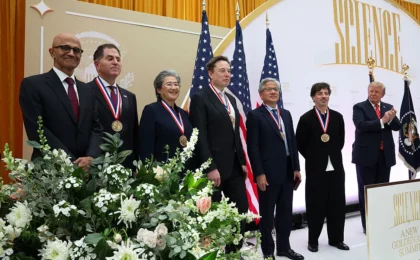
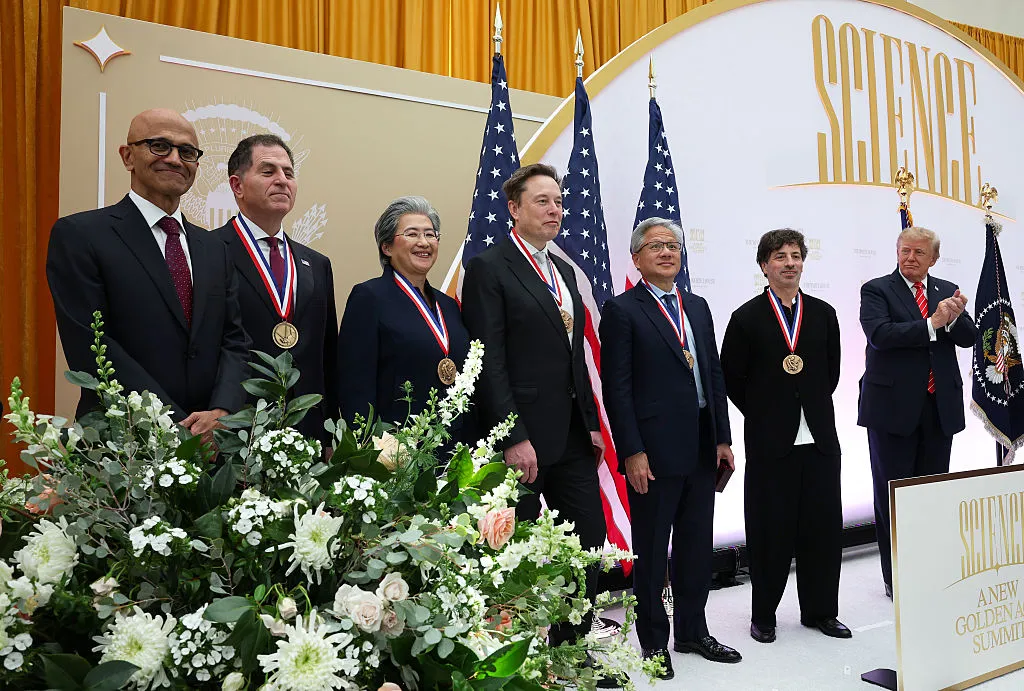
In a ceremony that underscored the deepening entanglement between the American tech establishment and the federal government, President Trump presided over the “Golden Age of American Innovation Summit” on Thursday. The event, held under the grand architecture of the White House, served as a stage for the presentation of the nation’s highest honors in scientific and technological achievement: the National Medal of Science and the National Medal of Technology and Innovation.
The recipients represented a veritable "who’s who" of the global technology landscape, including figures whose companies currently dictate the trajectory of artificial intelligence, space exploration, and semiconductor manufacturing. However, the prestige of the awards has been sharply contrasted by reports concerning the significant financial contributions made by these honorees to the Trump administration’s political and charitable initiatives, raising questions about the intersection of meritocracy and political patronage.
The Honorees: A Blueprint for the Future
The roster of recipients reads like a summary of modern technological dominance. The National Medal of Science—traditionally reserved for groundbreaking researchers—was bestowed upon individuals whose work has redefined the limits of hardware and software:
- Elon Musk: Acknowledged for his contributions to aerospace engineering and sustainable energy infrastructure.
- Jensen Huang: Recognized for his leadership at NVIDIA and the proliferation of high-performance computing required for the AI revolution.
- Sergey Brin: Honored for his foundational role in organizing the world’s information and pioneering algorithmic search.
- Lisa Su: Celebrated for her transformative leadership at AMD, which has been instrumental in keeping U.S. chip manufacturing competitive on the global stage.
In parallel, the National Medal of Technology and Innovation—which rewards those who have translated scientific research into market-moving products—was awarded to Michael Dell of Dell Technologies and Satya Nadella of Microsoft.
During the ceremony, President Trump lauded the group, stating, "These individuals have pioneered an incredible future for America. Because of their vision, their tenacity, and their commitment to our national strength, we will always be on top. No one else can compete with us."
Chronology of the Summit and the Awards
The lead-up to the summit was marked by intense speculation regarding the administration’s focus on domestic technological sovereignty.
- October 6, 2026: The White House officially confirmed the list of honorees, signaling a departure from traditional, strictly academic selections toward a more industry-centric list of recipients.
- October 8, 2026, 10:00 AM: The Golden Age of American Innovation Summit commenced. The morning sessions focused on the necessity of "decoupling" American tech infrastructure from reliance on foreign talent and supply chains.
- October 8, 2026, 2:00 PM: The formal award ceremony took place. The atmosphere was noted by attendees for its focus on nationalism and the preservation of American market dominance.
- October 8, 2026, 3:30 PM: Official press releases followed, coinciding with the news of the administration’s restrictive policy shifts regarding the H-1B visa program.
Supporting Data: The Financial Context
A central point of contention surrounding this year’s awards is the documented financial history between the recipients (or their respective corporations) and the Trump administration. According to data analyzed by The New Republic, the honorees are linked to roughly $6 billion in total donations, pledges, and contributions directed toward initiatives supported by the President.
Breakdown of Contributions:
- The Trump Accounts: Michael and Susan Dell have pledged $6.25 billion to the "Trump Accounts," a specialized savings and investment program championed by the administration to encourage long-term financial security for American children.
- Infrastructure and Inauguration: Alphabet (Google’s parent company) and Microsoft have historically provided significant funding to the President’s inauguration efforts and the refurbishment of White House facilities, including the Presidential ballroom.
- Political Action: AMD, under the leadership of Lisa Su, has been a notable contributor to pro-Trump Super PACs, highlighting a strategic alignment between the chip giant’s legislative interests and the current administration’s protectionist trade policies.
Critics argue that the concentration of awards among major donors suggests a "pay-to-play" dynamic, while defenders of the administration argue that the recipients are the only individuals whose private wealth and influence are capable of funding the massive infrastructure projects the government deems necessary for national security.
Official Responses and Strategic Disconnects
The ceremony was not without irony. The most glaring instance occurred with the presentation of the medal to Satya Nadella. The CEO of Microsoft accepted the honor at the same time the Department of Homeland Security issued a directive indefinitely suspending Microsoft from the H-1B visa program.

This program, which allows U.S. companies to hire foreign workers in specialty occupations, has been a cornerstone of the tech industry’s talent acquisition strategy for decades. The suspension represents a significant friction point between the administration’s rhetoric—which demands that tech leaders build an "American future"—and its policy actions, which restrict the very global talent pools that these companies rely on to remain competitive.
When asked for comment regarding the suspension, a White House spokesperson stated: "The President believes that American innovation should be driven by American workers. While we value the contributions of industry leaders like Mr. Nadella, the era of relying on foreign labor to build our future is coming to an end."
Representatives for Microsoft declined to comment on the record regarding the suspension, focusing their official statements instead on the honor of receiving the medal and their commitment to "continuing to support the American digital economy."
Implications: A New Era of Corporate-State Relations
The 2026 National Medals ceremony serves as a barometer for a shift in the relationship between Silicon Valley and Washington. For the past two decades, the tech industry operated with a degree of autonomy, often finding itself at odds with federal regulators. The current climate suggests that this era of independence is closing.
1. The Politicization of Merit
By aligning the nation’s highest scientific honors with political donors, the administration risks devaluing the prestige of the awards. Historically, these medals were viewed as objective measures of scientific excellence. Moving forward, the awards may be viewed through a partisan lens, potentially deterring future researchers who prioritize academic neutrality.
2. The Rise of "National Champion" Capitalism
The administration’s selection of honorees indicates a preference for "National Champions"—large, consolidated firms that are capable of working in lockstep with the government. This signals to the market that firms aligning with the administration’s economic agenda will be rewarded with prestige and, likely, future federal contracts, while those that do not may find themselves facing regulatory hurdles, such as the H-1B restrictions.
3. Talent Mobility Constraints
The suspension of Microsoft from the H-1B program, contrasted with the awarding of a medal to its CEO, creates a precarious environment for tech companies. If the government forces the industry to "Americanize" its workforce while simultaneously cutting off the global pipeline of engineering talent, the long-term impact on productivity and innovation remains to be seen. Industry analysts warn that such moves could lead to a "brain drain," where top-tier global talent relocates to more open jurisdictions, potentially undermining the very "innovation" the summit aimed to celebrate.
4. Long-Term Economic Impacts
The $6 billion in private funding for the "Trump Accounts" and other initiatives indicates that the administration is successfully offloading certain state responsibilities onto the private sector. This model—where tech giants act as extensions of the state in exchange for favorable regulatory treatment—could become the defining economic framework of the late 2020s.
As the dust settles on this year’s summit, the tech industry is left in a state of high-stakes transition. The message from the White House is clear: those who wish to lead the future of American technology must be prepared to integrate their corporate goals with the administration’s broader vision of national sovereignty. Whether this path leads to a true "Golden Age" or a period of technological stagnation remains the central question for the industry’s future.