Main Facts: A Midterm Gathering Centered on a Single Figure
DALLAS — The Republican Party convened an unprecedented two-day midterm convention at the American Airlines Center in downtown Dallas, an event officially dubbed "Trumpapalooza" that highlighted President Donald Trump’s overwhelming control over the GOP machinery. Rather than adhering to the traditional structure of a party nominating convention, the gathering operated as a high-octane political rally designed to energize the conservative base ahead of critical congressional elections.
From the venue’s entry protocols to the merchandise worn by attendees, the president’s presence dominated the proceedings. Laminated entry passes were printed with Trump’s likeness, while attendees wore apparel emblazoned with his name in rhinestones. For Republican candidates competing in competitive House and Senate districts across the country, the convention offered a national platform to praise the president, criticize Democratic opponents, and attempt to translate Trump’s personal political magnetism into down-ballot votes.
The primary objective of the gathering was to fortify Republican majorities in Congress during an election cycle marked by voter anxiety over a sluggish domestic economy and sinking approval ratings for the administration. By focusing heavily on base activation, party leaders sought to shift public attention away from economic headwinds and toward a unified show of party loyalty.
Chronology of the Gathering: Two Days of High-Energy Campaigning
The convention unfolded over forty-eight hours, combining national party branding with targeted candidate showcases:
+-----------------------------------------------------------------------------------+
| DAY 1: RISING STARS & BATTLEGROUND CANDIDATES                                     |
| • Focus on House/Senate contenders in key swing districts.                       |
| • Brief speeches attacking Democratic rivals and praising Trump's agenda.         |
| • Speeches by emerging conservative figures like Reps. Brandon Gill & Anna Luna.  |
+-----------------------------------------------------------------------------------+
                                         │
                                         ▼
+-----------------------------------------------------------------------------------+
| DAY 2: PARTY LEADERSHIP & THE PRINCIPALS                                          |
| • NRCC Chair Richard Hudson frames election as a "rescue mission."                |
| • Speaker Mike Johnson proposes lighthearted J.Q. Adams post-presidency scenario. |
| • VP JD Vance delivers a structured, polished policy address.                      |
| • Keynote: President Donald Trump rallies the base to vote as if he were running. |
+-----------------------------------------------------------------------------------+
Day 1: Rising Stars and Battleground Candidates Take the Stage
The opening day focused primarily on platforming congressional candidates running in contentious districts across the nation. Candidates were granted brief windows in the national spotlight to pitch their campaigns, raise funds, generate clips for social media, and draw sharp contrasts with their Democratic rivals.
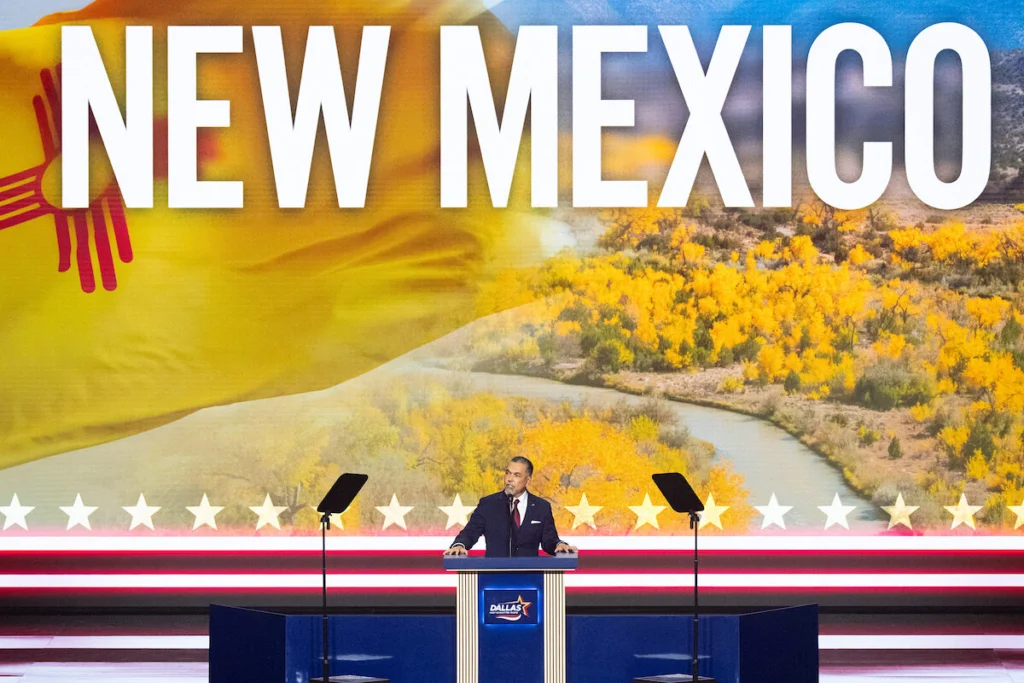
Emerging GOP figures, including Representatives Brandon Gill of Texas and Anna Paulina Luna of Florida, delivered speeches designed to excite younger and digital-first conservative voters. Battleground candidates, such as Marine Corps veteran Greg Cunningham (running for New Mexico’s 2nd Congressional District), framed their individual races as critical extensions of the broader Trump platform.
Day 2: Leadership Addresses and Keynote Performances
The second day shifted focus to congressional leadership and executive branch officials.
- NRCC Chair Richard Hudson opened the high-profile evening segment by framing the midterm elections as an urgent push to maintain governance, telling the crowd that Trump was engaged in a "rescue mission to save this country."
- Speaker of the House Mike Johnson took the stage to champion legislative victories while offering lighthearted speculation regarding Trump’s future after his current term.
- Vice President JD Vance delivered a key speech preceding the president, delivering the administration’s core political message in a structured, policy-focused format.
- President Donald Trump concluded the convention with a lengthy rally speech, calling on supporters to treat the upcoming midterms with the same urgency as a presidential election year.
Supporting Data and Political Backdrop: Turnout Mechanics and Economic Headwinds
The strategic imperative behind the Dallas convention was rooted in electoral arithmetic and historical turnout patterns. Republican strategists faced two distinct challenges: persistent economic concerns and changing urban demographics.
                  2024 DALLAS COUNTY PRESIDENTIAL ELECTION RESULT
                  ===============================================

                  Kamala Harris (DEM)  [####################] 60%
                  Donald Trump  (GOP)  [##############]      40%
The Turnout Imperative and Low-Propensity Voters
Midterm elections historically suffer from significant turnout drops compared to presidential cycles. The decline is especially pronounced among "low-propensity voters"—working-class and non-traditional voters who participate primarily when Trump himself is on the ballot.
To prevent a drop-off in down-ballot participation, party officials structured the convention to convince these voters that Trump’s agenda relies entirely on holding congressional majorities.
Shifting Local and National Polling Realities
The decision to hold the convention in Dallas highlighted shifting political dynamics within Texas. While the Dallas-Fort Worth region was historically foundational to the rise of the modern Texas GOP, Dallas County has transitioned into a reliable Democratic base. In the 2024 presidential election, Democratic nominee Kamala Harris secured Dallas County with 60% of the vote.

Nationally, the convention took place against a backdrop of public dissatisfaction with economic conditions. With polling showing Trump’s job approval ratings reaching low points for his term, GOP campaign committees recognized the need to nationalize congressional races around culture, leadership, and base-mobilization strategies rather than defense of the economic status quo.
Official Responses: Quotes and Perspectives from Key Figures
Party leaders, battleground candidates, and convention delegates expressed strong support for the administration’s strategic focus throughout the event.
+------------------------------------------------------------------------------------------+
|                                key STATEMENTS & QUOTES                                   |
+--------------------------+---------------------------------------------------------------+
| Speaker / Figure         | Core Message / Direct Quote                                   |
+--------------------------+---------------------------------------------------------------+
| Rep. Richard Hudson      | "He told us he will never stop fighting for you... because   |
| (NRCC Chairman)          | President Trump is on a rescue mission to save this country." |
+--------------------------+---------------------------------------------------------------+
| Scott Singer             | "We have low-propensity voters who only come out for          |
| (FL Congressional Cand.) | presidentials... Trump’s push demonstrates the necessity...   |
|                          | to have their voice be heard."                                |
+--------------------------+---------------------------------------------------------------+
| Leticia Muñoz            | "The policies we voted for in 2024, and everything President  |
| (New Mexico GOP)         | Trump stands for, are on the ballot this year."               |
+--------------------------+---------------------------------------------------------------+
| Larry Marker             | "We have a leader. His name is Jesus Christ. But Donald Trump |
| (NM Senate Candidate)    | is the leader of the MAGA movement..."                        |
+--------------------------+---------------------------------------------------------------+
| Chris Ryan               | "It’s going to be whoever President Trump says it’s going to  |
| (MA State Committee)     | be... If he wants Lassie the dog, then that’s who’s getting   |
|                          | the nomination."                                              |
+--------------------------+---------------------------------------------------------------+
| Speaker Mike Johnson     | Joked that Trump could follow John Quincy Adams and run for   |
| (House Speaker)          | the U.S. House of Representatives after his presidency.       |
+--------------------------+---------------------------------------------------------------+
House Leadership and Strategy
Representative Richard Hudson, chairman of the National Republican Congressional Committee (NRCC), energized the crowd by emphasizing Trump’s dedication to his base:
"How great was President Trump last night? He told us he will never stop fighting for you … because President Trump is on a rescue mission to save this country."
Speaker Mike Johnson pointed out historical anomalies in presidential post-terms, noting that John Quincy Adams was the only former president in U.S. history to serve in the House of Representatives after leaving the White House.
"Maybe our current president would do that?" Johnson joked.
Battleground Candidates on Mobilization
Scott Singer, former mayor of Boca Raton running against Democratic Rep. Jared Moskowitz in a newly redrawn South Florida district, detailed the logistical goal of the convention:
"We have low-propensity voters who only come out for presidentials. Trump’s get-out-the-GOP-vote push demonstrates the necessity for Americans to get involved and have their voice be heard."
Leticia Muñoz, executive director of the New Mexico Republican Party, brought a delegation of 34 figures from her state, where Trump had narrowed the margin to 6 percentage points in 2024—the strongest GOP presidential performance in New Mexico since 2004.
"The policies we voted for in 2024, and everything President Trump stands for, are on the ballot this year. We’ve got to protect that."
Larry Marker, an underdog Republican candidate challenging Democratic Senator Ben Ray Luján in New Mexico, addressed criticisms of the party’s focus on Trump:

"We have a leader. His name is Jesus Christ. But Donald Trump is the leader of the MAGA movement, and we support his policies. We’re proud of what he’s done."
Former Iowa State Representative Joe Mitchell, competing for an open battleground seat in Iowa’s 2nd Congressional District to succeed Senate candidate Ashley Hinson, dismissed thoughts of a declining Trump influence:
"We’re in a stronger position because of the president, and he’s not going away."
Grassroots and Delegate Perspectives
Nicole Moore, a Dallas nonprofit worker attending the event in an oversized foam hat from a Turning Point Action rally, highlighted local enthusiasm for the party’s new generation of leaders alongside Trump:
"As far as Dallas, we’ve always been a huge supporter of Trump. Those ties run deep."
Chris Ryan, a member of the Republican State Committee from Massachusetts (which he referred to as the "Commiewealth of Marxachusetts"), remarked on Trump’s absolute influence over the party’s future:
"It’s going to be whoever President Trump says it’s going to be, and that’s a fact. I’ll tell you right now: If he wants Lassie the dog, then that’s who’s getting the nomination. I don’t think we’ll ever see somebody like that again."
Strategic and Long-Term Implications: The Post-Trump Horizon
The Dallas midterm convention underscored several strategic developments that will shape the Republican Party through the current midterms and into the 2028 presidential cycle.
+-----------------------------------------------------------------------------------+
|                        FUTURE OUTLOOK: KEY STRATEGIC TAKEAWEAYS                   |
+-----------------------------------------------------------------------------------+
| 1. Nationalization of Down-Ballot Races                                           |
|    GOP candidates rely directly on Trump's brand identity rather than local platform  |
|    differentiation to drive mid-cycle turnout.                                    |
|                                                                                   |
| 2. Succession Dynamics                                                            |
|    Vice President JD Vance presents a disciplined, structured policy alternative   |
|    while remaining loyal to the core MAGA platform.                               |
|                                                                                   |
| 3. Enduring Kingmaker Status                                                      |
|    Party delegates expect Trump to retain primary endorsement power over the      |
|    2028 GOP nomination field even after leaving office.                           |
+-----------------------------------------------------------------------------------+
Test of the "Trump Transfer" Strategy
The primary risk of nationalizing midterm elections around a sitting president with low approval ratings is the potential activation of opposition voters. By urging voters to pretend he is personally on the ballot, Trump is testing whether his coalition can be mobilized without his direct presence at the top of the ticket. The outcome in contested House districts in Florida, Iowa, and New Mexico will serve as a definitive metric of whether the MAGA movement can reliably drive turnout in off-year elections.
Shaping the 2028 Succession Framework
While the convention focused on immediate legislative control, the gathering provided an early look at post-presidential GOP power dynamics:
- Vice President JD Vance established himself as a leading candidate for the post-Trump era. His speech delivered traditional MAGA movement themes within a disciplined, structured presentation, offering a prospective model for governance after Trump’s second term ends.
- Trump’s Continued Influence: Party officials and state committee members widely agree that Donald Trump will retain decisive influence over the party nomination process in 2028. Rather than fading into a traditional elder-statesman role, Trump is expected to remain the central kingmaker of conservative politics, ensuring his movement continues to define the party platform for years to come.