Introduction: A Fragile Homecoming
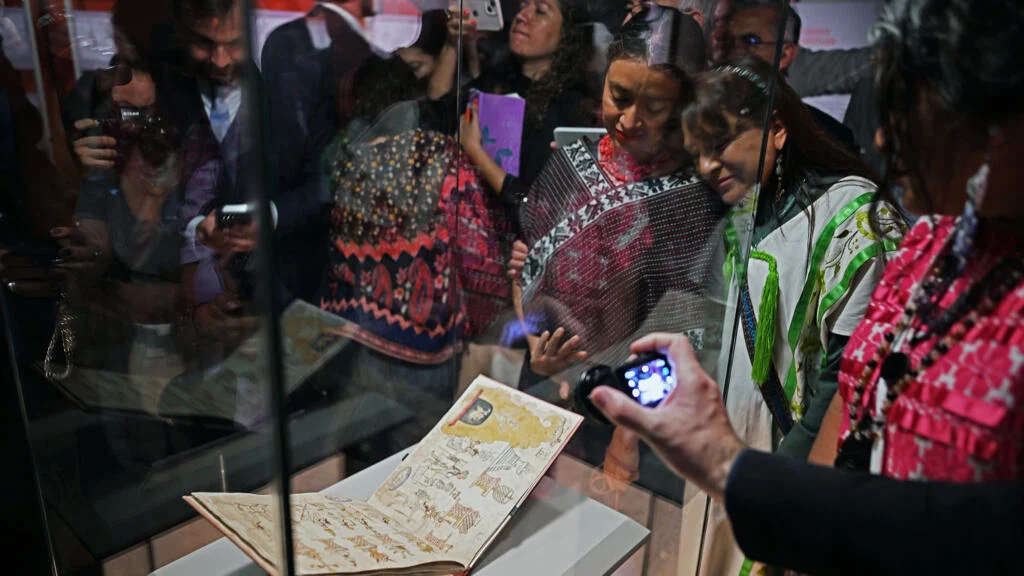
In the hallowed halls of Mexico City’s National Museum of Anthropology, a moment of profound emotional resonance unfolded this past Thursday. Beneath the soft, protective glow of specialized museum lighting, two folios from the Codex Azcatitlan—a 16th-century manuscript of incomparable historical significance—were unveiled to the public. For the Indigenous communities of Mexico, the display was not merely an exhibition; it was a fleeting reunion with a stolen ancestor.
The manuscript, which chronicles the epic journey of the Aztec people from their mythical origins in Aztlan to the zenith and subsequent tragic fall of the Aztec Empire, has spent nearly two centuries in France. While the document is currently on loan from the National Library of France to commemorate the bicentennial of diplomatic relations between the two nations, its presence in Mexico City has reignited a fierce, decades-long debate over colonial-era looting, national identity, and the moral obligation of Western institutions to return cultural treasures to their lands of origin.
Chronology of a Displaced Treasure
To understand the gravity of the Codex Azcatitlan’s return, one must trace its journey through the turbulent history of the 19th century.
- The Early 16th Century: Shortly after the Spanish conquest, the codex was composed on European-imported parchment. It utilized traditional Aztec pictographic storytelling, capturing the migration, the founding of Tenochtitlan, and the cultural shifts brought about by the imposition of Christianity.
- The 1840s: The manuscript was acquired by Joseph Marius Alexis Aubin, a French researcher and collector who specialized in Indigenous American cultures. During his time in Mexico, Aubin amassed a significant collection of pre-Columbian and colonial-era documents, effectively removing them from their cultural context and transporting them to France.
- 1898: Following the death of collector Eugène Goupil, his widow donated the massive collection, including the Codex Azcatitlan, to the National Library of France. There, it remained shielded from the public eye of its creators for over a century.
- 1982: A flashpoint in diplomatic relations occurred when Mexican lawyer José Luis Castañeda engaged in a daring act of "repatriation by theft." He removed the Codex Tonalamatl from the National Library of France, arguing that its rightful place was in Mexico. While France decried the act as a criminal theft, the Mexican public celebrated it as a heroic recovery, and the document remained in Mexico.
- 2018–Present: Under the current administration, Mexico has launched an aggressive campaign to recover thousands of colonial-era cultural objects held abroad. Since 2018, the National Institute of Anthropology and History (INAH) reports that over 16,200 items have been successfully repatriated.
The Pictographic Narrative: Why the Codex Matters
The Codex Azcatitlan is far more than a historical record; it is a bridge to a world largely erased by conquest. Its 25 sheets of parchment are saturated with vibrant, meticulously preserved pigments—deep reds, blues, greens, and yellows that illustrate the complex social structure of the Aztec civilization.
The manuscript serves as a visual encyclopedia. It depicts warriors adorned in elaborate feathered headdresses, ritual sacrifices, and the architectural majesty of pyramid temples. By narrating the migration from Aztlan to Tenochtitlan, the codex provides a foundational mythos for the Mexican identity. For historians, it is an invaluable primary source that bridges the gap between pre-Hispanic tradition and the forced transition into the colonial era. When the Spanish arrived, the "written voice" of the Aztecs was systematically silenced; the codex remains one of the few surviving instances where that voice was captured in its native, pictographic language.
Official Responses and Diplomatic Friction
The exhibition of the codex has served as a lightning rod for political discourse. During the inauguration, Mexican Foreign Minister Roberto Velasco framed the event as an act of "reuniting a population with its collective memory."
"These pictograms represent our history, the written voice of our ancestors, and the deep root of our identity," Velasco remarked. However, the diplomatic tone is underscored by persistent pressure from the highest levels of government. President Claudia Sheinbaum has made the repatriation of these manuscripts a priority of her foreign policy, having personally pressed French President Emmanuel Macron on the issue during his recent visits to Mexico.
France’s position, however, remains rigid. Both the National Library of France and the French National Assembly—which holds the Codex Borbonicus, a partner manuscript to the Azcatitlan—insist on their legal ownership. They categorize these items as part of their national collections, acquired through 19th-century trade and acquisition practices that, while viewed as exploitative today, were legal at the time. The loan, according to French officials, is a gesture of goodwill intended to celebrate the anniversary of bilateral ties, not an admission of a need for permanent restitution.
The Human Impact: "They Stole Our History"
For the Indigenous groups who have campaigned for the return of the codex, the legal nuances of European property law are secondary to the moral reality of theft. Emilia Mendoza, a representative of the Hnahnu community, stood before the glass case in the National Museum of Anthropology, visibly moved.
"They hid our history from us, they stole it!" she declared. For her and many others, the codex is not an artifact to be traded or loaned; it is a sacred relic of their lineage. The current exhibition is viewed by these activists as a "battle won," but they maintain that the loan is only the first step. The goal remains full and permanent repatriation.
Karen Trejo, a 28-year-old ethnohistorian who attended the opening, echoed this sentiment, capturing the frustration of a generation that sees these items as essential to the healing of colonial trauma. "If it’s from Mexico, why isn’t it in Mexico?" she asked. It is a question that resonates far beyond the museum walls, reflecting a global shift in how former colonial powers are expected to treat the cultural patrimony of the nations they once occupied.
Implications for Global Cultural Heritage
The tension surrounding the Codex Azcatitlan is a microcosm of a much broader global movement. From the Benin Bronzes in Nigeria to the Parthenon Marbles in Greece, the discourse surrounding the ownership of antiquities is reaching a boiling point.
- Legal vs. Ethical Ownership: The current situation highlights a growing rift between legal property rights and ethical ownership. While France holds the legal titles, the origin of these items in the context of colonization undermines their moral claim to them.
- The Precedent of "Theft": The 1982 incident involving the Codex Tonalamatl remains a cautionary tale for both sides. It proves that the demand for repatriation can lead to direct action, which threatens to sour diplomatic relations. Conversely, it shows that holding onto such items can create a permanent source of resentment and tension.
- Digital Repatriation vs. Physical Return: Some institutions have proposed high-quality digital facsimiles as a compromise. However, as the emotional reaction at the National Museum of Anthropology proves, there is no substitute for the physical presence of the original object. The connection to the "deep root of identity" requires a tangible connection to the past.
Conclusion: A Future of Shared Memory
As the Codex Azcatitlan continues its temporary stay in Mexico City, the world watches to see if this loan will evolve into a precedent for permanent return. The exhibition is a powerful reminder that history is not a static set of facts kept in a vault, but a living, breathing component of national identity.
For the people of Mexico, the return of their manuscripts is an act of reclaiming their voice after centuries of being spoken for by others. Whether France will eventually yield to the persistent calls for full restitution remains to be seen. However, one thing is certain: the conversation has shifted. The Codex Azcatitlan is no longer just a treasure of the French National Library; it is the center of a moral awakening, a testament to the endurance of a culture that refuses to let its history remain under lock and key in a foreign land.