In the rapidly evolving landscape of autonomous logistics, few startups have generated as much industry intrigue as the Bengaluru-based Airbound. Founded just three years ago, the company is aiming to solve the "last-mile" puzzle that has frustrated retailers and healthcare providers for decades: the inefficiency of ground-based transport.
This week, Airbound announced a significant milestone in its mission, securing $37 million in a Series A funding round. Led by Greenoaks, the round included strategic participation from delivery giant DoorDash, as well as high-profile investors including Lachy Groom, Lightspeed, and Humba Ventures. This latest injection of capital brings the startup’s total funding to nearly $50 million, underscoring a growing institutional confidence in the viability of aerial logistics.
The Core Mission: Achieving Cost Parity with Road Transport
For decades, the promise of drone delivery has been hampered by a fundamental flaw: the economics of flight. Traditional aviation models, even those scaled down for drones, are burdened by the weight of the aircraft itself. In most conventional designs, a significant portion of a drone’s energy is spent lifting its own chassis, leaving little room for payload. This makes small-scale, short-distance deliveries prohibitively expensive compared to a delivery truck or a motorcycle.
Naman Pushp, the 20-year-old founder and CEO of Airbound, is challenging this paradigm by fundamentally redesigning the aircraft architecture. "We want to build towards a world where everything has cost parity with trucking," Pushp stated in a recent interview.
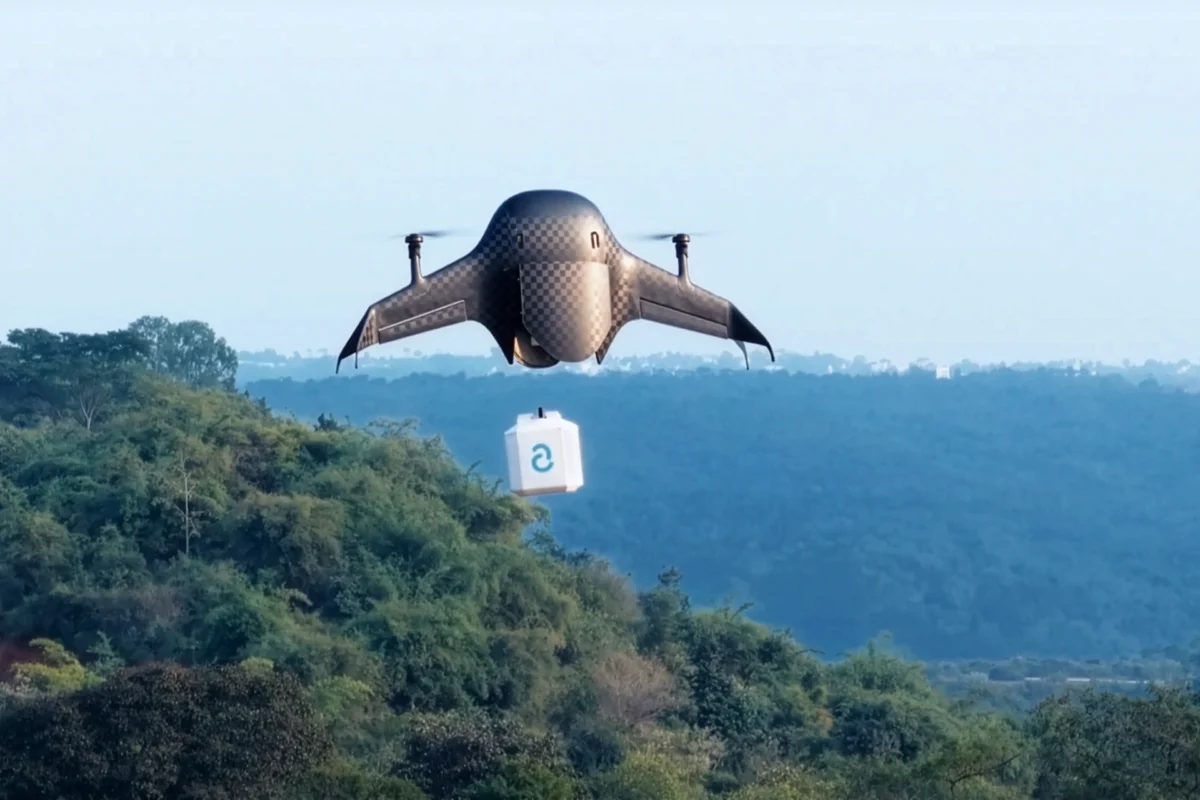
To achieve this, Airbound has pioneered a lightweight, rocket-like, "tail-sitter" design. These drones take off and land vertically in an upright position before transitioning to efficient horizontal flight. This design allows Airbound to operate without the need for traditional runways—a critical factor in navigating the dense urban environments of Indian cities like Bengaluru and Guntur.
The strategy is simple but bold: create an aircraft that weighs less than the cargo it carries. Currently, the company’s "TRT" drone weighs approximately 3.3 pounds and is capable of carrying a 2.2-pound payload. The next generation of the aircraft, currently in the prototyping phase, aims to weigh 6.6 pounds while hauling an 11-pound payload, effectively doubling the weight-to-payload efficiency.
A Brief Chronology: From Concept to $50 Million
Airbound’s rise has been nothing short of meteoric. Founded in 2023, the startup moved quickly to validate its technology in the real world.
- 2023: Airbound is established in Bengaluru, focusing on vertical takeoff and landing (VTOL) autonomous systems.
- Late 2024: The company demonstrates its utility by conducting thousands of test flights in Bengaluru and Guntur.
- October 2025: Airbound secures an $8.65 million seed round, signaling early interest from venture capital firms in the potential for "one-cent" drone delivery at scale.
- 2026 (Present): The company closes a $37 million Series A round, bringing total investment to nearly $50 million, enabling the expansion of its manufacturing facility and fleet.
Throughout this period, the company has maintained a rigorous testing schedule, logging over 13,000 autonomous flights. These missions have served as the proving ground for the startup’s software, flight control systems, and mechanical durability.
Supporting Data: Healthcare as the First Frontier
While retail and e-commerce are the ultimate goals, Airbound has found its most immediate utility in the healthcare sector. Partnering with the Narayana Health hospital network, the startup has transformed the logistics of diagnostic testing.
In a typical scenario, transporting diagnostic samples via two-wheelers through Bengaluru’s notorious traffic can take three to five hours. This is largely because couriers wait to bundle multiple samples together to make the trip "worth it" for the logistics provider. Airbound’s drones, by contrast, fly the samples directly between facilities in roughly seven minutes.
The impact of this speed is profound. By bypassing road congestion, Narayana Health can provide faster diagnoses, potentially saving lives through quicker medical intervention. The success of this pilot has led to an expansion: the new Banashankari hospital in Bengaluru was specifically designed without an on-site diagnostic lab or blood bank, relying entirely on Airbound’s drone network to connect to centralized facilities.
The Three-City Ambition and Regulatory Challenges
Airbound’s vision extends beyond individual hospital routes. The company has entered into a strategic agreement with the government of Andhra Pradesh to create a massive drone delivery network connecting three major cities.
The scale of this ambition is staggering. Pushp envisions a system that facilitates 10,000 flights per day, servicing retail, e-commerce, and healthcare sectors. To achieve this, Airbound estimates a fleet requirement of 250 to 1,000 aircraft. While the Andhra Pradesh government is not providing direct subsidies or a government contract, they are collaborating closely with the startup to establish the necessary regulatory framework for such high-frequency operations.
However, the road to mass adoption is fraught with regulatory hurdles. The most significant obstacle is "Beyond Visual Line of Sight" (BVLOS) certification. Current aviation regulations in India—and globally—often require drone operators to keep their aircraft within the direct line of sight. Securing BVLOS approval is essential for scaling, as it allows drones to fly autonomously over long distances without human intervention.
Pushp acknowledges that regulations, rather than manufacturing capability, represent the primary bottleneck. Despite a robust 43,000-square-foot facility in Bengaluru where the company manufactures its own airframes, the startup remains largely pre-revenue. The team of over 150 employees is currently focused on long-term infrastructure rather than immediate short-term profit.
Implications: The "Boeing of Drones"
Perhaps the most unique aspect of Airbound’s strategy is its positioning within the industry. While competitors like Skye Air Mobility and TSAW Drones are aggressively pursuing the role of the "delivery operator"—the company that manages the logistics—Airbound is carving out a different identity.
"That’s the Boeing role," says Pushp. "The aircraft airlines everywhere rely on, not the airline itself."
By focusing on manufacturing the aircraft rather than just managing the delivery service, Airbound is positioning itself to be a technology provider for a future where drone delivery is as common as trucking. If they succeed, they won’t just be a delivery startup; they will be the primary hardware supplier for an entire global logistics ecosystem.
The Road Ahead
The $37 million investment is more than just a financial boost; it is a validation of the "tail-sitter" vertical-flight concept. For Airbound, the next few years will be a race against time and regulators. They must prove that their aircraft can handle the intensity of 10,000 flights a day without maintenance fatigue, and they must successfully navigate the complex aviation policies of the Indian government.
While the company is currently pre-revenue, the leadership remains unperturbed. Their goal is not to capture the market in a quarter, but to fundamentally alter the cost structure of global shipping over the coming decades. As the startup scales its manufacturing and expands its network across Andhra Pradesh, the world will be watching to see if Airbound can truly turn the sky into a superhighway for commerce.
For now, the startup is a testament to the idea that with enough technical ingenuity and capital, the most mundane tasks—like moving blood samples or packages across town—can be transformed by the marriage of vertical flight and autonomous intelligence. If Airbound achieves even a fraction of its stated goals, the logistical landscape of India will be permanently changed, providing a blueprint for the rest of the world to follow.