The quest to conquer the 24 Hours of Le Mans is perhaps the most grueling challenge in automotive engineering. It is a crucible of speed, reliability, and sheer tactical endurance. For Ford, a brand synonymous with some of the most storied victories in motorsport history, the path back to the top step of the podium is a massive undertaking. As the Ford Racing team intensifies its development cycle, the automotive world is getting its first real taste of the company’s LMDh (Le Mans Daytona h) challenger—a machine designed not just to compete, but to redefine Ford’s performance legacy for the modern hybrid era.
The Roar of the Future: Testing at Circuit Paul Ricard
The Ford Hypercar has officially transitioned from the digital drafting board to the tarmac. The motorsport division of the Blue Oval has been putting its LMDh competitor through a rigorous shakedown at the famed Circuit Paul Ricard in France. While the technical specifications of such a vehicle are often shrouded in the proprietary secrecy of a Formula 1 team, the sensory reality of the car is impossible to ignore.
Photographer and motorsport enthusiast @leo.rampal recently captured high-definition footage of the prototype navigating the French circuit. The audio profile of the car is a revelation; the vehicle features a sonorous 5.4-liter V8 engine that signals a departure from the smaller, forced-induction powerplants favored by some rivals. As the V8’s exhaust note echoes off the track’s concrete barriers and surrounding topography, it creates a unique, visceral soundtrack—a mechanical mash-up that evokes the raw soul of a NASCAR stock car blended with the high-frequency precision of a fighter jet.
Structural Aggression: Analyzing the Aerodynamics
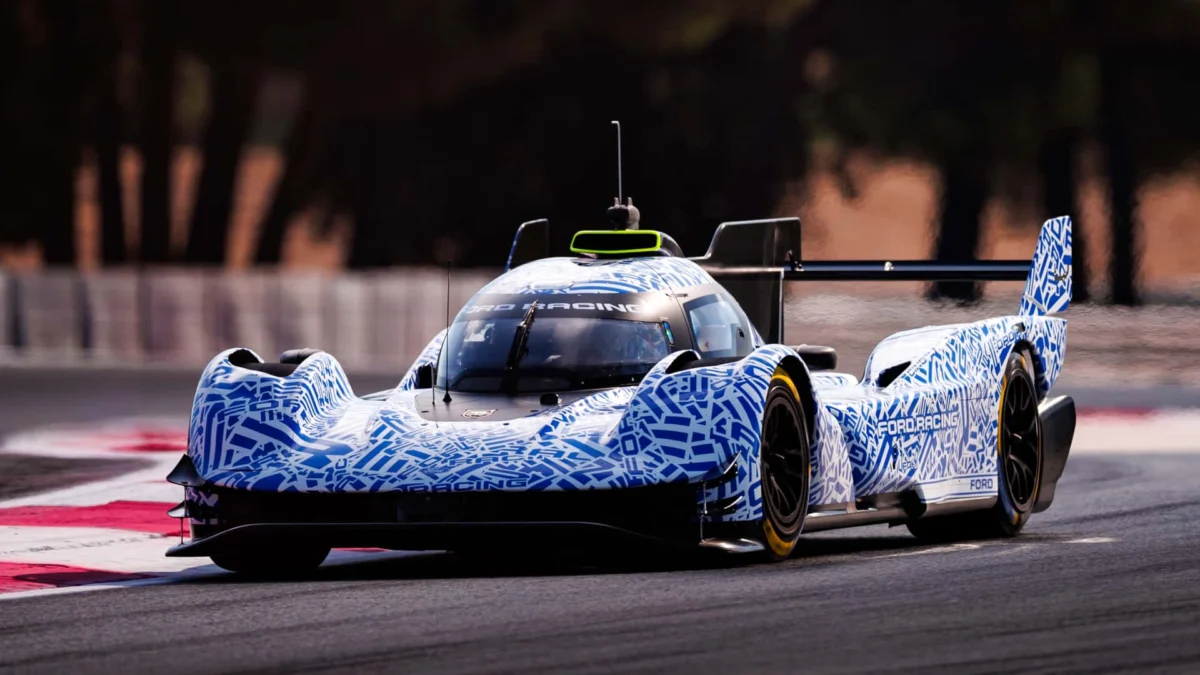
Beyond the engine, the physical form of the Ford Hypercar serves as a masterclass in modern aerodynamic philosophy. The bodywork is a study in controlled aggression. The nose of the car rises sharply to meet massive, sculpted front fenders, which house integrated venting systems designed to manage high-pressure airflow and maximize downforce.
The profile flows with a dramatic, tapered intensity toward the rear, meeting even larger, wide-body fenders that define the vehicle’s footprint. Even under the camouflage of a blue-and-white livery—a pattern designed to confuse the eyes of rival engineers during the testing phase—the car’s silhouette is unmistakably menacing. While this "camo" look is temporary, it highlights the technical complexity of the carbon-fiber chassis. Enthusiasts and industry insiders alike are already speculating on the final race livery, which is expected to honor Ford’s heritage while signaling a new technological frontier.
A Chronology of Development: From Concept to Track
The journey to this point has been a methodical, years-long effort by the Ford Performance arm.
- Initial Conception: The project began in the wake of Ford’s strategic pivot toward high-performance hybrid racing, identifying the WEC (World Endurance Championship) and IMSA platforms as the primary proving grounds for its electrification technology.
- The Powerplant Integration: Developing a 5.4-liter V8 capable of seamlessly integrating with a mandated hybrid system presented a massive engineering hurdle. Balancing thermal management, battery life, and the sheer torque output required careful simulation cycles before the first engine ignition.
- The "Fire Up" Milestone: Late 2024 marked the successful initial ignition of the engine, a moment that signified the transition from bench testing to vehicle assembly.
- Circuit Paul Ricard Debut: The recent testing in France represents the first time the complete package—chassis, suspension, aerodynamics, and hybrid powertrain—has operated as a cohesive, high-speed unit.
- The Path to 2027: The current phase involves a rotating roster of factory drivers who are providing critical feedback. This data will be used to calibrate the traction control, energy deployment, and braking systems ahead of the full-scale 2027 WEC campaign.
Supporting Data: Why LMDh?
The decision to enter the LMDh category is not merely a marketing choice; it is a strategic business maneuver. The LMDh regulations offer a cost-effective path to compete for overall wins at Le Mans while sharing a technical platform with the IMSA WeatherTech SportsCar Championship in North America.
| Feature | Specification/Detail |
|---|---|
| Engine Configuration | 5.4-Liter V8 Hybrid |
| Primary Testing Ground | Circuit Paul Ricard, France |
| Target Series | FIA WEC / IMSA |
| Aerodynamic Focus | High-downforce, integrated fender vents |
| Development Status | Active track testing / Driver calibration |
This dual-series approach allows Ford to maximize its return on investment. By racing in the United States and Europe simultaneously, the company can stress-test its hybrid systems across a wider variety of track surfaces, weather conditions, and regulatory environments, ensuring that the final iteration of the car is bulletproof by the time it lines up on the grid for the 2027 season.
Official Perspectives: The Business of Performance
Ford’s leadership has been vocal about the necessity of this project. In recent interviews, Ford CEO Jim Farley emphasized that the company’s racing division cannot function solely as a marketing arm. Instead, it must serve as an incubator for the next generation of performance engineering.
"We are not here to participate; we are here to push the boundaries of what a Ford powertrain can achieve," stated a spokesperson for the Ford Racing program. The team is currently balancing the need for rapid testing with the necessity of maintaining operational secrecy. As the development progresses, the team plans to move its base of operations back and forth between Europe and the United States, utilizing top-tier facilities to fine-tune the car’s handling characteristics.
Strategic Implications: What the Future Holds
The implications of this project reach far beyond the podium. For Ford, this is a "halo" project that informs the development of future production road cars. The hybrid systems being refined on the track today will, in some iteration, find their way into the high-performance vehicles consumers see in showrooms.
Furthermore, the 2027 WEC season represents a "looming date with destiny." By the time the lights go out for that first race, the competition—comprising heavyweights like Ferrari, Porsche, and Toyota—will have had years of experience in the current hypercar regulations. Ford’s advantage, however, lies in its ability to leverage the latest in software and material science. The team’s commitment to exhaustive testing, from the hills of France to the circuits of North America, demonstrates that they are leaving nothing to chance.
Conclusion
As the echoes of the 5.4-liter V8 continue to reverberate across the French countryside, one thing is clear: Ford is not playing a short game. The meticulous attention to aerodynamics, the strategic choice of a high-displacement engine, and the iterative testing process all point to a singular goal. The road to the 2027 WEC season is long, and the challenges will only grow in intensity, but the Ford Hypercar is already proving itself to be a formidable contender. For the Blue Oval, the race for glory hasn’t just begun—it is being engineered, one lap at a time.