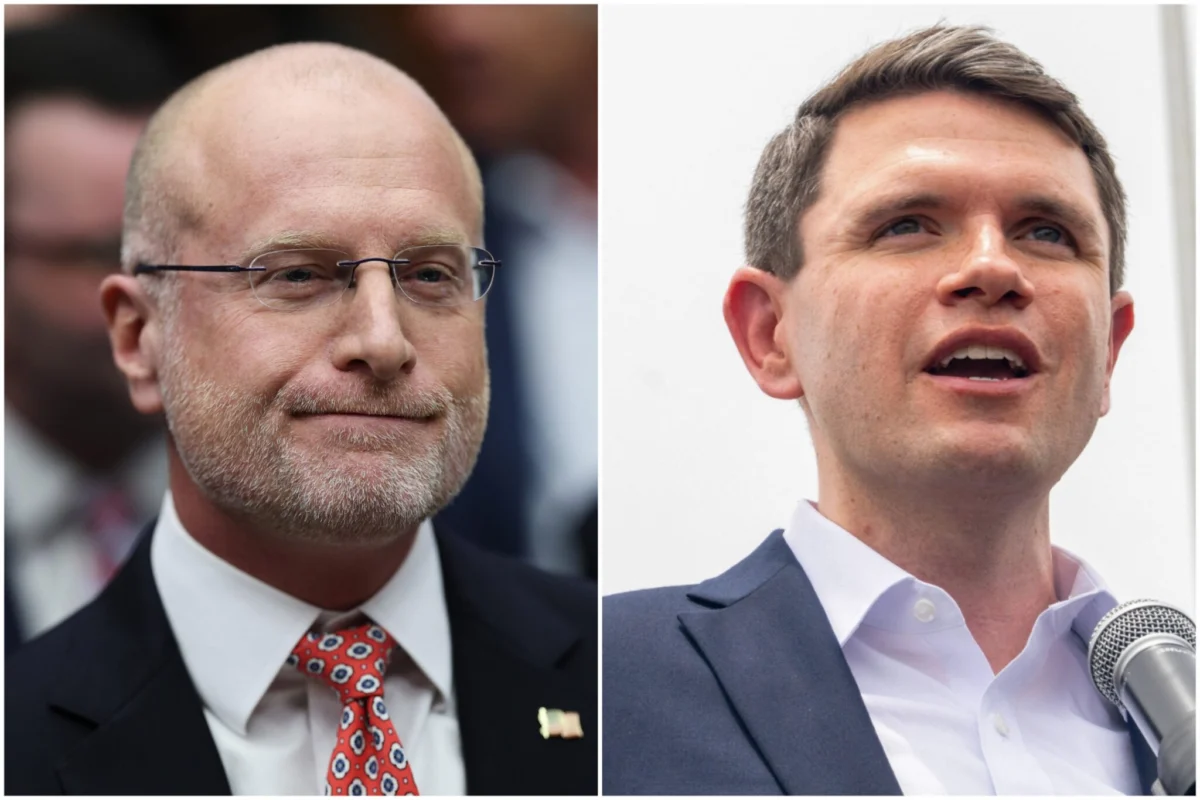
In a rapidly escalating confrontation between federal regulators and the nation’s broadcast giants, the Federal Communications Commission (FCC) has found itself at the center of a fierce national debate over political speech, media gatekeeping, and the interpretation of decades-old broadcast statutes. At the heart of this controversy is FCC Chairman Brendan Carr, who has launched a scathing critique of Texas Democratic U.S. Senate candidate James Talarico, labeling the candidate’s recent media strategies as a “hoax” designed to manufacture political theater.
The friction reached a fever pitch this week when ABC opted to move a high-profile interview between late-night host Jimmy Kimmel and Talarico exclusively to YouTube, bypassing broadcast television entirely. The move was a defensive maneuver, intended to insulate the network from potential regulatory penalties stemming from the FCC’s long-standing, yet increasingly contested, “equal-time” rule.
The Chronology of a Regulatory Standoff
The current dispute is not an isolated incident but rather the latest chapter in a broader regulatory push by Chairman Carr. The tension began to build earlier this year when Carr initiated a formal review into whether popular daytime talk shows, specifically ABC’s The View, should continue to enjoy exemptions from the equal-time rule.
The Colbert Precedent
The pattern of broadcasters exercising extreme caution began in February, when Stephen Colbert’s interview with James Talarico was pulled from the airwaves at CBS. While CBS officials later clarified that they did not explicitly ban the segment, they confirmed that they provided producers with “legal guidance” indicating that airing the interview could trigger the FCC’s equal-time obligations. This effectively chilled the interview’s broadcast path, setting a precedent that political candidates like Talarico could effectively be “de-platformed” from traditional network television due to legal risk-aversion.
The Kimmel-Talarico YouTube Pivot
On Wednesday, Jimmy Kimmel announced that his scheduled interview with Talarico would not air on television. Kimmel was blunt in his assessment of the decision, telling his audience, “The decision was made out of consideration for our local stations, especially our ABC affiliates in Texas who would have to deal with this nonsense.”
By moving the content to YouTube, the production team bypassed the FCC’s jurisdiction. The resulting video became a viral sensation, accumulating over 7.3 million views within its first 48 hours, highlighting a massive audience appetite for content that the traditional broadcast industry is increasingly wary of hosting.
The FCC’s Stance: Public Resource or Private Platform?
Chairman Brendan Carr, an appointee of President Donald Trump, has emerged as a staunch defender of the agency’s oversight authority. In a lengthy response posted to X (formerly Twitter) on Saturday, Carr pushed back against the narrative that the FCC is engaging in censorship.
The Argument for Regulatory Oversight
Carr’s defense rests on the unique legal status of broadcast spectrum. He argues that broadcasters are not merely private companies operating in a free market; they are the beneficiaries of government-granted licenses worth billions of dollars, providing them with a “government-sanctioned monopoly” on specific frequencies.
“The FCC gave them free licenses to use a public resource,” Carr stated. “If anyone else wants to use that same public resource for the purpose of expressing their own views, the government will not let them—it will eject anyone else that tries to use a broadcaster’s licensed spectrum.”
Carr maintains that the equal-time rule is fundamentally about “more speech, not less.” He contends that Congress implemented these rules specifically to prevent “media gatekeepers” from picking winners and losers in elections by granting preferential access to certain candidates while ignoring others. He further cited Supreme Court precedent, noting that holding broadcasters to their “public interest obligations” is not a violation of the First Amendment, but a condition of their license to operate.
The Candidate’s Perspective: Censorship or Campaign Strategy?
James Talarico has positioned himself as a victim of state-sponsored suppression, framing the FCC’s regulatory pressure as a dangerous encroachment on democratic discourse. During an appearance on MS NOW, Talarico declared, “Government censorship should be a concern to all of us, regardless of our political party.” He labeled the FCC’s focus on talk shows as the “most dangerous form of cancel culture.”
The “Hoax” Allegation
Chairman Carr has rejected Talarico’s claims, asserting that the candidate is leveraging the regulatory environment for personal gain. In his social media commentary, Carr accused Talarico of orchestrating a “hoax” to drive donations and media attention. He included a meme depicting Kimmel riding a bicycle with Talarico in a child carrier, suggesting that the host was being forced into a political stunt that would inevitably crash.
“He’s banking on people not understanding the statute or operating as partisan lemmings,” Carr wrote, dismissing the candidate’s claims of censorship as a calculated campaign maneuver.
The “College GameDay” Discrepancy
The debate took an ironic turn when an account representing University Democrats at UT Austin questioned the disparity in regulation, asking: “So I can’t watch Talarico on Kimmel but I have to watch Ted Cruz on GameDay?”
The question referenced Sen. Ted Cruz’s (R-Texas) recent 10-minute appearance on ESPN’s College GameDay, during which he advocated for the Protect College Sports Act. While the appearance drew audible boos from the crowd, it did not trigger an equal-time outcry.
Chairman Carr addressed this directly, highlighting a fundamental distinction in current U.S. law:
- Jurisdiction: The equal-time rule applies only to broadcast television stations. ESPN, as a cable network, does not operate under the same broadcast license requirements.
- Statutory Application: The law specifically governs “legally qualified candidates.”
- The Nature of the Medium: Carr reiterated that Congress explicitly drew a line between the regulated broadcast spectrum and the broader, deregulated cable and internet landscape, a distinction he argues is essential to maintaining the integrity of the law.
Broader Implications for Media and Democracy
The standoff between the FCC and late-night television raises significant questions about the future of political engagement in an era of digital transition.
The Decline of Broadcast Relevance
As the FCC doubles down on its oversight of traditional broadcast networks, the industry faces an existential crisis. If the regulatory burden for hosting political candidates on broadcast TV becomes too high, networks may cease political interviews entirely, further pushing the electorate toward unregulated digital platforms like YouTube, TikTok, and podcasting.
Critics of the current FCC approach argue that this creates a two-tiered system: a highly regulated, stagnant broadcast environment and a wild-west digital landscape. By forcing content like the Talarico-Kimmel interview off the air, the FCC may inadvertently be accelerating the decline of broadcast television as a primary source of political information.
The First Amendment Debate
While the Supreme Court has historically upheld the “public interest” requirements for broadcasters, the modern political climate is testing the boundaries of these rulings. Proponents of the FCC’s current direction argue that broadcasters have become too partisan, and that the equal-time rule is a necessary check on their power. Opponents, including many in the entertainment industry, argue that the rules are being weaponized to target specific viewpoints under the guise of neutrality.
As the 2026 political cycle intensifies, this conflict is unlikely to subside. The case of James Talarico and Jimmy Kimmel serves as a bellwether for a larger struggle: how to balance the government’s role in managing the limited public airwaves with the democratic imperative of open, uninhibited political discussion.
For now, the standoff remains unresolved. With the FCC continuing its review of broadcast exemptions and candidates increasingly seeking viral success through alternative digital channels, the airwaves remain a battleground—not just for votes, but for the very definition of what constitutes a "fair" media landscape in the 21st century.