The Diplomatic Blitz: A Desperate Search for De-escalation
In a week defined by frantic shuttle diplomacy, the Middle East stands at a precarious crossroads. Qatar’s Prime Minister and Foreign Minister, Sheikh Mohammed bin Abdulrahman Al Thani, arrived in Tehran this week for high-level talks, marking the latest attempt to break the cycle of violence and economic strangulation paralyzing the region. His visit follows a whirlwind of activity in the Iranian capital, which has recently played host to Oman’s top diplomat and senior Pakistani officials, all seeking a mechanism to end the ongoing conflict and restore the free flow of energy through the Strait of Hormuz.
The diplomatic urgency is palpable. Washington has escalated its campaign of "economic asphyxiation," threatening a new wave of sweeping secondary sanctions against any international bank, corporation, or state that continues to maintain commercial ties with Tehran. This backdrop of immense geopolitical pressure has left Iran’s leadership in a position where the survival of their domestic economy is inextricably linked to the resolution of the maritime standoff.
Chronology of a Conflict: From Diplomatic Promise to Naval Blockade
The current crisis is the culmination of months of deteriorating relations that shattered the fragile progress made earlier this year.
- April – June: Under the mediation of Qatar and Pakistan, Iran and the United States reached a breakthrough ceasefire and a comprehensive deal aimed at normalizing maritime passage and easing regional tensions.
- February 28: The fragile truce collapsed, and open warfare erupted between Iran and the United States.
- March – May: The conflict shifted to the Strait of Hormuz. Tehran asserted total control over the vital conduit, while the U.S. Navy implemented a rigorous naval counter-blockade, effectively cordoning off Iranian ports from global trade.
- Current Week: A flurry of regional diplomacy led by Qatar and Oman has sought to establish a "temporary corridor" for shipping, though progress remains hampered by deep-seated distrust and incompatible demands from both Tehran and Washington.
The Domestic Fallout: Petrol Shortages and Economic War
While the geopolitical implications of the Strait of Hormuz remain a global concern, the internal reality for Iranian citizens has become increasingly dire. On Wednesday, Vice President Mohammad Jafar Ghaempanah provided a stark assessment of the country’s fuel crisis.
"Petrol production is insufficient, and because of the US naval blockade, we cannot import it," Ghaempanah admitted in a report carried by the state-run IRNA news agency. For a nation that has historically boasted some of the cheapest fuel prices in the world due to heavy state subsidies, the current reality—long queues at petrol stations and the prospect of ration reviews—is a significant political liability.
The economic strain is being framed by Tehran’s leadership as an "all-out economic war." Mohammad Bagher Ghalibaf, Iran’s top negotiator, remains defiant in his rhetoric. "The country is in an all-out economic war," Ghalibaf stated. "We will see that the government… will defeat the enemy on this ground as well." Yet, for many analysts, this rhetoric masks a deeper vulnerability. The Iranian economy, already battered by decades of sanctions, chronic inflation, and a plummeting currency, is arguably less equipped to handle an "all-out" conflict today than at any point in the last twenty years.
The Hormuz Standoff: A Strategic Chokepoint
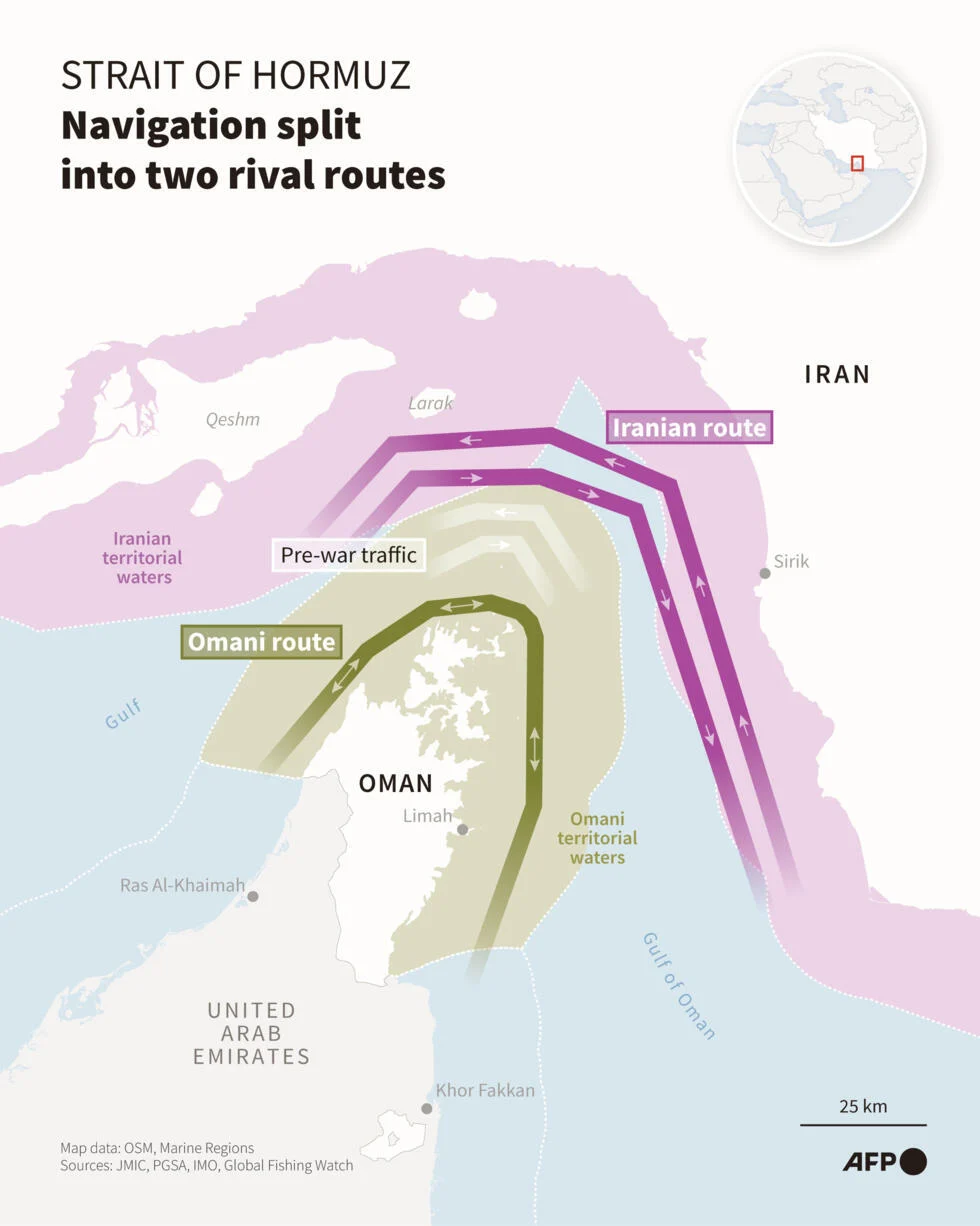
The Strait of Hormuz is not merely a geographic feature; it is the jugular vein of the global energy market. Since the onset of hostilities, the waterway has been transformed into a theater of kinetic conflict. Iran has mandated that all transiting vessels must secure "permission" to pass, a move that has effectively turned the maritime corridor into a controlled zone.
The Omani Framework
Iran has been engaged in intensive, quiet negotiations with Oman—a regional mediator with a long history of acting as a conduit between Tehran and the West. The proposed framework suggests the establishment of a "temporary corridor" for international shipping. Crucially, this agreement would involve clearing the mines that Tehran reportedly laid in the early days of the war.
According to sources within the Iranian Revolutionary Guards, the two nations have begun drafting terms regarding the division of the waters and the collection of management fees—a controversial point of contention. Tehran insists that if they are to manage the corridor, they are entitled to service fees, a proposal that has been met with vehement rejection from Washington and its regional allies.
The Ongoing Kinetic Risks
The volatility of the region was underscored this Thursday when the United Kingdom Maritime Trade Operations (UKMTO) reported that an "unknown projectile" had struck a tanker in the Strait. The resulting fire was extinguished, but the incident serves as a grim reminder that the waters remain a "grey zone" where one errant strike could trigger a broader, uncontrollable escalation.

Official Responses and Strategic Posturing
The diplomatic efforts led by Qatar have been framed as a pursuit of stability and adherence to international norms. Following his meeting with Iranian Foreign Minister Abbas Araghchi, Sheikh Mohammed bin Abdulrahman Al Thani emphasized the "necessity of respecting the sovereignty of neighbouring states and freedom of navigation."
However, Tehran’s position remains anchored in a list of non-negotiable demands. The Iranian leadership has explicitly stated that the strait will not be returned to normal operations unless Washington:
- Lifts the naval blockade of Iranian ports.
- Unfreezes Iranian financial assets currently held in foreign jurisdictions.
- Removes the oil sanctions that have gutted the country’s primary source of revenue.
Washington, for its part, has shown little appetite for these concessions. By framing the current strategy as "economic asphyxiation," the U.S. administration is betting that the cumulative pressure of the naval blockade and secondary sanctions will force a policy shift in Tehran.
Implications: A Global Energy Crisis in the Making
The implications of this standoff extend far beyond the borders of Iran and the Persian Gulf. As the world’s most significant energy transit point, any prolonged disruption to the Strait of Hormuz threatens to send global oil prices into a period of extreme volatility.
Economic Implications
For the global market, the "failed policies" mentioned by Iranian officials are perceived differently by international observers. The global economy is increasingly fragile; sustained high energy costs could act as a catalyst for a worldwide recession. Banks and shipping companies, terrified of running afoul of U.S. secondary sanctions, have already begun to reroute vessels, adding insurance costs and transit time to global supply chains.
Humanitarian and Geopolitical Implications
The humanitarian cost within Iran is mounting. As the government struggles to manage domestic fuel supply, the social contract between the Iranian leadership and its citizens is under unprecedented strain. Externally, the failure of previous agreements—specifically the collapse of the April ceasefire and June deal—has created a "diplomatic fatigue."
The mediation efforts by Qatar and Oman are essentially racing against time. If they fail to secure a framework that satisfies the basic security requirements of the U.S. and the economic survival requirements of Iran, the region faces the prospect of a long-term, low-intensity conflict that could permanently alter the geography of global trade.
Conclusion: The Path Ahead
As the world watches the diplomatic maneuvers in Tehran, the reality on the ground remains volatile. Qatar’s intervention represents the last, best hope for a negotiated settlement that avoids a total collapse of the maritime trade system. However, the chasm between Tehran’s demands for sovereignty and Washington’s demands for compliance remains wide.
The "economic war" declared by Tehran is hitting the average citizen harder than it is hitting the political apparatus. With the threat of wider secondary sanctions looming, the Iranian leadership is under immense pressure to find an exit strategy. Whether that exit strategy involves a compromise on the Strait of Hormuz or a doubling down on regional defiance will determine the fate of the Middle East in the coming months. For now, the ships continue to wait, the fuel lines continue to grow, and the world waits to see if diplomacy can prevail over the logic of the blockade.