By Editorial Staff
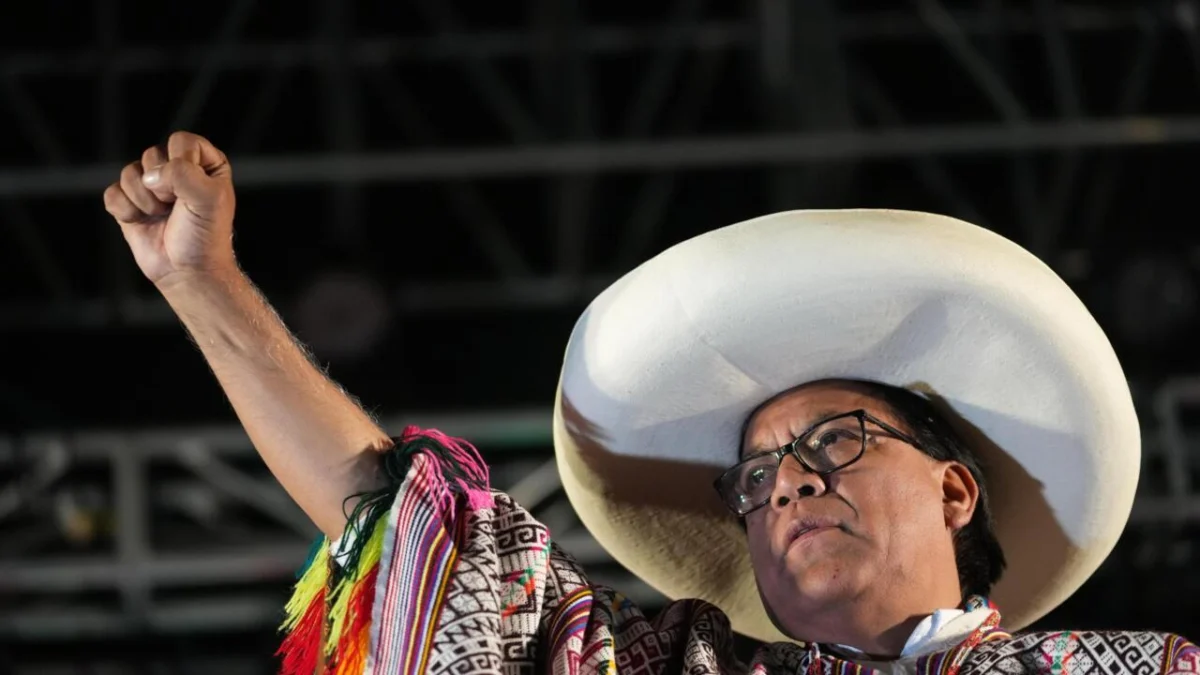
Peru, a nation already exhausted by a decade of unrelenting political turbulence, finds itself at a perilous crossroads. As the final ballots from Sunday’s presidential runoff are tallied, the country remains locked in a high-stakes standoff between two diametrically opposed candidates: conservative contender Keiko Fujimori and leftist challenger Roberto Sanchez. With the margin between the two separated by a razor-thin percentage, the electoral process has devolved into a battle of accusations, demands for recounts, and deep-seated societal division.
The Current Impasse: A Nation Split Down the Middle
As of Friday, electoral authorities have processed 98.27 percent of the ballots cast in the second round of voting. The results reveal a statistical dead heat that has plunged the Andean nation into uncertainty. Keiko Fujimori, the daughter of the polarizing former president Alberto Fujimori, holds a tenuous lead with 50.005 percent of the vote, while Roberto Sanchez trails marginally at 49.995 percent.
The tension reached a breaking point on Friday when Sanchez, in a televised press conference, called for a joint request to electoral authorities for an exhaustive recount. Citing alleged irregularities in Lima and among the diaspora voting abroad, Sanchez argued that the integrity of the democratic process could only be restored through full transparency.
"I propose that we jointly request an exhaustive review, a recount of the entire process, especially where there are alleged indications that transparency may not have been upheld as it should," Sanchez declared. The proposal comes as a direct response to aggressive maneuvers by the Fujimori camp, which has recently called for the annulment of votes from the southern regions—a stronghold for the leftist candidate.
A Chronology of the 2026 Electoral Cycle
The current crisis did not emerge in a vacuum; it is the culmination of a protracted electoral cycle marked by administrative sluggishness and public distrust.
- April 2026: The first round of voting takes place amidst significant voter apathy and widespread disillusionment with the political establishment. The count takes weeks, serving as a precursor to the logistical nightmares currently unfolding.
- Early June 2026: Peruvians head to the polls for the decisive runoff. Initial exit polls and early returns suggest a competitive race.
- Wednesday, June 2026: A pivotal shift occurs. As votes from abroad are tabulated—traditionally a demographic that leans toward conservative candidates—Keiko Fujimori overtakes Sanchez, securing the narrow lead she maintains to this day.
- Friday, June 2026: The formal demand for a recount is issued by Sanchez, citing systemic concerns and responding to the Fujimori party’s push to invalidate votes in the south.
- Present Day: Electoral authorities are engaged in the painstaking process of reviewing challenged and disputed tally sheets. Officials have indicated that a final, official declaration of the winner could take anywhere from two to three weeks.
Supporting Data: The Anatomy of a Tight Race
The volatility of this election is best understood through the demographic and geographic divide that defines modern Peru. Fujimori’s strength is concentrated in urban centers, particularly the capital, Lima, and among the expatriate community. Conversely, Sanchez, who enjoys the endorsement of jailed former president Pedro Castillo, draws his mandate from the rural south, where voters often feel disenfranchised by the political elite in the capital.
The statistical margin—a mere 0.01 percent difference—is effectively within the margin of error, rendering every single ballot, including those from remote mountainous regions and distant foreign consulates, a matter of national importance. The "snail’s pace" of the counting, while frustrating to the electorate, is a standard procedure in Peru meant to allow for the review of contested tally sheets. However, in the current hyper-partisan climate, these procedural safeguards are being interpreted by both sides as evidence of potential manipulation.
The Players: Legacy and Controversy
The two candidates embody the deep-seated ideological wounds of the Peruvian state.
Keiko Fujimori is making her fourth bid for the presidency. Her political identity is inextricably linked to her father, Alberto Fujimori, a figure who remains one of the most divisive in Latin American history. While he is credited by some for stabilizing the economy and defeating insurgency movements in the 1990s, his legacy is scarred by a documented history of human rights violations, for which he was imprisoned. Keiko’s campaign has struggled to detach itself from the "Fujimorista" brand, leading to the widespread "Fujimori never again!" protest movement that has filled the streets of Lima throughout the campaign.

Roberto Sanchez, on the other hand, represents a populist left that seeks to overhaul the neoliberal structures that have governed Peru for decades. His backing by Pedro Castillo—who was removed from office and imprisoned after an abortive attempt to dissolve Congress in 2022—adds a layer of instability to his candidacy. Critics view Sanchez as an extension of the failed Castillo administration, while his supporters view him as the only viable path to genuine social reform in a country plagued by inequality.
Official Responses and the Institutional Vacuum
The National Office of Electoral Processes (ONPE) and the National Jury of Elections (JNE) are currently under immense pressure. Their challenge is not merely administrative but existential. With a Congress that remains fragmented and lacking a clear majority for either candidate to enact meaningful reform, whoever emerges victorious will inherit a poisoned chalice.
Official responses have been measured, with authorities emphasizing that every challenge to a tally sheet will be processed in accordance with the law. However, they have acknowledged that the process is significantly more complex than in previous years, given the high number of challenged sheets and the heightened stakes of the race.
Implications: A Fragile Future for Peruvian Democracy
The implications of this election reach far beyond the presidency. Peru has seen nine presidents in the last decade, a revolving door of leadership that has stunted economic growth, eroded public trust in institutions, and fueled social unrest.
The Governance Gap
The primary concern for international observers is the "governance gap." Even if a winner is eventually certified, the margin of victory is so thin that the new president will lack a clear mandate. Without a strong majority in Congress, the winner will likely face immediate legislative gridlock, potential impeachment threats, or a repeat of the street protests that have characterized recent years.
The Risk of Civil Unrest
The request for a recount, while a legitimate legal mechanism, carries the risk of further radicalizing the base of both candidates. If the losing side refuses to accept the final tally—a scenario that has become increasingly common in global politics—the result could be prolonged civil instability. The streets of Lima have already seen "Fujimori never again!" demonstrations; a loss for Sanchez could trigger similar, perhaps more violent, responses in the southern provinces.
The Economic Toll
Financial markets in Lima are watching the standoff with trepidation. Political uncertainty is a known deterrent to foreign investment, and the prospect of a weeks-long wait for a declared leader threatens to stifle economic recovery in a post-pandemic environment. Investors are particularly wary of the policy shifts threatened by both the extreme right and the populist left.
Conclusion
As the sun sets over Lima, the air remains thick with tension. The recount request submitted by Roberto Sanchez is not just a plea for electoral accuracy; it is a symptom of a systemic failure to bridge the deep ideological chasms that divide the Peruvian people. Whether the electoral authorities can deliver a result that is both transparent and accepted by the population remains the single most critical question for the nation.
Until the final vote is counted and the results are certified, Peru remains in a state of suspended animation. The "snail’s pace" of the democracy is testing the patience of its citizens and the durability of its institutions. For the sake of the country’s stability, the coming weeks will require a level of statesmanship that has been largely absent from the campaign trail thus far. The world is watching to see if Peru can navigate this transition, or if it is destined to continue its cycle of institutional collapse and political instability.