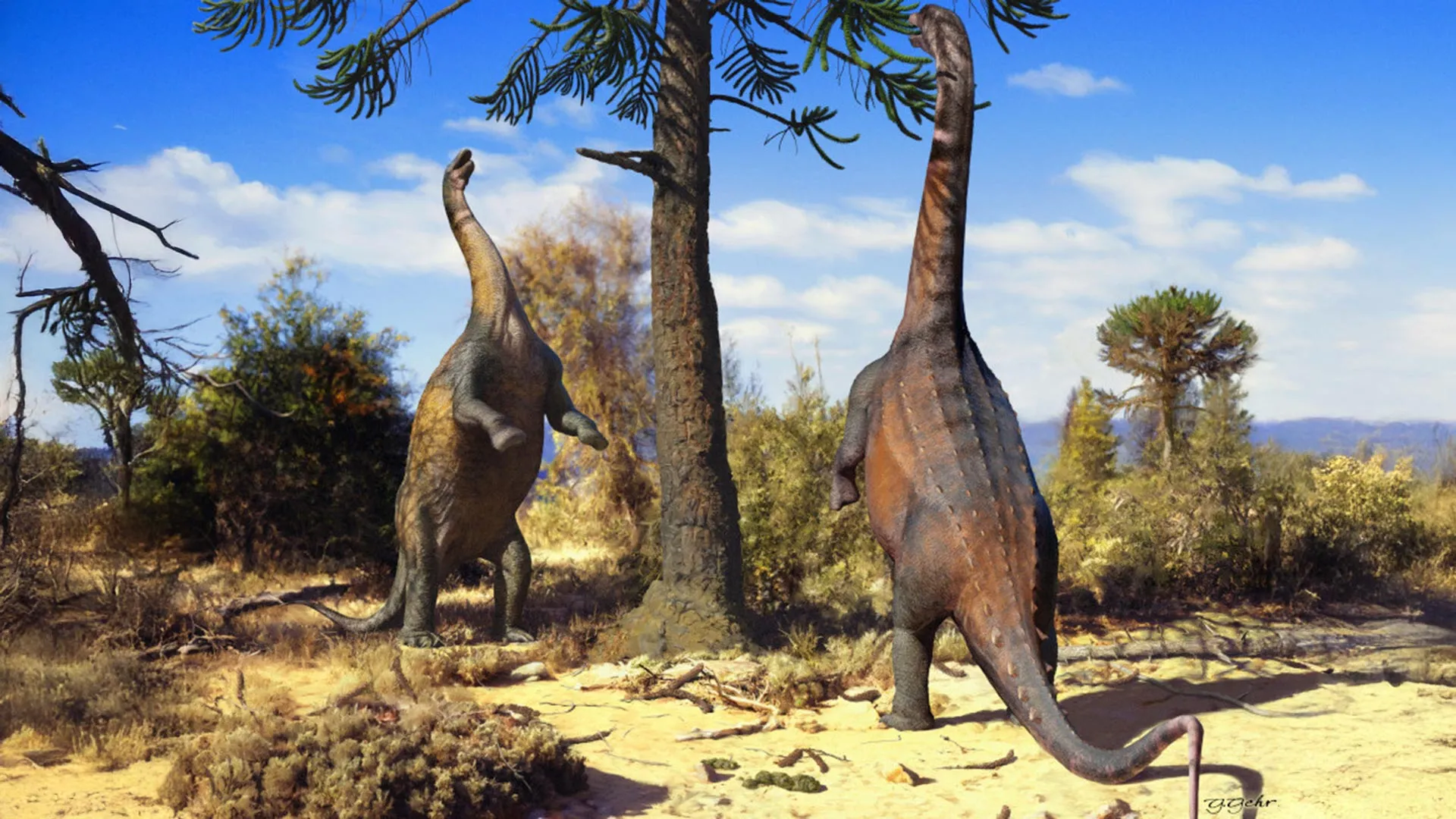
For decades, the image of the sauropod—the iconic long-necked, long-tailed dinosaur—has been one of slow, lumbering stability. We have long pictured these gargantuan creatures as permanent quadrupeds, their four pillar-like legs firmly planted on the earth as they grazed across the Late Cretaceous landscape. However, groundbreaking new research suggests that this picture of sedentary, four-legged giants may be incomplete.
A team of international researchers, supported by the São Paulo Research Foundation (FAPESP), has revealed that some sauropods were far more capable of bipedalism—standing on their hind legs—than previously believed. By applying sophisticated engineering simulations to fossilized remains, scientists have determined that certain species could rear up to forage, defend themselves, or attract mates with surprising ease, a trait that likely evolved as a functional advantage during their youth.
The Mechanics of Magnitude: Main Facts
The study, published in the journal Palaeontology, focuses on two specific South American species: the Brazilian Uberabatitan ribeiroi and the Argentinian Neuquensaurus australis. Both lived roughly 66 million years ago, near the very end of the Age of Dinosaurs.
While these species were significant in size—comparable to modern elephants—they were relatively modest when measured against the true titans of the sauropod lineage, such as the colossal Argentinosaurus. The research indicates that the ability to transition into a tripodal stance (supported by two hind legs and the tail) was a trait tied intimately to the dinosaur’s developmental stage. Younger, smaller sauropods possessed a skeletal architecture that facilitated upright standing, while their adult counterparts likely found the maneuver physically taxing, if not altogether prohibitive, due to the sheer mechanical strain on their femurs.
A Journey Through Time: Chronology of the Study
The investigation into dinosaur biomechanics represents a marriage of two disparate fields: paleontology and civil engineering. The project, led by postdoctoral researcher Julian Silva Júnior of the School of Engineering of São Paulo State University (FEIS-UNESP), began with a simple question: How does a massive, biological structure handle the forces of gravity when shifted from a horizontal to a vertical orientation?
The team’s research timeline unfolded as follows:
- Data Acquisition: Scientists sourced high-resolution digital reconstructions of femoral bones from seven distinct sauropod species housed in natural history museums across the globe. These specimens were selected to provide a wide cross-section of evolutionary history and anatomical variation.
- Computational Modeling: Utilizing finite element analysis (FEA)—a methodology typically reserved for testing the structural integrity of bridges and skyscrapers—the researchers broke down the digital bones into thousands of minute sections to measure stress distribution.
- Simulation Phase: The team conducted two distinct simulations. The first, an "extrinsic" analysis, measured the stress caused by the dinosaur’s own weight and gravity on the femur during an upright stance. The second, an "intrinsic" analysis, calculated the force exerted by the massive muscles attached to the bone.
- Synthesis and Comparison: By combining these datasets, the researchers were able to create a comparative map of stress levels, identifying which species could handle the "tripodal" load and which were structurally limited by their own mass.
Engineering the Past: Supporting Data and Methodology
The methodology relies on the premise that bones, much like steel beams in a bridge, are subject to the laws of stress and strain. Finite element analysis (FEA) is the gold standard for predicting failure points in materials, and applying it to dinosaur anatomy provides a quantitative rigor that fossil observation alone cannot achieve.
"Using this technique, we performed two simulations," explains Julian Silva Júnior. "One dealt with the extrinsic scenario—the force coming from outside to inside, namely gravity and body weight. In the other, we analyzed the intrinsic scenario—the force that the muscles would exert on the femur."
The findings revealed that the Uberabatitan and Neuquensaurus possessed uniquely robust femurs. Their bones were thicker and more structurally dense, allowing them to dissipate the immense stress of a two-legged stance far more effectively than their larger cousins. In contrast, while larger sauropods possessed more powerful muscles, the exponential increase in their body mass rendered their bones less capable of sustaining an upright position for extended periods. As the researchers noted, it wasn’t that the giants couldn’t stand, but rather that the energetic and physical cost was likely too high for the action to be anything more than a fleeting necessity.
Expert Perspectives: Official Responses
The research team, which includes experts from Brazil, Germany, and Argentina, emphasized the importance of using engineering tools to decode biological behavior. The study, conducted during Silva Júnior’s internship at the University of Tübingen with FAPESP funding, highlights the shift toward multidisciplinary approaches in evolutionary biology.
"Smaller sauropods like these had a bone and muscle structure that allowed them to stand more easily and for longer on their two hind legs," Silva Júnior summarizes. "Larger ones were probably also able to stand, but for a shorter time and with less comfort, since the position caused a lot of stress on the femur."
The study does include a critical caveat: the absence of soft tissue in the fossil record. Because the models could not account for cartilage—the flexible, shock-absorbing tissue found in joints—the team assumed a consistent baseline of cartilaginous support across all species. While this means the resulting measurements are comparative rather than absolute, the researchers maintain that the validity of the relative differences between the species remains robust. By comparing lineages, the team has successfully constructed a reliable window into the behavioral patterns of these ancient animals.
The Evolutionary "Why": Implications of Upright Stance
The ability to stand upright was not merely a mechanical curiosity; it was a significant evolutionary advantage. For a plant-eating sauropod, the world was a resource-rich environment where height equated to survival.
Foraging and Nutrition
The most immediate benefit of a bipedal stance was reach. By rising onto their hind legs, these sauropods could access the lush, untouched vegetation in the upper canopy of trees, bypassing the competitive grazing occurring at ground level. This access to high-nutrient foliage may have been a critical survival strategy for younger animals who needed rapid growth.
Reproduction and Display
Beyond nutrition, the upright stance likely served as a tool for social signaling. Paleontologists theorize that the ability to rear up could be used for visual displays, allowing males to assert dominance or attract mates. Furthermore, the mechanics of reproduction in such large animals are notoriously difficult; a tripodal stance may have been a necessary physical adjustment for mating rituals.
Defense and Survival
Finally, the "tripodal" pose—where the tail serves as a third, stabilizing point of contact—would have significantly altered the dinosaur’s profile. By lifting their forelimbs, these creatures would appear vastly larger, a potent deterrent against the predators that shared their habitat.
Conclusion: A New Understanding of Sauropod Life
This research fundamentally alters our perception of the sauropods. By viewing them not as rigid, permanent quadrupeds but as animals capable of dynamic, weight-shifting movement, we gain a deeper appreciation for their versatility. As the young Uberabatitan or Neuquensaurus moved through the forests of the Late Cretaceous, they were not restricted to the ground. They were, in their own way, masters of their vertical environment, using the sophisticated engineering of their own skeletons to claim their place in a competitive world. The work of the Brazilian-German-Argentine team serves as a testament to how far modern science can reach back in time, turning fossilized bone into a vivid portrait of living, moving, and thriving creatures.