RIYADH, Saudi Arabia — In what marks the deadliest assault on a Gulf Arab nation since the inception of the current conflict involving Iran and its regional proxies, a missile strike targeted King Khalid International Airport in Riyadh on Saturday. Civil aviation authorities confirmed early Sunday that the attack claimed the lives of at least 12 individuals and left more than 300 others injured. The strike, which hit a critical domestic flight hub, has sent shockwaves through global energy markets and prompted a sharp re-evaluation of security protocols for international airlines operating in the Middle East.
The incident underscores a dramatic surge in hostilities between the Iran-backed Houthi rebels in Yemen and the Saudi-led coalition. As the conflict’s fronts expand, the targeting of civilian infrastructure has transitioned from a peripheral threat to a central component of the Houthi military strategy, raising urgent questions about the efficacy of Saudi Arabia’s missile defense shield and the potential for direct United States military intervention.
I. Main Facts: A Mass Casualty Event at the Kingdom’s Gateway
The attack occurred during the busy Saturday afternoon period, a time when King Khalid International Airport (RUH) typically handles a high volume of domestic and regional traffic. According to a statement released by the Saudi General Authority of Civil Aviation (GACA), the missile struck a complex housing Terminals 3 and 4, which are primarily dedicated to domestic operations.
The human cost of the strike is unprecedented for the Saudi capital. Among the 12 deceased, the victims represent a diverse cross-section of the international workforce and local population:
- Four Saudi citizens
- Two Bangladeshi nationals
- One American citizen
- One Palestinian national
- One Egyptian national
- One Jordanian national
- One Syrian national
- One Sudanese national
Medical sources in Riyadh report that of the 300 injured, several remains in critical condition, with trauma units across the city working at full capacity. The Saudi government has not yet officially assigned blame, though the tactical nature of the strike and the recent history of cross-border fire point toward the Houthi movement in Yemen.
II. Chronology: A Week of Escalating Fire
The Saturday afternoon strike was not an isolated incident but rather the bloody climax of a week-long aerial campaign targeting the Kingdom’s infrastructure.
The Prelude: A Surge in Hostilities
The escalation began in earnest following a major military offensive launched by the Saudi-led coalition against Houthi positions in Yemen earlier this week. This offensive was designed to reclaim territory along Yemen’s Red Sea coast—a strategic vantage point that allows the rebels to monitor and disrupt international shipping.
Mid-Week Volleys
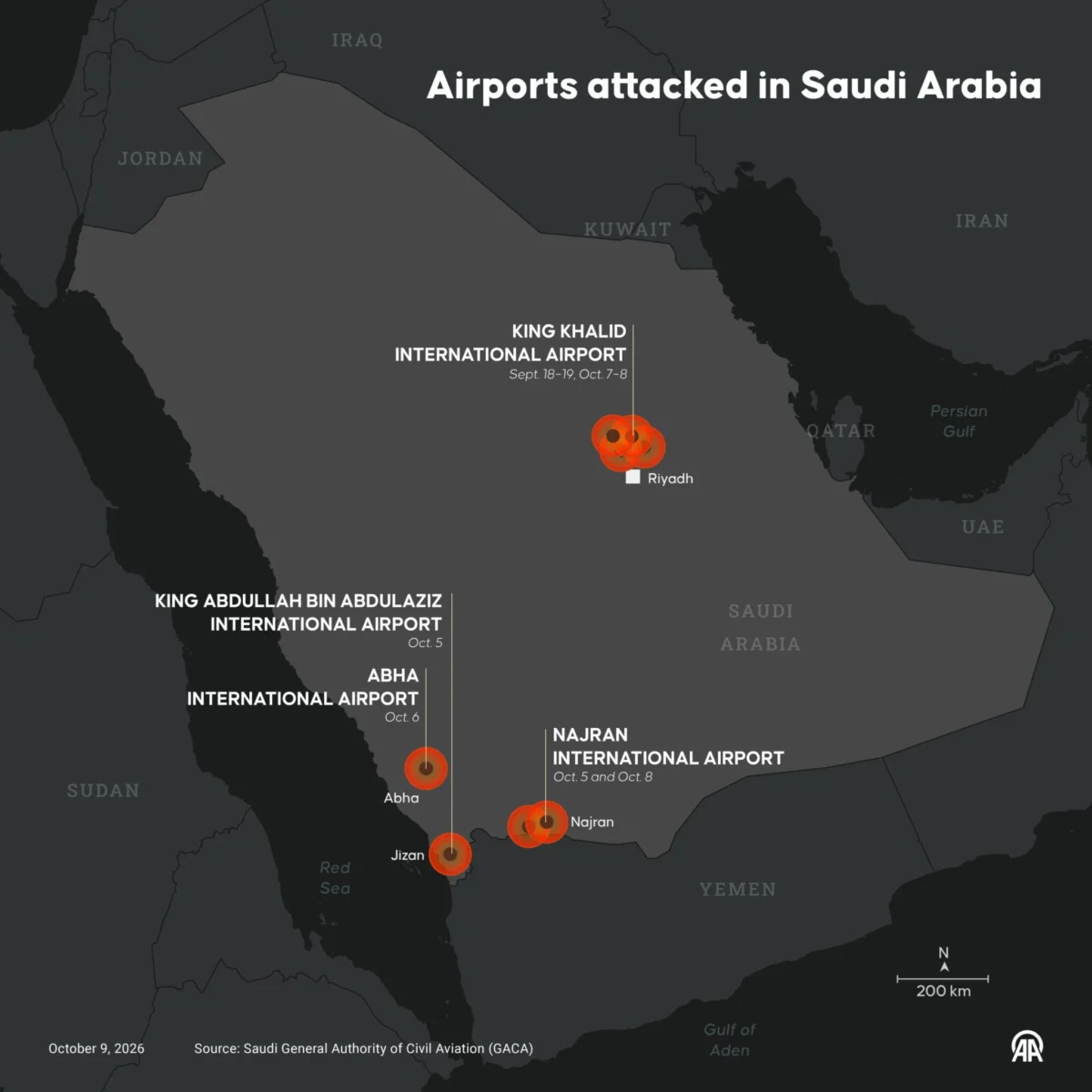
Prior to the Saturday disaster, King Khalid International Airport had already been targeted several times within the last seven days. Those previous incursions resulted in the deaths of four people and caused minor damage to the airfield. On Thursday, two regional officials confirmed that Houthi-launched projectiles damaged three aircraft on the tarmac, including one belonging to the Saudi national carrier.
The Saturday Strike
- 14:00 – 16:00 (Local Time): Reports emerged of a massive explosion at the airport. A missile successfully bypassed or overwhelmed local defenses, striking the Terminal 3 and 4 complex.
- Late Saturday Afternoon: President Donald Trump, briefed on the situation, indicated that the U.S. is considering direct strikes against Houthi targets.
- Saturday Evening: The Saudi-led coalition reported additional attacks, including a projectile landing near King Fahd International Airport in Dammam and the interception of a ballistic missile over Al-Kharj, southeast of Riyadh.
- Sunday Morning: Civil aviation authorities officially raised the death toll to 12 and confirmed the suspension of all operations at Riyadh’s primary airport.
III. Supporting Data: Defense Deficits and Aviation Risks
The success of the Saturday strike has highlighted a growing vulnerability in the Kingdom’s multi-billion-dollar defense apparatus. For years, Saudi Arabia has relied heavily on the U.S.-made Patriot missile defense system. However, the sheer volume of Houthi drone and missile attacks has begun to deplete the Kingdom’s stockpiles.
The Interceptor Crisis
Regional officials have indicated that Saudi Arabia is "running low" on missile interceptors. The sustained nature of the "war of attrition" waged by the Houthis has forced Riyadh to look beyond Washington for support. Recent diplomatic overtures have been made to France, Britain, Pakistan, and Egypt, requesting the deployment of supplementary air defense systems to protect the Kingdom’s urban centers and oil facilities.
Impact on Global Aviation
The European Union Aviation Safety Agency (EASA) recently expanded its safety guidance for Saudi airspace, citing the Houthis’ demonstrated ability to strike deep into Saudi territory. The EASA warned that the frequent use of missiles and drones, coupled with intense interception efforts, creates a "high risk of misidentification" of civilian aircraft.
Major international carriers had already begun pulling back before Saturday’s tragedy:
- Lufthansa Group, Air India, and FlyDubai suspended various routes to Riyadh earlier in the week.
- Flightradar24 data showed dozens of flights being diverted to neighboring hubs in Jeddah, Dammam, and Dubai immediately following the Saturday blast.
- Airport Status: As of Sunday morning, the airport remains under a heavy police cordon, with lights dimmed and all entrances blocked to the public.
IV. Official Responses: Rhetoric and Diplomacy
The reaction from the international community has been a mixture of condemnation, tactical evaluation, and cautious diplomacy.
The United States’ Stance
Speaking from Washington, President Donald Trump signaled a potential shift in American involvement. "We may [join Saudi strikes]. We’re going to look at it," Trump told reporters. He emphasized the speed of U.S. military decision-making, suggesting that a retaliatory campaign could be imminent if the Houthi threat to U.S. citizens and global stability persists.
The Saudi Strategy
Despite the carnage, the Saudi government has attempted to project an image of resilience. Hours after the attack, the Ministry of Energy continued to promote a high-profile international energy conference scheduled to begin in Riyadh on Sunday. This move is seen by analysts as an effort to reassure global markets that the Kingdom remains "open for business," despite the obvious security failures.
On the diplomatic front, Saudi Foreign Minister Prince Faisal bin Farhan spoke with his Omani counterpart to discuss "de-escalating tensions." Oman has historically served as a bridge between the Saudi-led coalition and the Houthi leadership, as well as their backers in Tehran.
The Houthi Position
While the rebels have not yet issued a formal claim of responsibility for the Saturday strike—a delay that is common as they assess the impact of their operations—they did issue a "final warning" to global airlines earlier in the week. The Houthi leadership described Saudi airspace as a "theater of military operations," warning that any civilian aircraft operating within it does so at its own risk.
V. Implications: Security, Oil, and the Path Forward
The strike on King Khalid International Airport represents more than just a tragic loss of life; it signifies a shift in the gravity of the regional conflict.
Geopolitical Destabilization
The expansion of the "Iran war" to include consistent, successful strikes on Gulf capitals suggests that the deterrence strategies employed by the Saudi-led coalition and its Western allies are failing. The Houthis’ ability to monitor and threaten the Red Sea shipping corridors—a vital alternative to the Strait of Hormuz—gives them significant leverage over global trade. If the rebels continue to strike civil infrastructure with impunity, the pressure on the U.S. to enter the conflict directly may become irresistible.
Economic Volatility
As the world’s top oil exporter, any threat to Saudi Arabia’s internal stability immediately impacts global crude prices. While oil infrastructure was not hit in this specific Saturday attack, the proximity of the intercepted missile in Al-Kharj (an area with significant military and industrial presence) keeps the market on edge. The psychological impact of a major international airport being paralyzed by a missile strike cannot be understated in terms of investor confidence.
Legal and Social Control
Domestically, the Saudi government has moved to tighten control over information. Following the attack, authorities reminded the public that filming or sharing footage of missile impact sites or the activities of air defense units is a criminal offense. This "information blockade" is intended to prevent the Houthis from gaining "battlefield damage assessment" through social media, but it also reflects the government’s sensitivity regarding the visibility of its defensive gaps.
Conclusion
As Riyadh mourns the 12 victims of Saturday’s strike, the region stands at a precarious crossroads. The transition of the Yemen conflict into a broader, more lethal regional war has reached the gates of the Saudi capital. With the U.S. weighing military intervention and the Kingdom’s air defenses under unprecedented strain, the coming days will determine whether the Middle East can find a diplomatic off-ramp or if it is headed toward a wider, more catastrophic conflagration.