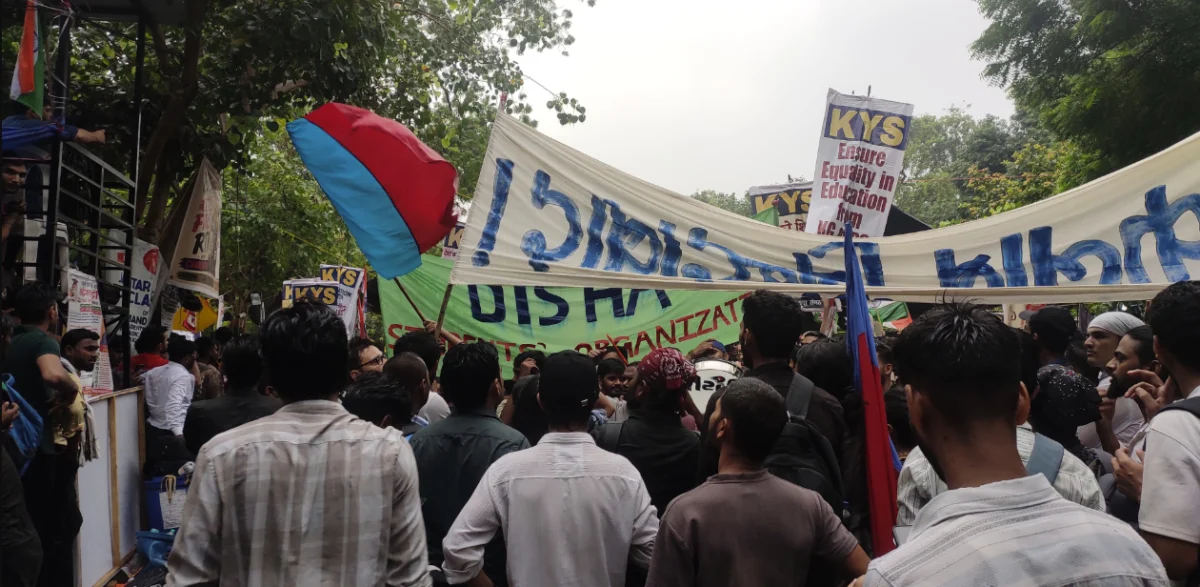
NEW DELHI – The national capital of India is bracing for a tense October 10 as authorities implement unprecedented security measures to stifle large-scale protests demanding the resignation of Chief Election Commissioner (CEC) Gyanesh Kumar. The capital has been transformed into a virtual fortress, with the Delhi Police deploying restrictive measures that have effectively brought the city’s movement to a grinding halt, sparking a significant legal and human rights showdown.
The protests, spearheaded by the Cockroach Janta Party (CJP), various student unions including the All India Students’ Association (AISA), and a coalition of opposition parties, are centered on allegations of systemic manipulation within the Election Commission’s Special Intensive Revision (SIR) of electoral rolls.
The Core Grievance: Allegations of Electoral Roll Manipulation
The current unrest is rooted in a deep-seated distrust of the electoral process that began escalating in 2025. Demonstrators claim that the SIR exercise—intended to clean and update voter lists—has been weaponized to disenfranchise millions of citizens.
Protesters allege that over 130 million voters have been systematically removed from the electoral rolls since 2025. According to the CJP and associated activists, the irregularities in the SIR process are not merely administrative errors but targeted interventions. The specific grievances include:
- Mass Deletion: The arbitrary removal of genuine, verified voters from the lists.
- Classification Errors: Systematic misclassification of citizens, rendering their documentation invalid.
- Document Tampering: Alleged alterations to critical registration documents, specifically Form 6, which is used for the inclusion of names in the electoral roll.
For the protesters, these actions represent an existential threat to the democratic process. They argue that CEC Gyanesh Kumar bears ultimate responsibility for these "irregularities," and his immediate resignation is a non-negotiable demand to restore the integrity of India’s electoral institutions.
Chronology of the Crisis
- October 2, 2026: The protest movement gains momentum at Jantar Mantar. Approximately 700 demonstrators, including prominent student leaders, are detained by police, setting the stage for a broader confrontation.
- October 8, 2026: Reports emerge of pre-emptive detentions. Activists and student union members are intercepted while attempting to enter Delhi; others are placed under house arrest.
- October 9, 2026: Delhi Police initiate a series of restrictive measures, including the tracking of grocery apps, coordination with cab aggregators to block access to Lutyens’ Delhi, and the announcement of a total liquor ban until Sunday.
- October 9, 2026, 10:00 PM: A mobile internet shutdown is enforced in a 4-kilometer radius around the Janpath-Kartavya Path crossing.
- October 10, 2026: The scheduled date for the mass protest.
A City Under Siege: The Police Response
The Delhi Police’s approach to the October 10 demonstrations has been characterized by observers as a "lockdown-style" containment strategy. Beyond the standard deployment of paramilitary forces, the police have extended their reach into the digital and private sectors of the city.
In a move that has drawn widespread criticism, the police have coordinated with major service providers to isolate the protest zones. Ola and Uber have been instructed to limit movement toward the city’s power centers in Lutyens’ Delhi. Furthermore, bulk food and grocery delivery applications are being monitored, and hotels have been explicitly instructed to deny reservations, presumably to prevent protesters from finding accommodation.
The Excise Department’s order to shut down liquor stores, citing "public order," is viewed by many as an attempt to create an atmosphere of austerity and control, rather than a genuine security necessity.
The most controversial element of the security response is the mobile internet blackout. Enforced without an official published order—relying instead on reports from wire services—the shutdown covers a critical 4-kilometer radius. Critics argue this violates the guidelines established by the Supreme Court in the 2020 Anuradha Bhasin v. Union of India case, which mandates that internet shutdowns must be temporary, necessary, and proportionate.
Judicial Intervention: "Using a Hammer to Kill a Fly"
The scale of the security measures led to a flurry of legal petitions before the Supreme Court. After the Delhi High Court declined an urgent hearing regarding the closure of metro stations and the suspension of long-distance train services, senior advocates escalated the matter to the Supreme Court.
The bench, during the hearing, expressed strong disapproval of the state’s heavy-handed tactics. Addressing the government’s arguments for total restriction, the Court noted: "If you want to restrict unruly movement, you can do so. But that does not mean you can bring everything to a halt and leave people without any transport facility. Everybody does not have a car."
In a partial victory for the protesters and the general public, the Supreme Court ordered the Centre to ensure that train services and the Delhi Metro remain operational. The bench delivered a sharp rebuke to the authorities, stating that restrictions must be "proportionate and minimal," explicitly warning the government that they cannot "use a hammer to kill a fly." The Court also suggested that the Centre must designate an alternate, accessible location for peaceful protests, acknowledging that Jantar Mantar may not be sufficient for the scale of the current agitation.
Implications for Democracy and Civil Liberties
The situation in Delhi has transcended a local protest; it has become a focal point for the broader debate on the state of Indian democracy. Organizations such as Amnesty International India have voiced significant concern over the government’s reaction.
Aakar Patel, Chair of the Board at Amnesty International India, stated, "Peaceful protesters must be able to demand accountability from those in power without facing intimidation, arbitrary detention, or sweeping restrictions on their freedoms."
The Legality of the Internet Shutdown
The mobile internet blackout, in particular, has drawn sharp condemnation from digital rights groups. By failing to publish an official order and bypassing the transparency requirements set out in the Telecommunication (Temporary Suspension of Services) Rules, 2024, the authorities have been accused of acting outside the rule of law. The Internet Freedom Foundation and other bodies have characterized the move as "patently illegal," arguing that it sets a dangerous precedent for the state to use administrative silence to avoid legal scrutiny.
The Erosion of the Right to Protest
The proactive detention of student leaders and the "interception" of individuals traveling to the capital suggest a shift in policing tactics. Rather than managing protests on the ground, the state is increasingly focusing on preventing the formation of large groups before they can congregate.
As the capital enters the peak of the October 10 protests, the conflict highlights a fundamental tension: the government’s mandate to maintain public order versus the citizens’ constitutional right to dissent and hold constitutional bodies, like the Election Commission, accountable. With the Supreme Court having stepped in to limit the most extreme forms of the lockdown, the focus now shifts to how the authorities manage the protesters on the ground—and whether the grievances regarding the integrity of India’s electoral rolls will receive the substantive response the demonstrators are demanding.