Introduction: A New Chapter in Paleontology
For over a century, the La Brea Tar Pits have captivated the public imagination with visions of colossal Columbian mammoths, predatory saber-toothed cats, and lumbering dire wolves. These iconic megafauna have long dominated the narrative of Ice Age Los Angeles. However, a groundbreaking discovery recently pulled from the dust-covered archives of the museum suggests that the true story of the Pleistocene may be found not in the massive bones of predators, but in the delicate, overlooked skeletons of creatures no larger than a human palm.
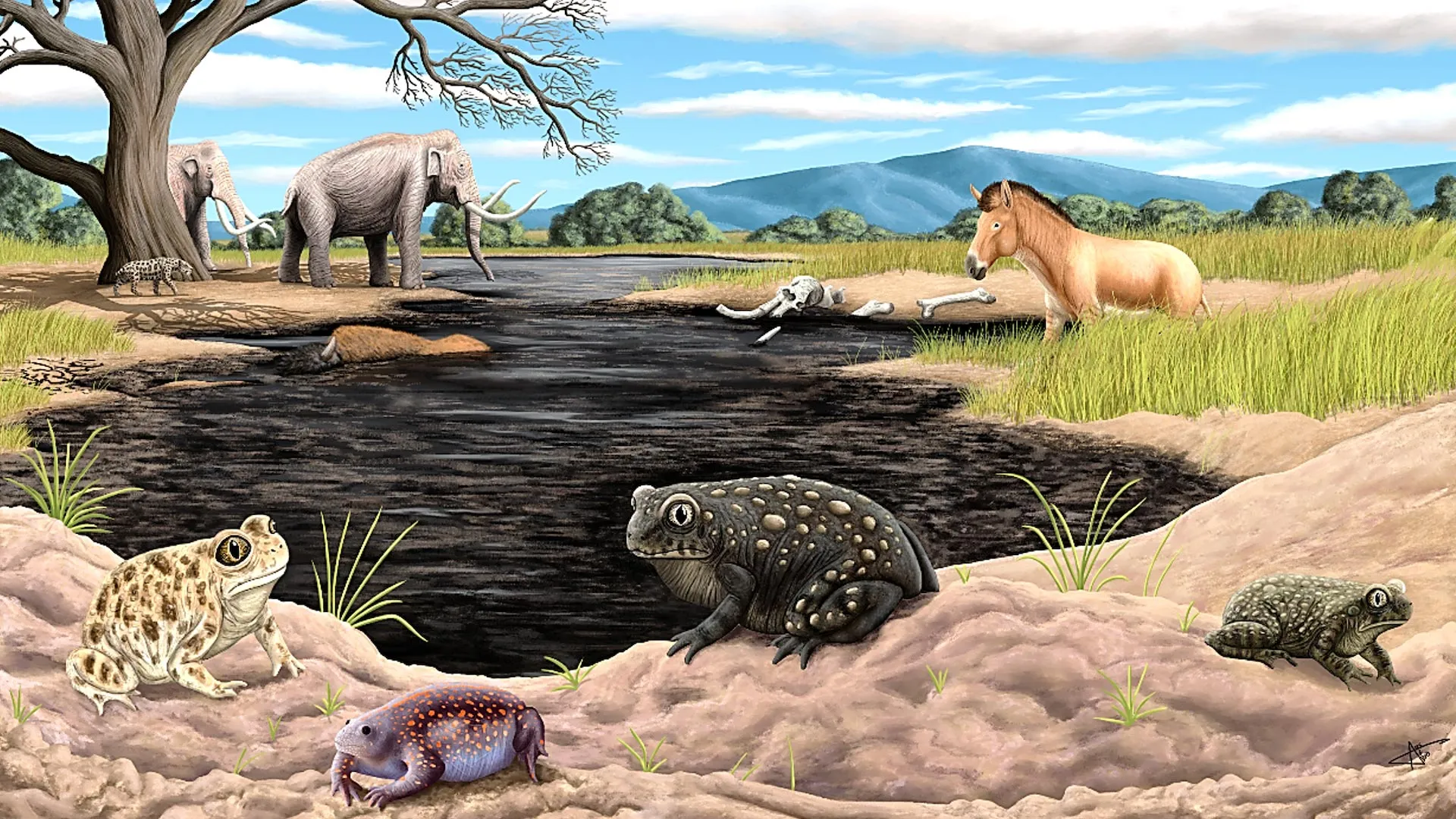
Researchers at the La Brea Tar Pits have officially identified a previously unknown amphibian species, Spea labreae, a type of spadefoot toad that thrived in the Los Angeles basin during the Pleistocene epoch. This discovery marks a historic milestone: it is the first new extinct amphibian species ever described from the world-famous La Brea fossil site. While the toad’s size pales in comparison to the predators that once roamed the area, its scientific significance is monumental, offering a high-resolution lens through which researchers can view the dramatic environmental shifts that defined the end of the last Ice Age.
Chronology: The Journey from 1950s Storage to Scientific Stardom
The path to identifying Spea labreae was not a high-octane excavation on the front lines of the Tar Pits, but rather a methodical, intellectual detective story. The fossils themselves had been sitting in the museum’s collection since the 1950s, largely ignored as researchers focused on the more charismatic megafauna.
The journey began when Dr. Alberto Cruz, then a Postdoctoral Fellow at the Tar Pits and currently a researcher for Mexico’s Centro de Investigación Paleontológica Quinametzin (CIPAQ), began a deep dive into the museum’s understudied reptile and amphibian archives. Unlike the celebrated mammal pits, these smaller specimens had not undergone a comprehensive taxonomic review in nearly three decades.
"I’m really more of a paleoecologist, a paleogeographer, not a taxonomist," Dr. Cruz admitted. Yet, as he meticulously cataloged the bones, he noticed morphological discrepancies that didn’t align with any known spadefoot toad species. Initially, he entertained the possibility of paleopathology—the idea that these specimens were simply deformed due to injury or illness. To verify his hypothesis, Dr. Cruz embarked on an exhaustive comparative study. He examined the La Brea fossils alongside 80 modern specimens housed in the Herpetology Collections at the Natural History Museum of Los Angeles County and the Museum of Vertebrate Zoology at the University of California, Berkeley.
After months of rigorous "reviewing and re-reviewing," the evidence became undeniable. The unique structural characteristics of the fossilized bones were consistent and distinct, signaling a brand-new species. His findings were recently published in the Journal of Vertebrate Paleontology, cementing Spea labreae into the scientific record.
Supporting Data: The Fragility of the Fossil Record
The discovery of Spea labreae is exceptionally rare, making it a "unicorn" in the world of paleontology. To date, only one other extinct Pleistocene amphibian has been identified in North America: a tree frog discovered in the fossil deposits of Florida.
The scarcity of these finds is not due to a lack of prehistoric amphibians, but rather the extreme fragility of their anatomy. Amphibians possess delicate, cartilaginous skeletons that rarely survive the process of fossilization. In most geological settings, these bones dissolve or are crushed long before they can be preserved. The La Brea Tar Pits, with their unique asphaltic preservation, provide a rare exception, yet even here, these tiny remains are often overlooked or damaged during excavation.
Dr. Cruz’s research suggests that for every species discovered, there are likely many more that have been lost to the ravages of time. "The same fragility may also mean that many extinct reptiles and amphibians have disappeared from the fossil record entirely," Cruz notes. The survival of S. labreae is a stroke of scientific fortune, providing a rare window into a lost ecological niche.
Official Responses: Re-evaluating Museum Archives
The discovery has sent ripples of excitement through the paleontology community, specifically at the Samuel Oschin Global Center for Ice Age Research. The museum is currently undergoing a historic transformation, and this find serves as a poignant reminder that museums are living entities, not just static repositories of the past.
Dr. Emily Lindsey, Curator and Excavation Site Director at the Samuel Oschin Global Center, views the discovery as a testament to the untapped potential of museum collections. "It’s a great example of how we’re still finding new things at La Brea Tar Pits, even after a century of ongoing excavation and research," says Dr. Lindsey. "There’s definitely more to come."
The discovery highlights a shift in modern paleontology: the transition from "heroic" fossil hunting to the meticulous re-examination of legacy collections. As Dr. Cruz put it, "This material is originally from the 1950s, but when you study it again, you can find gold in these specimens. It’s very cool."
Implications: A Climate Proxy for the Future
Beyond the taxonomy of a single toad, the presence of Spea labreae provides critical data on the ancient climate of Los Angeles. Amphibians are notoriously sensitive to their environment; they do not travel long distances and are highly reactive to changes in temperature, humidity, and vegetation. This makes them ideal "climate proxies."
By mapping the distribution of these amphibians, researchers can effectively reconstruct the local climate of the Pleistocene. Dr. Cruz emphasizes this point: "If you change the environment, you change the vegetation, the climate is warmer or colder, it affects these animals directly."
Furthermore, the research yielded an additional, unexpected surprise: the identification of the first known record of the Mexican burrowing toad (Rhinophrynus) in the southwestern United States. Today, the nearest populations of this species reside nearly 2,500 kilometers away in southern Mexico. The fact that this toad once lived in Los Angeles confirms that the regional environment during the Pleistocene was vastly different from the climate we experience today.
Conclusion: Lessons for a Warming World
The extinction of Spea labreae and the migration of the Mexican burrowing toad offer a cautionary tale about the volatility of ecosystems. As the last Ice Age waned, the rapid, large-scale climate shifts triggered a collapse in biodiversity that forced species to either adapt, migrate, or face extinction.
By examining how these tiny, sensitive creatures responded to the warming climate of the late Pleistocene, scientists hope to gain valuable insights into how modern species might react to human-caused climate change. The tiny toad, once buried in the tar and forgotten for seventy years, has emerged as an unlikely mentor. Spea labreae does more than populate the pages of history; it stands as a sentinel of environmental change, urging modern researchers to look closer at the small, fragile things, for they are often the first to feel the tremors of a changing world.
As the Samuel Oschin Global Center continues its modernization, the legacy of the Tar Pits is expanding. No longer just a graveyard for the giants of the Ice Age, the site is proving to be a treasure trove of ecological data, proving that even in the deepest, thickest tar, the most important lessons are often the ones we’ve yet to uncover.