Introduction: A Ghost Emerges from the Deep
For over a century, the goblin shark (Mitsukurina owstoni) has existed in the human imagination as a nightmare of the deep—a “living fossil” with a protruding, prehensile jaw and a haunting, translucent appearance. Until recently, our understanding of this enigmatic predator was derived almost exclusively from the tragic, accidental bycatch of commercial fishing operations. These specimens, hauled up from the crushing pressures of the abyss to the surface, rarely survived long enough to offer more than a fleeting, dying glimpse into their existence.
However, a groundbreaking study led by researchers at the University of Hawaiʻi at Mānoa has fundamentally altered our understanding of this species. By documenting live, thriving goblin sharks in their natural deep-sea environments, scientists have finally pulled back the veil on one of the ocean’s most mysterious residents. Published in the Journal of Fish Biology, this research does more than just provide rare footage; it shatters previous assumptions regarding the shark’s geographic range and vertical limits, signaling a new era in deep-sea exploration.
The Chronology of Discovery: From Archives to the Tonga Trench
The path to this discovery was not a single, lightning-strike moment, but rather the result of a two-pronged effort involving modern technological collaboration and meticulous archival research.
The 2019 Kingman Reef Encounter
The journey toward this milestone began in 2025, when Aaron Judah, a doctoral candidate at the University of Hawaiʻi at Mānoa’s Department of Oceanography, engaged in a professional dialogue with colleagues at the Deep-Sea Animal Research Center (DARC). The discussion turned to a 2019 expedition conducted by the Ocean Exploration Trust aboard the E/V Nautilus. That mission had ventured into the Pacific Remote Islands Marine National Monument, specifically exploring the deep-sea ecosystems surrounding Kingman Reef, Palmyra Atoll, and Jarvis Island.
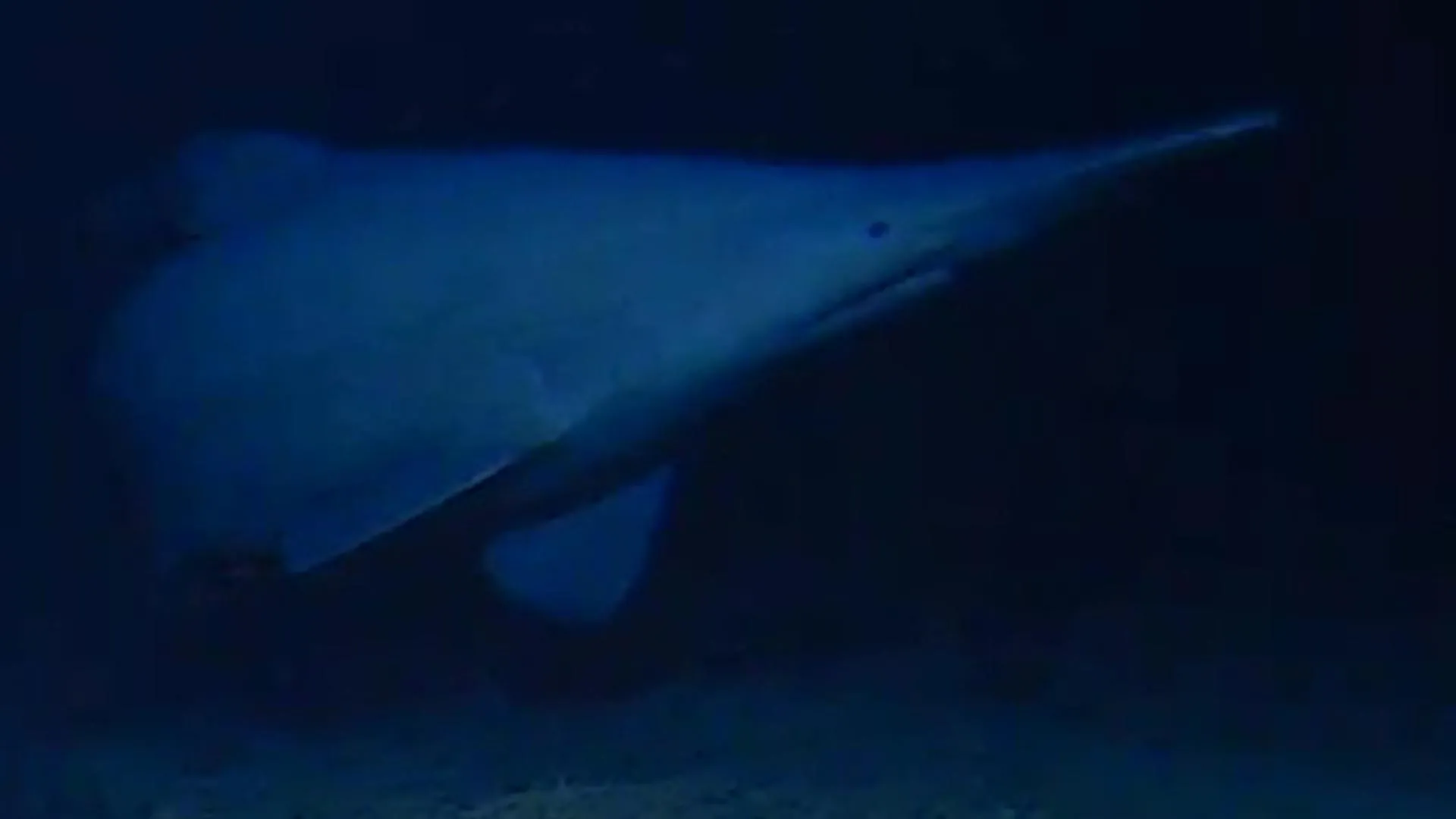
During that expedition, the remotely operated vehicle (ROV) Hercules had recorded hundreds of hours of high-definition video. While reviewing archived footage, Judah identified a biological anomaly: a shark exhibiting the unmistakable physiological traits of a goblin shark, gliding near an unnamed seamount northwest of Jarvis Island. The discovery was shocking, as there had been no prior record of the species inhabiting the Central Pacific.
The 2024 Tonga Trench Confirmation
While the 2019 footage provided the initial spark, the second, definitive piece of the puzzle arrived in 2024. During an expedition to the Tonga Trench aboard the R/V Dagon—led by the Minderoo-UWA Deep-Sea Research Center—scientists deployed a specialized baited camera mounted on a bottom lander.
The device, designed to withstand the extreme conditions of the hadal zone, captured rare, high-resolution footage of a healthy goblin shark swimming freely. This second observation served as the crucial empirical validation needed to confirm that these creatures were not mere outliers, but a stable population inhabiting the vast, unexplored reaches of the Pacific.
Supporting Data: Rewriting the Biology of a Living Fossil
The goblin shark is a member of the order Lamniformes, a group that includes the great white, the mako, and the basking shark. However, while its cousins are often the subjects of intense global study, the goblin shark—the sole surviving member of the Mitsukurinidae family, which dates back approximately 125 million years—has remained a "phantom" of the fossil record.
A Record-Breaking Depth
Perhaps the most significant scientific takeaway from the new data is the vertical range of the species. The specimen observed along the slope of the Tonga Trench was found at a depth nearly 700 meters deeper than any previously recorded instance.
This observation is not merely a record for Mitsukurina owstoni; it establishes a new depth benchmark for the entire order of Lamniformes. This finding challenges existing physiological models, forcing marine biologists to reconsider how these large, complex predators manage metabolic processes and prey acquisition in the nutrient-poor, high-pressure environments of the deep ocean.
Geographic Expansion
Before these discoveries, the goblin shark’s known habitat was confined to a fragmented range: coastal waters off Japan, Australia, and the western United States, with sporadic, unconfirmed reports in the Atlantic and Indian Oceans. The addition of the Central Pacific to this map represents a massive expansion of the species’ known range, suggesting that the goblin shark is far more cosmopolitan than previously theorized.
Official Responses: The Academic Perspective
The scientific community has reacted to these findings with a mix of professional rigor and genuine awe. For researchers like Aaron Judah, the discovery highlights the persistence required in marine science.
"Seeing the most iconic of all the deep-sea sharks alive and looking healthy in its natural habitat is a unique honor," said Judah. "I was also very surprised about how deep this species was found. The observation from the slope of the Tonga Trench is nearly 700 meters deeper than this species was known to live."
Professor Alan Jamieson, founding director of the Minderoo-UWA Deep-Sea Research Center and co-author of the study, shared this sentiment. "The Goblin Shark is one of these deep-sea charismatic animals that I never thought we’d see alive," Jamieson noted. "To do so was amazing, but to then learn that colleagues in Hawaiʻi also saw one was just incredible."
The collaboration between the University of Hawaiʻi at Mānoa and the Minderoo-UWA team underscores the importance of inter-institutional data sharing. By pooling archival ROV footage with modern lander technology, the researchers were able to synthesize a more comprehensive view of deep-sea life than either group could have achieved in isolation.
Implications: The Vitality of Natural History
In an era increasingly dominated by high-tech predictive modeling and algorithmic data analysis, the discovery of the goblin shark serves as a timely reminder of the necessity of traditional natural history—the hands-on, observational bedrock of biological science.
Biodiversity and Management
The implications of this discovery extend beyond academic curiosity into the realm of environmental policy. When a species is unknown in a specific region, it is excluded from biodiversity lists and regional management plans. By confirming the presence of the goblin shark in the Central Pacific, scientists have provided the necessary evidence for nations to include the species in their conservation frameworks.
"New discoveries like this demonstrate that there is still so much to explore in our deep ocean home," Judah stated. "Given the newly-expanded geographic range of the goblin shark, this species can be included in regional management and a nation’s biodiversity list, whereas, beforehand we didn’t know it was even there!"
The Future of Deep-Sea Research
The discovery of these sharks serves as a microcosm for the state of our planet’s oceans. If a creature as large and distinctive as the goblin shark has gone unnoticed in these regions for so long, it suggests that the true extent of deep-sea biodiversity remains significantly underestimated.
As climate change and deep-sea mining interests threaten to disrupt these fragile, lightless ecosystems, the need for baseline data becomes paramount. The work conducted by Judah, Jamieson, and their colleagues provides a template for future expeditions: look closer at the archives, deploy more sensors, and never assume that the absence of evidence is evidence of absence.
The "living fossil" has finally been seen on its own terms, not as a victim of a fishing net, but as a master of the deep. It is a reminder that the ocean remains the final, greatest frontier on Earth, and that its most iconic inhabitants are still waiting to be truly understood.