By Scientific Correspondent
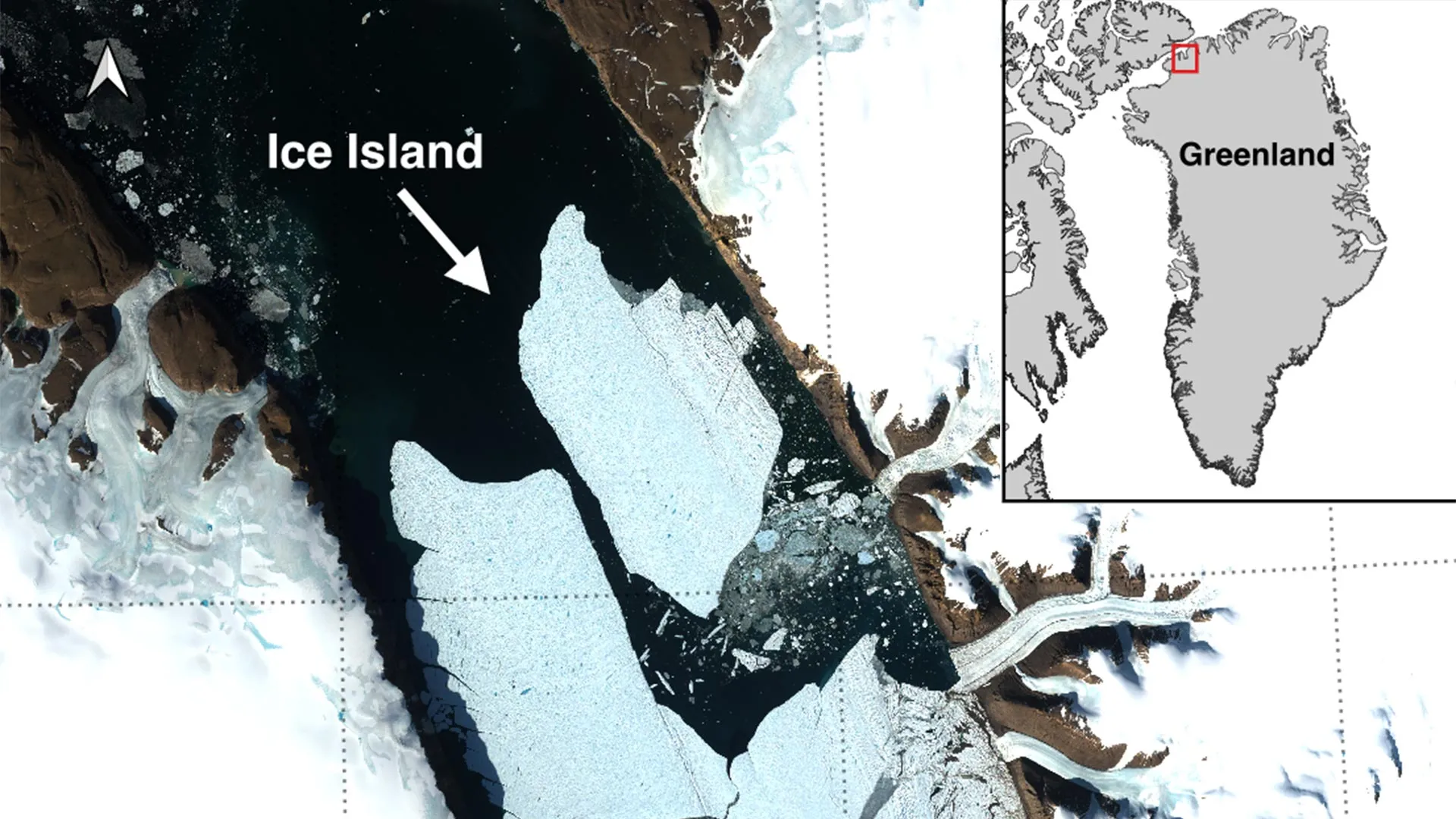
In a dramatic demonstration of the accelerating changes occurring at the top of the world, a colossal slab of ice—measuring 76.4 square kilometers—has sheared away from the Petermann Glacier in northwest Greenland. This monumental event, confirmed on August 4, 2026, marks the most significant loss of floating ice from the glacier since 2012 and stands as the largest Arctic calving event observed in the last six years.
The separation of this massive tabular iceberg, an ice island roughly the size of Manhattan, provides a rare, high-definition look at the structural degradation of the Arctic’s remaining ice tongues. As international research teams scramble to document the trajectory and disintegration of the island, the event serves as a stark reminder of the mounting pressures on Greenland’s cryosphere.
The Anatomy of the Event: A Chronology of a Glacier in Retreat
The rupture of the Petermann Glacier was not a sudden accident, but the culmination of years of meticulously documented structural decay. For researchers, the calving was the expected, albeit sobering, conclusion to a long-term observational study.
Years of Measured Instability
Since 2019, an international consortium of glaciologists—led by the University of Ottawa and including partners from the University of Stirling, Environment and Climate Change Canada (ECCC), Lancaster University, and the University of Leeds—has kept a virtual watch over Petermann. Using high-resolution satellite imagery, the team tracked the expansion of fractures across the glacier’s floating ice tongue.
The ice tongue, a massive extension of the glacier that pushes out over the ocean, had been showing visible signs of fatigue. Satellite monitoring revealed that these fractures were not merely superficial; they were deep-seated rifts that were progressively destabilizing the integrity of the ice mass.
The Final Break: August 3–4, 2026
The final act of the detachment began in early August. Data provided by the European Space Agency’s (ESA) Sentinel-1 mission—a workhorse of polar monitoring—captured clear evidence of structural failure along the centerline of the ice tongue on August 3. The stress, built up over half a decade, finally overcame the resistance of the ice. By 20:00 UTC on August 4, the eastern section of the ice tongue had fully liberated itself from the mainland glacier, drifting away as a massive, flat-topped island of ice, potentially reaching 150 meters in thickness.
Supporting Data: By the Numbers
The scale of this calving event is staggering, yet it is only a precursor to what researchers believe will be a significant reduction in the glacier’s footprint.
- Current Loss: 76.4 km² (The size of Manhattan).
- Historical Context: The largest Arctic calving since 2020 and the largest for Petermann since 2012.
- Impending Calvings: Researchers have identified two additional large rifts that are currently propagating through the tongue. These sections are estimated to measure 94 km² and 84 km², respectively.
- Cumulative Impact: Should these two predicted sections detach, the combined loss would strip approximately 254 km² from the Petermann ice tongue—an estimated 22 percent reduction of its current floating mass.
The significance of these figures lies in the nature of the ice. Unlike the smaller, jagged bergs typically seen in the North Atlantic, these are tabular ice islands. They are thick, stable, and possess a flat, plate-like geometry that allows them to persist for years, drifting through the Arctic waters and slowly shedding mass as they encounter warmer currents.
Polar Perspectives: Why the Arctic Matters
While the Southern Ocean surrounding Antarctica is known for its frequent, massive tabular iceberg production, such events are an anomaly in the Arctic. This rarity is exactly why the Petermann event is being studied with such intensity by the global glaciology community.
The "Transferable Knowledge" Hypothesis
Dr. Anna Crawford, a lead researcher from the University of Stirling, emphasizes that the mechanisms governing Arctic ice islands remain under-studied compared to their Antarctic counterparts.
"While large, tabular icebergs are relatively common in the Southern Ocean that surrounds the Antarctic Ice Sheet, Arctic ice islands are far rarer," Dr. Crawford explains. "By studying Arctic ice islands, we will gain knowledge that can be transferred across Polar regions. We are essentially watching a natural laboratory in real-time, observing how these massive ice masses develop, how they move through the ocean, and the complex thermodynamic processes that eventually lead to their fragmentation."
This research is critical for refining climate models. As Arctic temperatures rise at a rate significantly faster than the global average, the structural integrity of glaciers like Petermann becomes a bellwether for the health of the entire North Polar region.
Implications: Hazards to Navigation and Infrastructure
The departure of a 76-square-kilometer ice island is not merely a scientific curiosity; it is a significant maritime concern. As the Arctic continues to open due to declining sea ice, shipping lanes and resource exploration sites are increasingly encroaching on territory where these massive ice masses drift.
The Long-Term Maritime Risk
Dr. Abigail Dalton of the Canadian Ice Service (ECCC) underscores the logistical dangers posed by these drifting islands. "These are thick blocks of ice that can drift for years," says Dr. Dalton. "The primary risk is not just the initial size of the island, but its eventual lifecycle. Over time, they fracture into smaller, harder-to-track pieces that pose significant hazards to vessels and resource operations in the North."
The Canadian Ice Service has stepped up its monitoring efforts, tracking the island’s drift to provide safety data to the international shipping community. Because these islands can survive for years, they act as long-term hazards, moving unpredictably with ocean currents and winds, potentially entering shipping corridors long after the original calving event has left the news cycle.
Future Outlook: A Changing Landscape
Adam Garbo, the PhD candidate from uOttawa’s Department of Geography, Environment and Geomatics who first identified the event, remains at the center of the ongoing surveillance. For Garbo and his collaborators, the work is only beginning.
"Petermann Glacier has long been one of Greenland’s largest remaining ice tongues," Garbo states. "We’ve anticipated this break for years, and seeing it finally happen is remarkable, but our focus is now on the aftermath. We are looking at aerial observations, satellite tracking, and oceanographic data to determine what triggered this specific failure point."
The team’s ongoing effort is part of a broader, interdisciplinary project aimed at understanding the complex feedback loops between climate change, ocean warming, and the calving of Arctic ice shelves. The data collected from this specific ice island will be integrated into the global understanding of glacier retreat, helping scientists predict not just if a glacier will collapse, but when and how.
As the world looks toward the Arctic, the message from Petermann Glacier is clear: the ice is responding to a warming world in profound and lasting ways. The 76.4 km² island currently drifting away from Greenland is a physical testament to the ongoing transformation of our planet’s polar regions. Whether this is a signal of a new, more rapid phase of retreat remains to be seen, but for the researchers at the University of Ottawa and their partners, the data is unambiguous: the Arctic is in a state of rapid and irrevocable change.
Moving forward, the international team plans to continue their longitudinal study, ensuring that every fracture and every drift pattern is documented, providing the world with the best possible data to navigate a rapidly warming and increasingly ice-mobile Arctic.