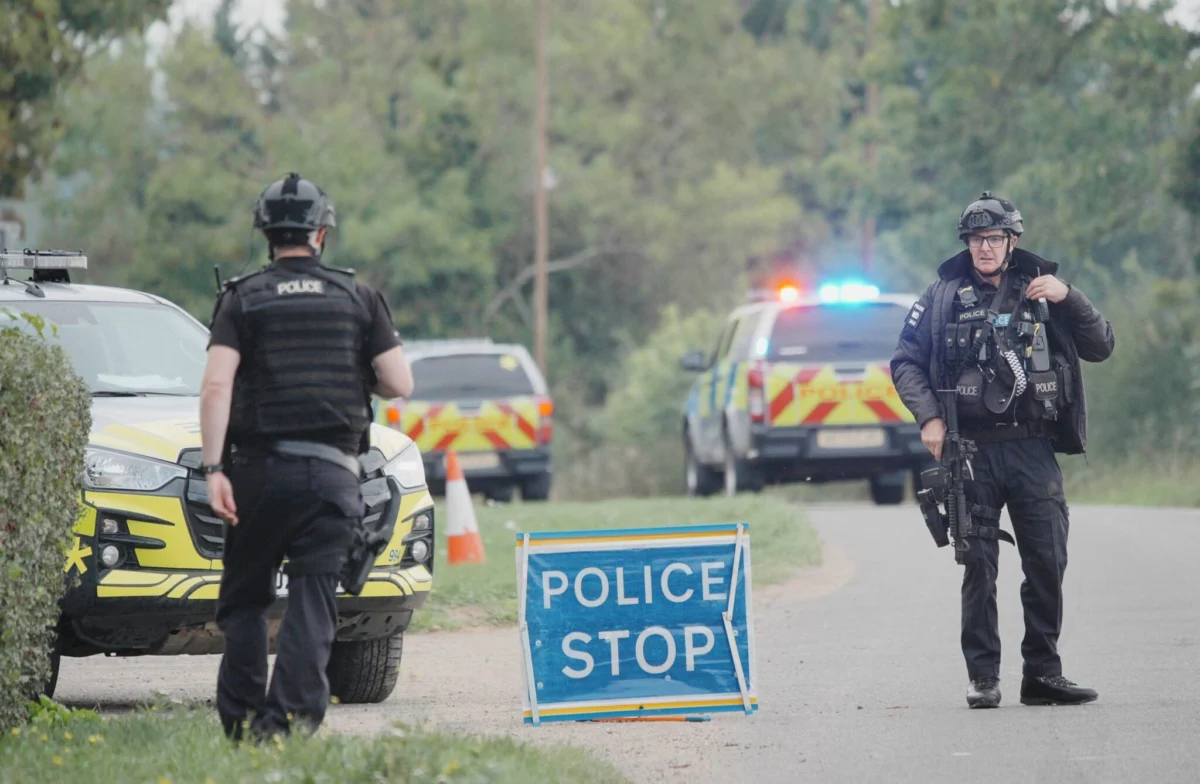
GLOUCESTERSHIRE, England — In a major security operation that has sent shockwaves through the British military establishment and heightened transatlantic tensions, British counter-terrorism police have arrested five men on suspicion of preparing an act of terrorism. The arrests took place on Sunday just outside the perimeter of RAF Fairford, a vital Royal Air Force station in western England operated by the United States Air Force (USAF).
The suspects, whose identities have not yet been released, are also being held on suspicion of explosives offenses. The operation, led by specialist counter-terror officers, underscores the precarious security situation in the United Kingdom as the military remains deeply involved in supporting U.S.-led operations in the Middle East. As of Sunday evening, three vehicles seized during the arrests were undergoing forensic examination by explosives experts, while a wide security cordon remained in place around the base’s access points.
Main Facts: The Incident at RAF Fairford
The arrests occurred during a period of heightened vigilance at military installations across the United Kingdom. According to a statement from the Gloucestershire Constabulary, working in coordination with Counter Terrorism Policing, the five men were intercepted in the immediate vicinity of the base. RAF Fairford, located approximately 100 miles (160 kilometers) west of London, is a critical node for U.S. strategic operations, serving as a primary forward operating location for heavy bombers.
The investigation is currently being spearheaded by the Counter Terrorism Policing South West (CTPSW) unit. While officials have not explicitly linked the suspects to a specific organization, the charges—encompassing both the preparation of terrorist acts and the possession or manufacture of explosives—suggest a plot of significant scale.
“We are working closely with our partners in the U.S. Air Force and the Ministry of Defence to ensure the continued safety of the base and the surrounding community,” a police spokesperson said. “At this stage, we are keeping an open mind regarding the motive, but the nature of the offenses necessitates a full counter-terrorism investigation.”
Chronology: A Timeline of Escalation
The security breach at Fairford does not exist in a vacuum. It follows a turbulent month of military activity and political shifts in the United Kingdom.
- February 28: A conflict involving U.S. and Israeli forces against Iranian targets begins. The initial outbreak of hostilities prompts immediate global concern over energy supplies and regional stability.
- Early March: Following the outbreak of the war, President Donald Trump requests the use of British sovereign bases to launch offensive strikes against Iranian military infrastructure.
- The Initial Denial: Prime Minister Keir Starmer initially denies the U.S. request, citing the need to avoid direct British involvement in a new Middle Eastern ground war and concerns over domestic security.
- The Policy Shift: Days later, after a series of Iranian-linked attacks on British commercial interests and allies in the Persian Gulf, Prime Minister Starmer reverses course. He announces that the U.K. will allow the U.S. to use bases like RAF Fairford for “defensive” operations, specifically targeting missile launch sites and assets deemed a direct threat to international shipping and U.K. interests.
- Mid-March: U.S. B-1B Lancer and B-52H Stratofortress bombers are deployed to RAF Fairford. Frequent sorties are observed by local residents and aviation enthusiasts, signaling the base’s active role in the conflict.
- The Week Leading to Sunday: Local residents report a visible increase in security. Heavy vehicles and concrete barriers are positioned across entrance gates. Simultaneously, RAF Lakenheath in Suffolk is placed on "Force Protection Condition (FPCON) Charlie."
- Sunday Morning: Counter-terrorism officers move in on five suspects and three vehicles outside the Fairford perimeter, leading to the current crisis.
Supporting Data: The Strategic Importance of RAF Fairford
To understand why RAF Fairford was a potential target, one must look at its unique role in the U.S. military’s global reach. Unlike many other bases, Fairford is a "Standby" airfield, meaning it is not usually home to a permanent wing of aircraft but is maintained in a state of high readiness to host massive deployments of heavy bombers.
1. The Infrastructure of Power
Fairford boasts one of the longest runways in Europe, measuring approximately 10,000 feet (3,000 meters). This allows it to support the weight and takeoff requirements of fully fueled and armed B-52 Stratofortress bombers, which are the backbone of the U.S. nuclear and conventional triad. The base is also the headquarters for the 501st Combat Support Wing, which provides the logistical "backbone" for U.S. operations across the U.K. and Norway.
2. Historical Precedent
The base has been a focal point for every major U.S. air campaign since the Cold War. In 1991, B-52s flew from Fairford to strike targets in Iraq during Operation Desert Storm. In 1999, it was used for B-52 and B-1 missions during the Kosovo War, and in 2003, it served as a primary launch point for "Shock and Awe" during the invasion of Iraq.
3. The Iran Connection
In the current conflict, the B-1B Lancer—a supersonic variable-sweep wing bomber—has been frequently spotted taking off from Fairford. These aircraft are capable of carrying the largest conventional payload of both guided and unguided weapons in the U.S. Air Force inventory. Their presence at Fairford makes the base a high-value target for any adversary looking to degrade U.S. strike capabilities.
Official Responses: Government and Military Stances
The response from official channels has been one of cautious transparency, emphasizing the strength of the "Special Relationship" while acknowledging the domestic risks.
The British Government
Downing Street issued a brief statement following the arrests, noting that Prime Minister Keir Starmer is being kept "regularly updated" on the situation. A spokesperson for the Prime Minister reiterated that the decision to allow the U.S. to use the base was made in the interest of "national and global security." The government has faced criticism from the opposition and anti-war factions for potentially "painting a bullseye" on British soil by hosting the bomber fleet.
U.S. European Command (EUCOM)
From its headquarters in Stuttgart, Germany, EUCOM acknowledged the security incident but declined to provide specifics on their internal defensive posture. “We are aware of the arrests made by British authorities near RAF Fairford. We value our partnership with U.K. law enforcement and will continue to coordinate closely. For operational security reasons, we do not discuss specific force protection measures,” a EUCOM official stated.
Local Law Enforcement
Gloucestershire police have urged the public to remain calm but vigilant. "The presence of increased police activity is a precautionary measure to ensure the safety of everyone in the area," said Chief Superintendent Sarah Johnson. "We are grateful for the patience of the local community as we conduct these vital searches."
Implications: Terrorism, Proxy Warfare, and Domestic Unrest
The arrests at Fairford highlight three major areas of concern for security analysts and the British public.
1. The Rise of Proxy Warfare
British intelligence agencies, including MI5, have recently warned that the U.K. is facing a "gray zone" threat from Iranian proxies. Officials have noted a string of arson attacks and sabotage attempts across Europe, often targeting Jewish communities or businesses with links to Israel. The Fairford incident raises the terrifying prospect that these proxy actors may be shifting their focus toward hardened military targets. If the five men arrested are indeed linked to a state-sponsored proxy, it would mark a significant escalation in the conflict, moving it from the Middle East directly onto British soil.
2. The "Charlie" Alert and Base Security
The fact that RAF Lakenheath—another key U.S. base—is on "Charlie alert" is highly significant. FPCON Charlie is only implemented when an incident occurs or intelligence indicates that some form of terrorist action against personnel or facilities is "likely." This suggests that the threat is not localized to Fairford but is part of a broader, credible intelligence picture suggesting a coordinated effort to strike U.S. assets in the U.K.
3. Domestic Anti-War Sentiments
The Iran conflict has been deeply polarizing in Britain. Anti-war campaigners have maintained a presence outside Fairford for weeks, arguing that the U.K.’s involvement makes the country less safe. While there is no evidence linking the arrested suspects to legitimate protest groups, the atmosphere of civil unrest provides a complex backdrop for security services. The government now faces the difficult task of balancing its military commitments to the U.S. with the need to protect its citizens from the blowback of those commitments.
4. The Future of the U.S.-U.K. Agreement
The 1950s agreement that allows the U.S. to use British bases is a cornerstone of NATO’s Atlantic security. However, as the nature of warfare changes and the threat of domestic terrorism grows, the "defensive" versus "offensive" distinction made by Prime Minister Starmer becomes harder to maintain. If further plots are uncovered, there may be increased political pressure to restrict the types of missions that can be launched from U.K. soil.
As the forensic search of the three suspicious vehicles continues, the United Kingdom remains on edge. The quiet countryside of Gloucestershire, usually known for its picturesque landscapes, is now the front line of a global struggle, as authorities work to determine just how close a major terrorist strike came to fruition on British soil.