HOUSTON — In a move that signals a dramatic shift in American foreign policy and maritime enforcement, three massive oil tankers linked to the Iranian regime are currently transiting the Atlantic Ocean toward the United States. These vessels, carrying nearly six million barrels of crude oil, were not intercepted through traditional law enforcement channels but were seized by the U.S. Navy under a resurrected legal doctrine known as "Prize Law."
The arrival of these ships—the Tifani, the Majestic X, and the Lenore (also identified as the Davina)—marks a significant escalation in the Trump administration’s strategy of "economic warfare." By pivoting away from kinetic strikes and toward the seizure of high-value sovereign assets, the U.S. is testing the limits of international maritime law and the resilience of the Iranian economy.
Main Facts: A $600 Million Seizure at Sea
The scale of the seizure is historic. All three vessels are classified as Very Large Crude Carriers (VLCCs), the giants of the shipping world. Each is capable of carrying approximately two million barrels of oil. With Brent crude futures currently trading at approximately $106 per barrel, the total value of the cargo crossing the Atlantic is estimated at $636 million.
According to data provided by TankerTrackers.com, an independent maritime tracking service, the vessels are at various stages of their journey:
- The Tifani and Majestic X: Currently positioned off the coast of Brazil. These ships were boarded and seized in the Indian Ocean in April.
- The Lenore (aka Davina): Recently cleared the Cape of Good Hope at the southern tip of Africa. It is currently heading west into the Atlantic after its interdiction in the Indian Ocean in June.
The ultimate destination for these prizes is expected to be the Texas Gulf Coast. As the hub of the American petrochemical industry, Texas possesses the refining capacity to process the heavy Iranian crude and the legal infrastructure to adjudicate the forfeiture of the vessels.
Chronology: From Blockade to Boarding
The journey of these tankers began with the imposition of a comprehensive naval blockade by President Donald Trump. This blockade, initiated in April, was designed to be more than a simple sanctions regime; it was a physical interdiction of Iranian commerce.
April: The Initial Surge
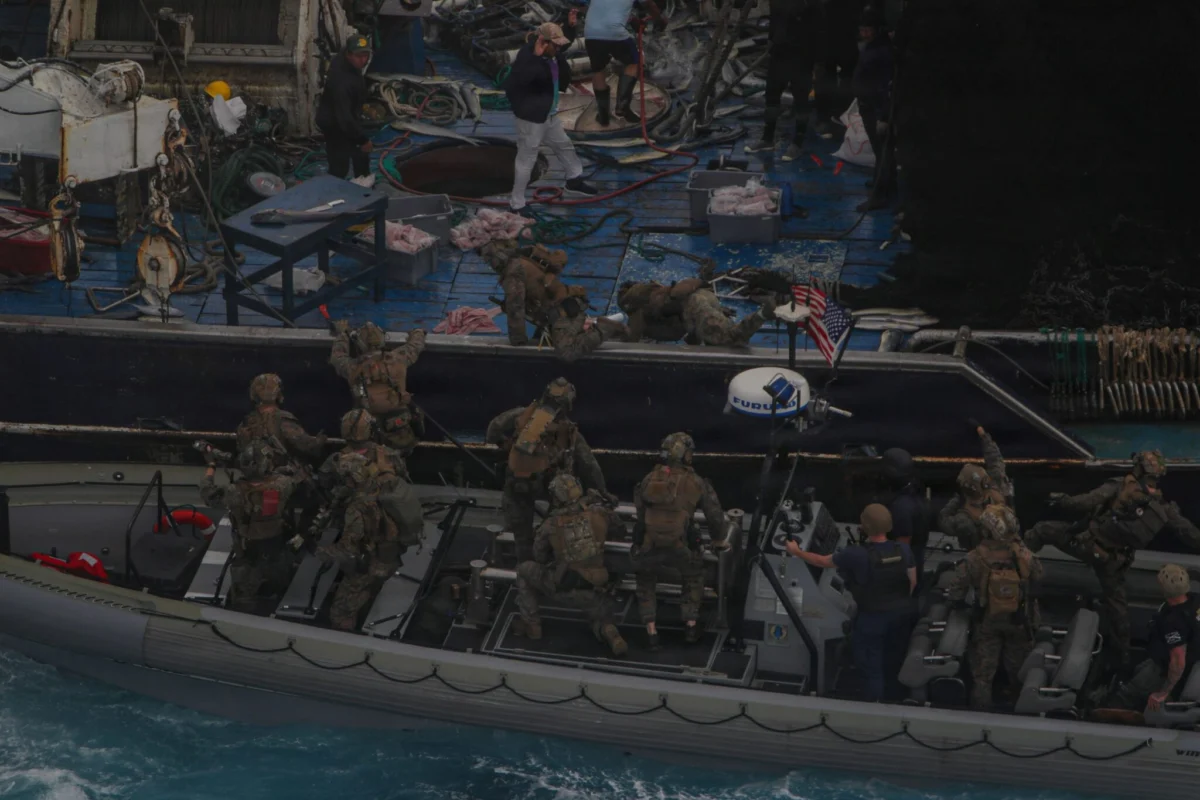
The U.S. Navy began targeting ships attempting to enter or exit Iranian ports. Unlike previous enforcement actions that focused on secondary sanctions against buyers, this blockade applied to Iran-linked vessels anywhere in international waters. The Tifani and Majestic X were among the first major targets, intercepted while navigating the Indian Ocean.
The Summer Ceasefire
A brief diplomatic window opened during the summer months, leading to a temporary ceasefire and a lifting of the blockade. During this period, tensions appeared to cool as intermediaries sought a diplomatic off-ramp. However, negotiations failed to produce a lasting agreement regarding Iran’s nuclear program and regional influence.
Late Summer: Reimposition and the "Economic Warfare" Pivot
Following the collapse of the ceasefire, President Trump reimposed the blockade with renewed vigor. This time, the administration explicitly framed the strategy as "economic warfare." The goal was to deplete the regime’s hard currency reserves by physically removing their primary export from the global market. It was during this phase that the Lenore was interdicted near the southern tip of Africa.
Supporting Data: The Logistics of VLCC Seizures
The logistics of seizing and navigating a VLCC are immense. These ships are over 1,000 feet long and, when fully loaded, have a draft that prevents them from entering many standard ports.
The Cargo Value
The financial impact on Tehran is substantial. The loss of 6 million barrels represents a significant percentage of Iran’s monthly export capacity under current sanctions. At $106 per barrel, the $636 million loss is compounded by the loss of the vessels themselves. A modern VLCC can be valued between $60 million and $120 million depending on its age and condition.
Strategic Navigation
The decision to sail these ships around the Cape of Good Hope rather than through the Suez Canal is a strategic one. While the Suez route is shorter, it involves navigating narrow chokepoints and passing through Egyptian waters, which could present diplomatic or security complications. By taking the long route around Africa and across the Atlantic, the U.S. Navy maintains total control over the environment surrounding the "prizes."
The Legal Framework: Reviving "Prize Law"
The most controversial and fascinating aspect of this operation is the legal mechanism utilized by the Justice Department: Prize Law.
Roots in Antiquity
Prize law is a body of maritime law that dates back to the Middle Ages. It allows a belligerent power in a time of conflict to seize enemy merchant vessels and cargo. Unlike modern civil asset forfeiture, which requires the government to prove a specific statutory violation (such as money laundering or smuggling) and establish jurisdiction in a traditional sense, prize law is a "right of war."
The Constitution and the Captures Clause
In the United States, the authority to engage in prize-taking is rooted in the Constitution. Article I, Section 8, Clause 11—known as the Captures Clause—grants Congress the power to "declare War, grant Letters of Marque and Reprisal, and make Rules concerning Captures on Land and Water."
Historically, this was used extensively:
- The War of 1812: The Prize Act of 1812 codified the process by which captured ships were brought to port, "condemned" by a court, and sold.
- The Civil War: President Abraham Lincoln used the Prize Act to justify the blockade of Confederate seaports, a move upheld by the Supreme Court in the Prize Cases of 1863.
- The Spanish-American War: This was the last time the U.S. significantly invoked prize law before the current era.
Prize Law vs. Civil Seizure
The shift to prize law is a tactical masterstroke by the administration’s legal team. Under civil law, the Coast Guard or FBI must identify a warrant and tie the seizure to a violation of an existing U.S. statute. Under prize law, the Department of Defense acts as the seizing authority. The ship is treated as "enemy property" captured during a military conflict, bypassing many of the procedural hurdles of domestic criminal law.
Official Responses: Texas Prepares for Adjudication
The legal battleground for these ships will be the U.S. District Court for the Southern District of Texas. Aaron Reitz, the U.S. Attorney for the Southern District of Texas, has been vocal about his office’s readiness to handle these unprecedented cases.
In a statement to Bloomberg, Reitz confirmed that his office is prepared to represent the United States in "adjudicating prizes." This process involves a "Prize Court" (a federal court sitting in admiralty jurisdiction) determining whether the capture was lawful and whether the property should be officially condemned and forfeited to the U.S. government.
"Our national security interests may require the United States military to seize vessels or cargo supporting the enemy during military conflict," Reitz stated. "If that happens, our federal courts must be ready to adjudicate the disposition of these captured vessels and cargo. Prize law is an ancient body of maritime law—already codified in statute but which we are now reviving—that sets the rules for how seized maritime property is condemned, returned, or disposed of."
While Reitz did not explicitly state which specific statute would be the primary vehicle—whether the Prize Act of 1812 or the Captures Clause itself—the intent is clear: the U.S. is creating a legal precedent for the seizure of sovereign assets in the "gray zone" between peace and total war.
Implications: A New Era of Global Maritime Security
The arrival of the Tifani, Majestic X, and Lenore on American shores will have far-reaching implications for international relations and global trade.
1. Geopolitical Retaliation
Tehran has historically responded to the seizure of its tankers with "tit-for-tat" actions in the Strait of Hormuz. The seizure of these three VLCCs could lead to Iranian attempts to harass or seize Western-flagged tankers in the Persian Gulf. The "Tanker War" of the 1980s provides a grim blueprint for how this escalation could play out.
2. The "Shadow Fleet"
For years, Iran has utilized a "shadow fleet" of aging tankers with obscured ownership to bypass sanctions. By using prize law, the U.S. is signaling that "flags of convenience" or complex shell company structures will no longer protect these assets. If the Navy identifies a vessel as "supporting the enemy," the legal threshold for seizure is significantly lowered.
3. Impact on Maritime Insurance
The revival of prize law creates immense uncertainty for the global maritime insurance industry. If ships can be seized not just for smuggling, but as "prizes of war" in an undeclared conflict, insurance premiums for any vessel operating in sensitive regions are likely to skyrocket.
4. Economic Warfare as the New Standard
The Trump administration’s preference for "economic warfare" over "bombs" suggests a future where the battlefield is the global ledger. By capturing $600 million worth of oil, the U.S. achieves a strategic objective—depriving an adversary of funds—without the political fallout of a kinetic military strike. However, this strategy relies on the U.S. maintaining total naval dominance and the ability to project power across the world’s shipping lanes.
As the three tankers continue their slow journey toward Texas, the world watches to see how the American legal system will handle these "prizes." If the courts uphold the use of prize law, it will mark the most significant change in maritime enforcement in over a century, turning the high seas into a primary theater of 21st-century conflict.