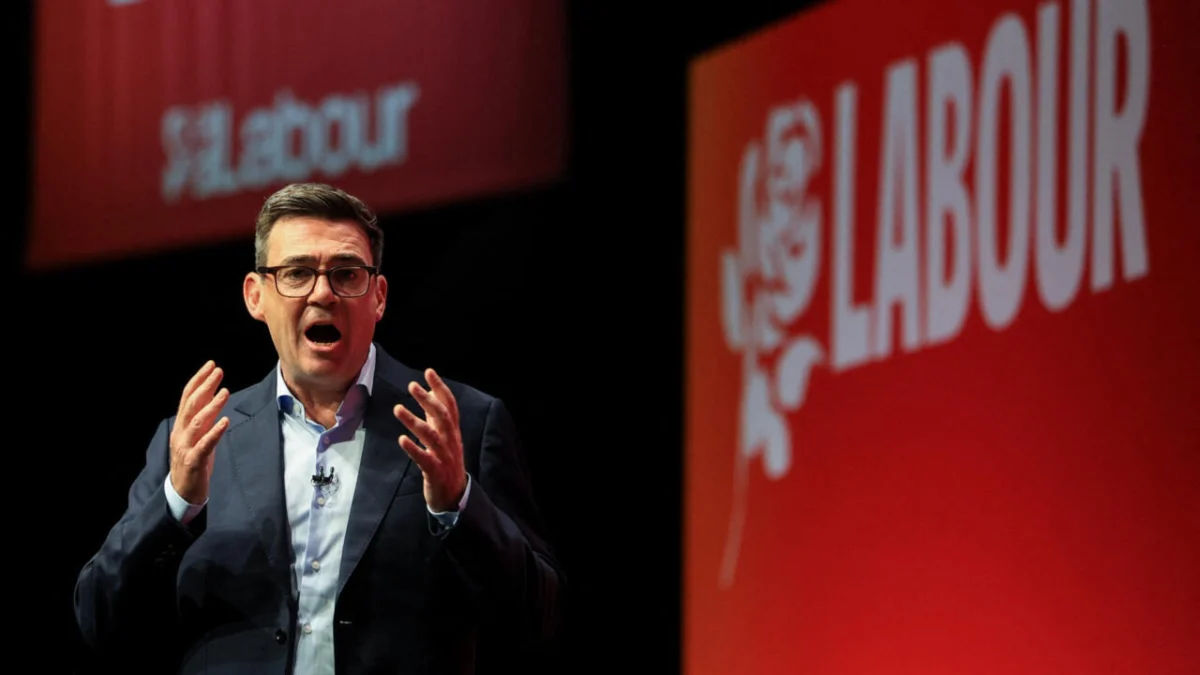
LIVERPOOL – In an emotionally charged and politically audacious keynote address at the Labour Party’s annual conference in Liverpool, Prime Minister Andy Burnham signaled a definitive end to the era of Thatcherite economic orthodoxy. Just ten weeks after being catapulted into Downing Street to replace the embattled Keir Starmer, Burnham laid out a sweeping, transformative vision for the United Kingdom, one that promises to rewrite the social contract through state-led investment, the re-nationalization of essential utilities, and a daring overhaul of the nation’s social care system.
The 56-year-old former Mayor of Manchester, speaking to a capacity crowd of activists and MPs, sought to contrast his leadership with the previous two years of parliamentary infighting and policy drift. By positioning himself as a populist reformer willing to "break the plaster off" on long-standing national crises, Burnham is attempting to re-energize a party that has struggled to find its footing in an era of economic stagnation.
A Vision Defined by Personal Loss
The hour-long speech was defined by a moment of raw, unscripted vulnerability. Midway through his address, the Prime Minister was forced to pause, visibly choking back tears as he spoke of his father, who passed away earlier this month following a battle with Alzheimer’s.
"I’m going to use this job to build the kind of Britain my dad wanted to see and fight with everything I’ve got to keep it together," Burnham declared, his voice trembling. The personal narrative served as a bridge to his central policy pillar: the creation of a National Care Service (NCS).
Burnham’s pledge to introduce free social care in England—modeled on the principles of the NHS—is arguably his most controversial move to date. Acknowledging that the initiative would likely carry a staggering price tag of nearly £19 billion ($25 billion) annually, according to the Health Foundation, Burnham warned his audience that he expected to pay a "political price" for the reform. Yet, he insisted that the current system is fundamentally broken, leaving millions of elderly and disabled citizens to navigate a fragmented, underfunded landscape.
Chronology of a Political Reset
To understand the gravity of Burnham’s current mandate, one must look at the rapid-fire sequence of events that brought him to power:
- 2024–2026 (The Starmer Years): The Labour Party, under Keir Starmer, faces two years of stagnant polling, internal party friction, and a series of high-profile policy U-turns that alienate the party’s traditional base.
- July 2026: Amid a mounting crisis of confidence, Labour MPs move to trigger a leadership transition. Andy Burnham is "parachuted" into the premiership, tasked with stabilizing the government and restoring public trust.
- August 2026: Burnham spends his first month touring the UK, emphasizing regional empowerment and "hope" as his core messaging pillars.
- September 1, 2026: Burnham delivers his maiden parliamentary address, calling for "substantial change" to the UK’s economic trajectory.
- September 2, 2026: The Liverpool Conference address. Burnham officially pivots to his "Break with the Past" platform, outlining the repeal of privatization laws and the promise of a future National Care Service.
Reindustrialization and the Public Hand
Burnham’s speech was not merely a statement of social values; it was an economic manifesto. He declared his intention to undo the legacy of the 1979–1990 Thatcher administration, specifically calling for the repeal of the ideological ban on the public ownership of water companies.
"I will make a break with the direction of the past 40 years," Burnham told the delegates. His plan centers on three core pillars:
- Public Ownership: A transition of energy and water sectors back into public or highly regulated municipal hands to curb soaring costs for consumers.
- Infrastructure Investment: The announcement of a new government body dedicated to modernizing the UK’s aging electricity grid.
- Local Empowerment: A devolution of power, drawing on his experience as a mayor, to allow local leaders to manage housing, transport, and economic development in their regions.
This strategy of "reindustrialization" is designed to address the "insipid growth" that has plagued the UK economy. By prioritizing domestic production and state-led infrastructure projects, Burnham hopes to insulate the nation from the shocks of volatile global markets and the ongoing energy price spikes driven by geopolitical instability in Ukraine and the Middle East.
Supporting Data and Economic Realities
The Prime Minister’s ambition faces a daunting fiscal reality. The UK economy remains heavily leveraged, with borrowing costs at multi-decade highs. Furthermore, the government is under immense pressure to increase defense spending to meet its NATO commitments—a requirement that will cost billions and potentially compete with Burnham’s domestic social programs.
According to a recent YouGov poll, the honeymoon period for the new administration may be shorter than expected. Despite the optimism in the conference hall, Labour has slipped to 24% in voting intentions, trailing the Reform UK party, which sits at 25%. This suggests that while Burnham’s rhetoric is resonating with the party faithful, the broader electorate remains skeptical of the economic feasibility of his promises.
Official Responses and Political Friction
The political backlash to Burnham’s proposed reforms began almost immediately. Nigel Farage, leader of Reform UK, wasted no time in attacking the Prime Minister’s plan to potentially scrap the "triple lock" on pensions to fund the National Care Service.
"By potentially scrapping the triple lock, Andy Burnham will abdicate his responsibility to British pensioners," Farage stated, framing the move as a direct attack on the elderly population.
Business groups have also expressed concern, questioning how the government plans to pay for massive infrastructure projects without further increasing the tax burden on a struggling private sector. Conversely, local activists and union leaders have praised the move as a long-overdue return to Labour’s founding principles. "I thought it was inspirational," said Margaret Greer, a trade unionist in attendance. "He really spoke from the heart."
Implications: A New Era of Foreign and Domestic Policy
Perhaps the most intriguing part of Burnham’s agenda is his subtle pivot on the UK’s relationship with the European Union. While stopping short of promising to rejoin the bloc, Burnham acknowledged that the post-Brexit landscape has done "more harm than good." He has promised to present "different options" for future ties during a planned summit later this year, signaling a departure from the confrontational stance of his predecessors.
The implications for the UK are profound. If Burnham succeeds, he will have fundamentally shifted the UK from a market-liberal model to a social-democratic one, characterized by high state involvement and a robust safety net. If he fails, the combination of high spending and economic instability could lead to a deeper fiscal crisis.
As the conference concludes, the atmosphere in Liverpool remains one of cautious optimism. For the first time in years, Labour is campaigning under the slogan "Hope Again." However, as Burnham himself acknowledged, the path ahead is filled with "pain barriers." Whether the British public is willing to join him in breaking through those barriers will determine not only the future of his premiership but the trajectory of the United Kingdom for the next generation.
As one business owner, Ralitsa Vasilovska, noted, "It’s something I’ve always wanted to hear from a prime minister. So honest, a lot of energy, saying things that are not popular." In a political climate defined by cynicism, Burnham is betting everything on the idea that honesty and radical change are, ultimately, what the country needs most.