DALLAS — Over an intense 48-hour stretch in mid-September 2026, President Donald Trump executed a high-stakes balancing act between solemn commander-in-chief duties and unchecked partisan campaigning. Moving from the roaring arena of the first-ever Republican Midterms Convention in Dallas to the venerated halls of the National Medal of Honor Museum in Arlington, and ultimately to the Pentagon for the 25th anniversary of the September 11 terrorist attacks, Trump demonstrated both the limits and the expansiveness of his unconventional political style.
By the time the whirlwind tour concluded, the contrast between sacred national remembrance and hyper-partisan spectacle reached a crescendo—leaving political observers, allies, and critics parsing a series of extraordinary moments that included audience loyalty pledges, self-directed military honor jokes, and stark warnings of political damnation.
Main Facts: A Dual-Role Spectacle in Texas and Washington
The multi-day itinerary was designed to serve two distinct purposes: rally the Republican base ahead of crucial 2026 midterm elections and honor the nation’s military heroes and historic sacrifices. However, the boundaries between official statecraft and campaign theatrics dissolved rapidly throughout the swing.
Key elements of the three-day sequence include:
- The Inaugural Republican Midterms Convention: Trump headlined both nights of the GOP’s first dedicated midterm convention at the American Airlines Center (AAC) in Dallas, aiming to solidify Republican majorities in the House and Senate.
- The Texas Senate Race Push: Trump used his platform to vigorously endorse Texas Attorney General Ken Paxton for the U.S. Senate while mounting fierce attacks against Democratic nominee James Talarico, whom Trump labeled "Talafreako."
- The Crowd Oath: In a dramatic departure from standard rally rhetoric, Trump directed convention attendees to raise their right hands and recite a pledge affirming their loyalty to him, their intent to vote, and accusations of election fraud against Democrats.
- Medal of Honor Museum Remarks: During an official presidential visit to the newly established National Medal of Honor Museum in Arlington, Trump combined praises for combat veterans with remarks expressing a desire to award himself the Medal of Honor, alongside continued campaign attacks against state Democrats.
- Pentagon 9/11 Memorial Service: Trump concluded his swing in Washington, D.C., delivering a largely script-bound address at the Pentagon commemorating the 25th anniversary of the September 11 attacks.
Chronology of Events: From Arena Roars to Hallowed Halls
Wednesday Evening: GOP Midterms Convention Opening (Dallas, TX)
  │  ──> Trump delivers nearly 2-hour speech bashing Democrats as "communists"
  │
Thursday Morning: National Medal of Honor Museum Visit (Arlington, TX)
  │  ──> Motorcade travels along Interstate 30; tour with Medal recipients
  │  ──> Unconventional audio backdrops (WWE Undertaker theme, Toby Keith, Beach Boys)
  │  ──> Trump jokes about self-awarding Medal of Honor; attacks Dem Rep. James Talarico
  │
Thursday Evening: Midterms Convention Finale (Dallas, TX)
  │  ──> 9/11 tribute with twin light beams, followed immediately by "God Made Trump" video
  │  ──> Trump leads crowd in controversial loyalty pledge ("go to hell" if you don't vote)
  │  ──> Speaker Mike Johnson floats idea of Trump running for U.S. House post-presidency
  │  ──> Event ends with opera performance by Christopher Macchio as Trump signals fatigue
  │
Friday Morning: 9/11 Commemoration at the Pentagon (Arlington, VA / Washington, D.C.)
     ──> Solemn, teleprompter-driven address marking the 25th anniversary of 9/11
Wednesday Evening: Setting the Tone in Dallas
The weekend of events opened on Wednesday night inside a packed American Airlines Center. Campaigning in full force, Trump addressed an enthusiastic crowd for nearly two hours. Framing the upcoming midterms in existential terms, he labeled the Democratic Party as "crazed" and "communists," insisting that retaining unified Republican control of Congress was the only barrier preventing national decline.
Thursday Daytime: The Arlington Interlude
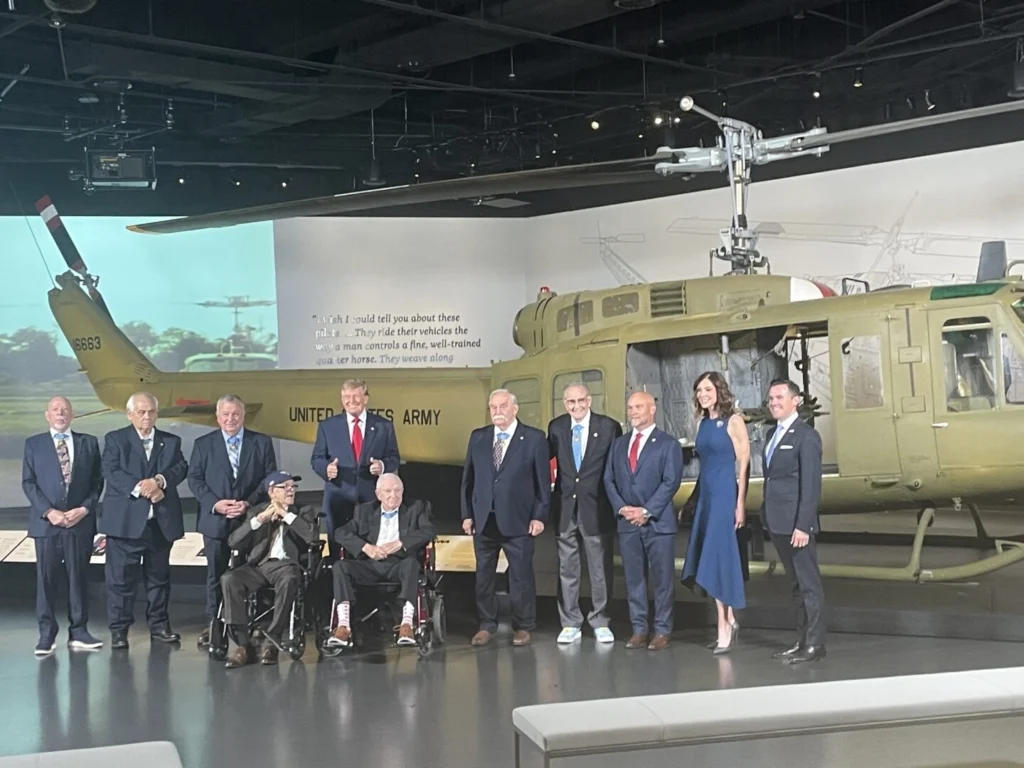
On Thursday morning, the presidential motorcade navigated Interstate 30 from downtown Dallas to nearby Arlington for a scheduled tour of the National Medal of Honor Museum. The atmosphere at the holding site was marked by unusual audio choices; members of the press pool reported hearing the entrance theme of WWE professional wrestler The Undertaker playing near a Bell UH-1H Iroquois "Huey" helicopter on display.
Later, inside the museum’s amphitheater, Toby Keith’s patriotic anthem "Courtesy of the Red, White and Blue" welcomed Medal of Honor recipients, followed minutes later by The Beach Boys’ upbeat track "Wouldn’t It Be Nice."
While Trump delivered solemn, scripted praise reading from a lectern binder—saluting veterans who "stormed into hellfire and crushed America’s enemies"—he quickly veered into partisan territory, criticizing local Democratic candidates before invited guests and veterans.
Thursday Night: Twin Beams, Oaths, and Opera
Returning to the American Airlines Center on Thursday evening, the convention attempted to weave solemn national memory into party momentum. Families of September 11 victims took the stage in silence as two bright spotlights projected upward to the arena rafters, representing the fallen World Trade Center towers.
However, the mood shifted rapidly. Moments after the 9/11 tribute concluded, the venue screens played a viral campaign video titled "God Made Trump."
Eighteen minutes into his closing remarks, Trump paused to instruct the thousands in attendance to raise their right hands and repeat a pledge after him. The ceremony culminated in an extended speech that mixed voter mobilization demands with warnings of eternal damnation.
To close the convention, Trump brought out opera singer Christopher Macchio to perform classical pieces including "Nessun Dorma" and "America the Beautiful," candidly remarking to the audience that he was "getting a little bit tired of politics now."

Friday Morning: The Pentagon Remembrance
By Friday morning, Trump had returned to the National Capital Region to lead official ceremonies at the Pentagon marking 25 years since September 11, 2001. Standing before military leadership and victims’ families, the president adopted a traditionally reserved, solemn demeanor, sticking strictly to prepared remarks focused on national resilience and honoring the fallen.
Supporting Data and Detailed Statements
The Loyalty Pledge Incident
The most widely discussed moment of the Dallas convention occurred during Trump’s closing speech on Thursday night. Demanding a public show of allegiance, Trump asked the crowd to raise their right hands to recite the following pledge:
"I pledge, to the greatest president in the history of the United States, that loves us so much he can’t even breathe, that I will go out with my family, my friends. I’ll do it anyway. I don’t care if I’m registered or not. I’m gonna try and cheat like hell like they do… I am gonna go out, and I’m gonna get my friends, my family, and we are going to vote on Nov. 3 or we are going to vote before that."
Trump capped the recitation with a stark warning regarding turnout:
"You know what happens if you don’t vote? You go to hell. You know that."
While supporters in the arena responded with enthusiasm, press pool reporters noted visible surprise among some attendees, while online commentators quickly seized on the wording.
       CONVENTION SEQUENCE: TONE JUXTAPOSITION
┌──────────────────────────────────────────────────────┐
│  1. 9/11 Victims' Families Tribute (Twin Light Beams)│
└──────────────────────────┬───────────────────────────┘
                           ▼
┌──────────────────────────────────────────────────────┐
│  2. Campaign Media: "God Made Trump" Video Screening │
└──────────────────────────┬───────────────────────────┘
                           ▼
┌──────────────────────────────────────────────────────┐
│  3. Audience Participation: The Loyalty Pledge       │
└──────────────────────────┬───────────────────────────┘
                           ▼
┌──────────────────────────────────────────────────────┐
│  4. Operatic Finale & Expressions of Political Fatigue│
└──────────────────────────────────────────────────────┘
Remarks at the National Medal of Honor Museum
During his remarks in Arlington, Trump made comments regarding the military’s highest award for valor that drew scrutiny given his personal history:
"I want for myself a Congressional Medal of Honor. And I’ve studied it. And I will give it to myself, I have no problem, but I’m not allowed to. Can you believe it?"
After mild laughter from the audience, Trump added:
"I’m only kidding… Actually, I’m not kidding. I would like to have it."
Historically, during the Vietnam War era, Trump received four academic deferments before receiving a 1-Y medical deferment for bone spurs in his heels, rendering him ineligible for military service.
Attacks on Texas Senate Candidates
Trump explicitly brought the contested Texas U.S. Senate race into his museum address, attacking state Rep. James Talarico, the Democratic nominee challenging incumbent Republican Attorney General Ken Paxton:

"I brought your state back. But all that can disappear very quickly. You put a ‘Talafreako’ in, or you put any one of these people in, these people that don’t know what the hell they’re doing… Some are radical left. They have crazy policies… But [Talarico] would be a disaster for this country."
Official Responses and Public Reactions
The combination of campaign rallies and military honors generated swift reactions across the political spectrum.
GOP Leadership and Speaker Mike Johnson
House Speaker Mike Johnson embraced the high-energy environment of the Dallas convention. During his Thursday address, Johnson floated an unconventional post-presidential scenario for Trump, referencing historic precedents:
"Maybe our current president would do that?" Johnson mused, suggesting Trump could follow the path of John Quincy Adams—the only former president to serve in the U.S. House of Representatives after leaving the White House. The suggestion drew loud cheers from convention delegates, though analysts noted a sitting Rep. Donald J. Trump (R-Fla.) would pose unique management challenges for future House leadership.
Public and Media Reaction to the Pledge
The loyalty oath prompted starkly divided reactions:
- Rally Attendees: The crowd inside the American Airlines Center overwhelmingly complied with the request, shouting affirmative responses to Trump’s voter turnout mandate and laughing at his warnings of "going to hell."
- Critics and Online Commentary: Opponents and political commentators heavily criticized the pledge on social media platforms, with several high-profile critics describing the forced oath and self-referential language as a "cult ritual" inappropriate for a democratic political process.
Solemnity at the Pentagon
In contrast to the polarization in Texas, the Friday morning Pentagon service was met with standard decorum. Military leaders and attendees observed Trump sticking to unified presidential rhetoric, where he stated:
"We cannot forget that moment of immense and horrible evil that took place in this world, bent on the destruction of all that is good. But this morning, we also remember how America responded to that wickedness."
Implications: Executive Decorum and 2026 Strategy
Trump’s multi-day swing through Texas and Washington highlights critical shifts in the modern presidency and the Republican Party’s strategy leading into the 2026 midterms.
1. The Erasure of Boundaries Between Statecraft and Campaigning
By embedding sharp campaign commentary into an official visit to a military museum, Trump further normalized the blending of executive duties with campaign operations. While previous presidents have used official visits to tout legislative achievements, directly attacking local opponents within memorial sites represents a departure from traditional norms surrounding military honors.
2. High-Pressure Base Mobilization
The imposition of a vocal loyalty pledge and threats of "going to hell" reflect an aggressive voter-turnout strategy. As Republicans seek to retain control of the House and Senate in 2026, the party is leaning heavily on Trump’s unique ability to command absolute loyalty from the grassroots base, even as national races—such as the Texas Senate battle—show unexpected competitiveness.
3. Rhetorical Shift and Campaign Fatigue
Perhaps the most telling moment arrived at the conclusion of the Dallas convention. Trump’s unexpected admission—"I’m getting a little bit tired of politics now"—followed by an operatic performance, hinted at the cognitive and physical toll of maintaining an unrelenting campaign posture. Whether this signals a shift toward delegating campaign duties or simply a brief moment of candor, it encapsulates the surreal dynamics defining the current political landscape.