The American Dream, once anchored in the promise of affordable homeownership, is undergoing a profound transformation. As the United States moves through the midpoint of the decade, the housing market remains defined by a stubborn affordability crisis that has fundamentally altered the trajectory of personal finance, migration patterns, and the socio-economic fabric of the nation. For millions of would-be homebuyers, the path to ownership has become an exercise in strategic relocation and fiscal discipline.
Data from mid-2026 reveals that while the housing market is beginning a slow, methodical rebalancing, the shockwaves of the pandemic-era surge are still being felt. With mortgage rates remaining elevated and home prices holding firm near record highs, the "American Dream" is no longer a guaranteed milestone, but a complex challenge that is forcing households to rethink their spending habits and their geography.
The State of the Market: A Chronology of Change
To understand the current housing climate, one must look back to the onset of the pandemic. In early 2020, the housing market experienced a radical disruption. As remote work became the norm and urban centers felt the strain of lockdowns, a massive migration began. Households fled high-cost coastal hubs in search of more space and affordability, gravitating toward the Sun Belt—specifically Florida, Arizona, and Texas.
This influx of demand, paired with historically low mortgage rates, caused a price explosion that outpaced wage growth. By 2022 and 2023, the very cities that had once promised an affordable escape were themselves becoming prohibitively expensive. This trend marked the end of the "easy" migration phase.
By 2024 and 2025, the market began to stall as interest rates rose to combat inflation, curbing buyer demand and locking many potential sellers into their existing low-rate mortgages. This "lock-in effect" caused inventory to plummet. Now, in 2026, the market is defined by a slow crawl toward equilibrium. Buyers are no longer chasing the sun; they are chasing value, increasingly turning their attention toward the Midwest and other overlooked regions where the supply-to-demand ratio remains more balanced.
Geography of Affordability: The Midwest Emerges
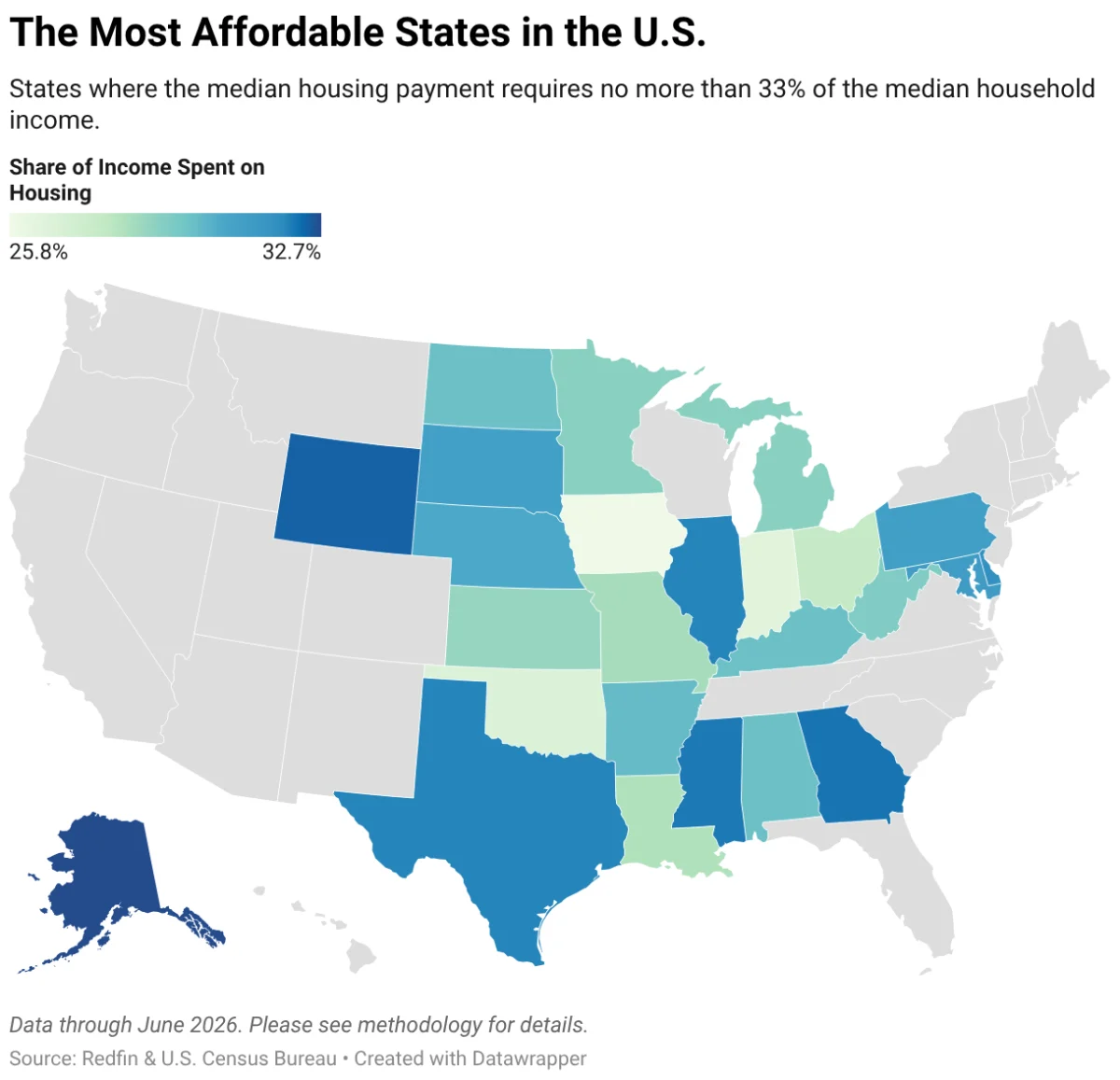
The data confirms a distinct shift in the map of American affordability. Currently, the most accessible housing markets are concentrated in the nation’s interior. Iowa, Indiana, and Oklahoma have emerged as the top three most affordable states for prospective buyers.
In these states, a household earning a median income typically spends roughly 27% of their monthly earnings on housing. This falls comfortably below the 30% threshold that financial experts generally cite as the benchmark for "affordable" housing.
The Top 10 Most Affordable States (By Income Share)
| State | Share of Income Needed | Median Household Income | Median Sale Price |
|---|---|---|---|
| Iowa | 25.8% | $81,442 | $269,058 |
| Indiana | 26.6% | $78,076 | $288,896 |
| Oklahoma | 26.8% | $70,570 | $261,681 |
| Ohio | 27.9% | $77,459 | $279,126 |
| Louisiana | 28.3% | $65,922 | $265,083 |
| Missouri | 28.5% | $76,714 | $299,064 |
| Kansas | 28.8% | $80,591 | $304,048 |
| Michigan | 29.1% | $79,072 | $299,064 |
| Minnesota | 29.1% | $96,635 | $373,830 |
| West Virginia | 29.3% | $64,677 | $274,142 |
When viewed at a macro level, it becomes clear that the Midwest and parts of the South are the only regions where the 30% benchmark is consistently met. This is largely due to three factors: lower land costs, consistent homebuilding that has largely kept pace with population growth, and the absence of the extreme tech-driven population spikes that defined the Pacific and Mountain West over the last two decades.
Improving Markets: Where Costs are Easing
While affordability remains tight, there is a silver lining. Across the country, the share of income required to purchase a home is beginning to decline. This isn’t necessarily because home prices are crashing, but because the market is finally moving away from the chaotic "bidding war" environment of 2021–2022.
States like Oregon and Washington, which have long been among the most expensive, are seeing the fastest improvement in affordability metrics, with a 3.6 percentage point decrease in income share requirements year-over-year.
Where Affordability is Improving Fastest
| State | Share of Income Needed | YOY Change (ppts) |
|---|---|---|
| Oregon | 42.4% | -3.6 |
| Washington | 42.5% | -3.6 |
| Hawaii | 47.1% | -3.5 |
| Vermont | 37.6% | -3.4 |
| Colorado | 38.5% | -2.6 |
| Massachusetts | 45.9% | -2.6 |
| California | 52.4% | -2.6 |
| Georgia | 32.1% | -2.3 |
| New Mexico | 36.0% | -2.3 |
| Texas | 31.9% | -2.2 |
Expert Insights: The "New Normal"
Despite these improvements, the reality for the average American household remains strenuous. Daryl Fairweather, Chief Economist at Redfin, emphasizes that we are still living in the shadow of the pandemic’s inflationary surge.
"Costs climbed dramatically during the pandemic and have only marginally dropped since, keeping a significant share of locals priced out of the market," says Fairweather. "Since 2020, the share of income a median-earning American household has to spend on housing has climbed from 23% to over 34%."
Fairweather points to a structural issue that goes beyond interest rates. While high rates have cooled demand, they are a temporary macroeconomic tool. The more permanent solution lies in the built environment. "What we can control is the permitting and zoning of housing," she explains. "It will take a concerted effort to make the policy changes necessary to increase supply and bring down housing costs at a systemic level."
Socio-Economic Implications
The ongoing housing crisis is creating a bifurcated society. In the most desirable, supply-constrained markets, homeownership is increasingly becoming the province of the wealthy or those with multi-generational family support. Younger generations, particularly Gen Z, are delaying milestones—such as marriage and child-rearing—partially because the capital required for a down payment remains an insurmountable barrier.
Moreover, the migration toward the Midwest is changing the political and economic landscape of those states. As professionals from coastal tech and service sectors move to states like Indiana or Ohio, they bring with them new economic demands and changing local economies. This "Zoom-town" phenomenon is injecting capital into the Midwest, but also raising concerns about the potential for long-term gentrification in areas that were historically shielded from such rapid price appreciation.
The Path Forward: Will Prices Drop?
The million-dollar question for millions of Americans is whether home prices will eventually fall. Economists generally do not anticipate a nationwide price crash. Instead, they expect a "rebalancing."
Affordability can improve through three mechanisms:
- Income Growth: As wages rise, the relative cost of a mortgage payment shrinks.
- Interest Rate Normalization: A gradual cooling of the Federal Reserve’s restrictive rate environment could lower monthly payments.
- Price Moderation: Home prices growing at a rate slower than inflation or wages.
We are already seeing the impact of price moderation in cities like Austin and San Antonio. Following the pandemic-era frenzy, these markets saw inventory swell and prices drop significantly—Austin saw a decrease of $142,000 from its peak. This serves as a case study for what happens when supply finally catches up to demand: the market cools, and sanity returns.
Conclusion: A Long Road to Equilibrium
The U.S. housing market is currently in a state of transition. We are moving away from the artificial, scarcity-driven peaks of the pandemic and toward a more traditional—if still expensive—market.
For the prospective buyer, the current environment demands a high degree of flexibility. The data suggests that for those willing to look beyond the high-demand coastal enclaves and consider the emerging hubs of the Midwest, the "American Dream" remains attainable. However, for the nation as a whole, the path to true affordability will require more than just market forces; it will require a sustained, bipartisan focus on land-use reform, zoning modernization, and a commitment to increasing the national housing supply.
As we look toward the remainder of 2026 and beyond, the focus will remain on whether these regional improvements in affordability can be scaled to create a more equitable housing market for all Americans. The crisis is not over, but the data indicates that the tide, however slowly, is beginning to turn.