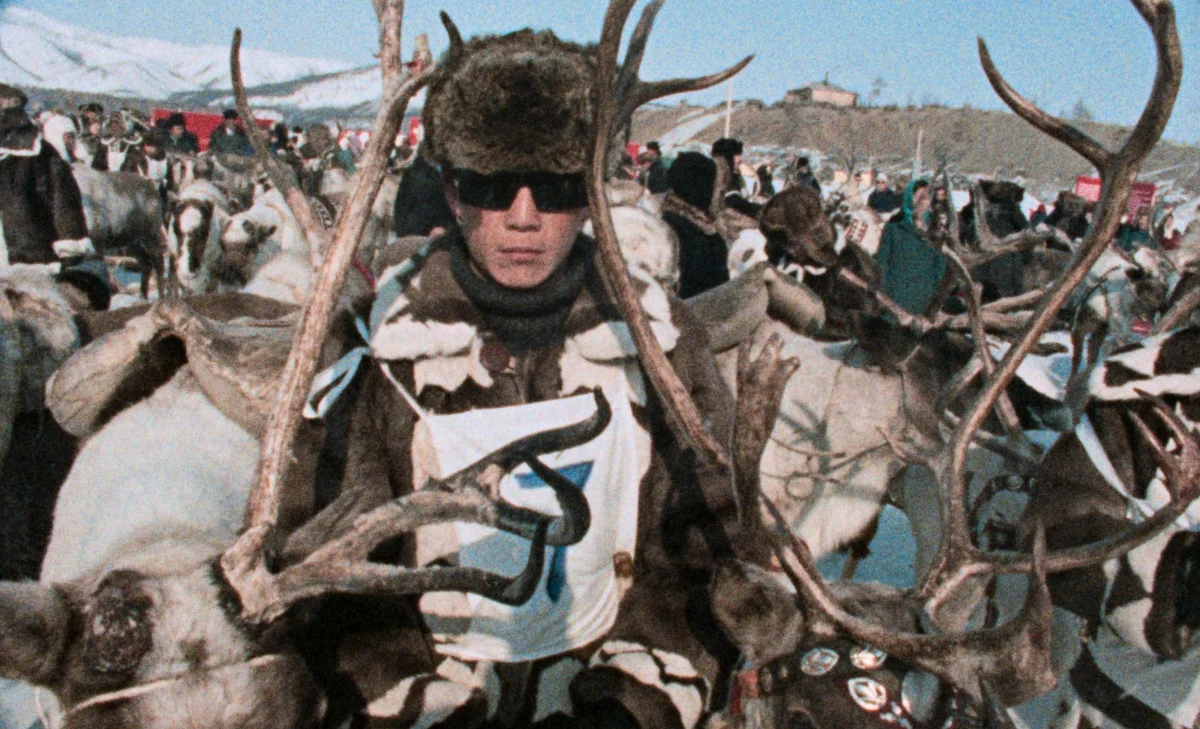
In the early 1970s, a team of Italian filmmakers embarked on a project of staggering ambition: to traverse the vast, heterogeneous geography of the USSR and capture the reality of a superpower that, to the Western eye, remained shrouded in a gray, monolithic fog. Armed with 16mm cameras and rare official clearance, these crews fanned out from the cobblestones of Red Square to the frozen reaches of the Sakha Republic. Yet, after a brief, truncated airing on Italian television, the footage vanished into the dark corners of the archives, effectively forgotten for half a century.
Today, master documentarian Sergei Loznitsa has rescued this material, weaving 60 hours of raw, unvarnished history into his latest film, Imperium. By stripping away the propagandistic veneer and focusing on the stubborn resilience of regional cultures, Loznitsa provides a haunting, panoramic look at a crumbling monolith—a state that claimed to be a unified, ideological machine while simultaneously harboring a kaleidoscope of disparate traditions that were never truly subsumed by the Kremlin’s reach.
A Chronology of Rediscovery: From Cold War Curio to Archival Masterpiece
The trajectory of Imperium begins with the geopolitical anxieties of the 1970s. At the time, the Western perception of the Soviet Union was largely defined by the binary extremes of the Cold War. In the United States, the discourse was increasingly dominated by the anti-communist rhetoric that would eventually culminate in Ronald Reagan’s "Evil Empire" speech—a term that reduced a complex, multi-ethnic civilization to a reductive, Star Wars-inspired trope.
The Italian perspective, however, was bifurcated by a domestic political landscape where the powerful Italian Communist Party (PCI) often shielded the public from the realities of life in the Eastern Bloc. When the Italian crews returned with their footage, the series was intended to be a monumental multi-chapter documentary. Instead, only a handful of episodes saw the light of day. The project was shelved, likely due to a combination of internal political censorship and a lack of appetite for a documentary that failed to neatly fit the prevailing ideological narratives of the era.
Loznitsa’s curation of this footage represents a major historical excavation. By organizing the journey along geographic lines—starting in Moscow, moving east through Siberia, looping back through the Central Asian "Stans," and ending in the Baltic republics before concluding in Leningrad—Loznitsa allows the footage to speak for itself. He utilizes his signature style: minimal intervention, occasional ambient sound design, and a refusal to impose a voice-over. The result is a historical document that feels like a time capsule unearthed from the permafrost.
The Illusion of Unity: Visual Evidence and Societal Contradictions
The film’s opening sequence serves as a masterclass in the dissonance between official state messaging and daily reality. We are greeted by the pageantry of the 24th Congress of the Communist Party in Red Square. Banners proclaim the fulfillment of production targets, echoing slogans that had remained static for four decades. The camera then pivots to the GUM department store, where window displays showcase luxury tuxedos and fine leather goods—items that ostensibly represented the "victory" of the proletariat, yet left the viewer to wonder which tier of the Soviet hierarchy could actually afford such finery.
This juxtaposition continues as the lens travels eastward. In Suzdal, the film captures an elderly woman washing clothes in an ice-covered hole, a scene of pre-Revolutionary austerity that stood in stark contrast to the gleaming, idealized images exported by Soviet state television. In the Siberian wilderness, the colonial dynamics become impossible to ignore. A group of Caucasian Russians plays guitars and sings songs of the Motherland, while local Yakut populations watch from the periphery—discontented, silent observers of a cultural hegemony that viewed their ancestral lands as nothing more than a backdrop for industrial resource extraction.
Religious Persistence in an Atheist State
One of the most compelling aspects of Imperium is its documentation of the persistence of faith. Despite the state’s rigorous, top-down mandate of atheism, the film captures a lively, thriving trade in Christmas decorations and quiet scenes of worship in Bukhara’s mosques and Etchmiadzin’s churches. These moments prove that the Soviet effort to engineer a "New Soviet Man," stripped of historical and religious identity, was a failure. The empire’s reach was vast, but its grip on the inner lives of its subjects remained tenuous.
Supporting Data: The "Stans" and the Baltic Resistance
The footage from Central Asia and the Baltic republics provides the most forceful critique of the Soviet project. In the "Stans," the footage captures societies that had not been fully collectivized. Traditions involving camel races and nomadic customs survived, operating parallel to the state apparatus.
For the contemporary viewer, these sequences serve as a vital corrective to the idea that the USSR was a singular, gray entity. The film reveals an immense state whose distinct regions maintained a defiant, unique cultural heartbeat. This resilience is what makes the subsequent collapse of the Soviet Union in 1991 feel, in retrospect, like an inevitability. The system was not a monolith, but a fragile assemblage of unwilling participants held together by the thin thread of central planning and the threat of state violence.
Implications: The Legacy of Utopianism
The release of Imperium arrives at a moment when Russia’s historical memory is being aggressively rewritten. While the film captures the absurdity of the Brezhnev-era state, it also invites a comparison to the present day. Vladimir Putin’s regime has adopted a different approach to social control—one that utilizes state-sanctioned religion and oligarchic capitalism rather than the forced atheism of the past. Yet, the underlying desire for a singular, unified narrative remains constant.
The broader implication of the film is a question regarding the nature of empires themselves: why do they consistently attempt to sell utopias, and why do populations, even when aware of the discrepancies between the promise and the reality, continue to endure them?
Loznitsa’s documentary serves as a companion piece to earlier works like Federico Ferrone and Michele Manzolini’s The Train to Moscow: A Journey to Utopia. That film, which chronicles an Italian party supporter’s disillusionment upon visiting the USSR, highlights the era’s "willful blindness." The Italian crews of the 1970s, by contrast, were often more observant, perhaps because they were tasked with capturing the "everyday" rather than the "heroic."
A Final Reflection: The Consumerist Aftermath
Perhaps the most ironic conclusion drawn from Imperium is the current state of these regions. Where Lenin and Brezhnev failed to unify the population through ideology, globalized capitalism and the internet have succeeded. The populations that once clung to their unique, pre-Soviet traditions as a form of passive resistance are now, in many cases, integrated into the global consumerist grid, looking toward Western markets for their acquisitions and their sense of self-worth.
Imperium is not an easy watch; its three-hour runtime requires a degree of patience that contrasts with the rapid-fire consumption of modern media. It is a film that demands the viewer grapple with the slow, crushing weight of history. For those old enough to remember the "Evil Empire" era, it serves as a profound reflection on how we once perceived our rivals. For younger audiences, it offers an essential, unvarnished look at the architecture of a vanished world.
Loznitsa has done more than just restore old footage; he has restored the humanity of those who lived within the borders of a system that tried, and failed, to define them. The empire has fallen, the banners have been burned, but the footage remains—a testament to the fact that, regardless of what the propaganda says, a people’s true identity is rarely found in the speeches of the Kremlin. It is found in the ice holes of Suzdal, the mosques of Bukhara, and the quiet, stubborn persistence of those who watched, waited, and outlasted the utopian dream.