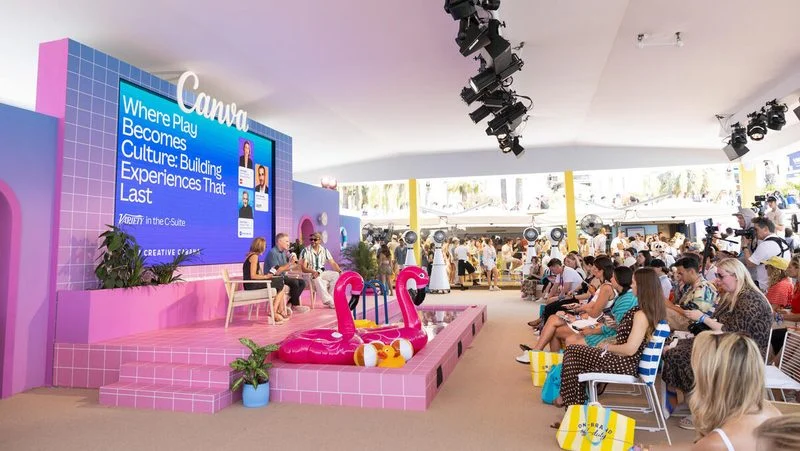
The 2024 Cannes Lions International Festival of Creativity served as more than just a celebration of advertising excellence; it functioned as a high-level laboratory for the world’s most influential brands. In a series of exclusive sessions recorded at the Canva Creative Cabana, Variety business editor Todd Spangler sat down with top executives from NBCUniversal, IBM, State Farm, Autodesk, and Coinbase to dissect the tectonic shifts currently reshaping marketing, technology, and consumer behavior.
The dialogue revealed a clear consensus: while artificial intelligence is the dominant catalyst for operational efficiency, the true competitive advantage remains in the delicate balance between machine-driven speed and human-centric storytelling.
The AI Paradox: Bridging the Talent Gap
The conversation opened with a critical examination of the current AI landscape. Dara Treseder, CMO of Autodesk, highlighted a growing “comfort gap” that threatens the labor market. Citing research indicating that 82% of the population is comfortable using AI in their daily lives, Treseder pointed out a startling discrepancy: only one-third of those individuals feel confident applying those same tools in a professional capacity.
“We don’t need AI to be our therapist, but we do need it to be a professional co-pilot,” Treseder noted. The data suggests a widening mismatch between job seekers and the evolving requirements of the modern workforce. To address this, Autodesk recently announced a $350 million initiative aimed at upskilling the next generation. The program focuses on critical sectors—architecture, engineering, construction, manufacturing, and media—ensuring that the human workforce is prepared to wield AI to design and "make" the future rather than be replaced by it.
The Operational Transformation: From Grunt Work to Creative Freedom
While some fear the impact of AI on creativity, IBM is proving that the technology serves as a liberator. Jonathan Adashek, Senior VP of Marketing and Communications at IBM, shared a candid look at how “Big Blue” has fundamentally restructured its internal workflows to favor high-value creative output.
According to Adashek, IBM’s creative team was previously bogged down by derivative tasks, spending roughly 80% of their time on repetitive production work. By integrating AI-driven automation, the company has slashed that figure to 40% and continues to trend downward.
The tangible results were on full display during IBM’s recent collaboration at the Sphere in Las Vegas. Tasked with a design project that would typically require over two weeks of conceptualization, the team utilized AI tools to finalize the design in just 48 hours. “The creatives involved actually said they got more ideas out of it because it gave them new things to think about,” Adashek reported. Beyond the creative output, the internal focus on automation has been a fiscal powerhouse, allowing IBM to trim $4.5 billion from its annual spend over the past three years, with plans to cut an additional $1 billion in the coming year.
The "Agentic" Future of Finance
Coinbase, representing the new guard of finance, is taking a different approach to AI integration. Cat Ferdon, CMO of the crypto giant, emphasized that for Coinbase, AI isn’t a retrofit—it is a foundational element.
“Coinbase has been super agentic-forward,” Ferdon stated, referencing the company’s internal philosophy championed by CEO Brian Armstrong. “We’ve been working it into our workflows for well over a year to optimize everything across marketing.”
However, Ferdon was quick to temper the excitement with a reality check on the limits of machine intelligence. While AI is a potent tool for accelerating the path to a creative outcome, she maintained that it is not a substitute for human ingenuity. The brand continues to prioritize the “human spark” in its campaigns, using AI to clear the path of administrative hurdles so that human strategists can focus on the core narrative.
Cultural Connectivity: Why Brands Must Go Where the Fans Are
As the tech conversation shifted to consumer engagement, the focus turned to the power of shared experiences. Kristyn Cooke, Chief Agency Sales Marketing Officer for State Farm, discussed the insurer’s strategic pivot toward cultural events like NBCUniversal’s BravoCon.
In an era of fragmented attention, State Farm has moved away from traditional, static advertising in favor of "passion point" marketing. “It’s about connecting around shared interests and relationships,” Cooke explained. By evolving their presence at BravoCon from simple branded booths to fully immersive, memorable experiences, State Farm has learned that the most effective way to reach the next generation of consumers is to become a facilitator of their joy.
“The audience is actually the story,” Cooke added. “They are super engaged, and by creating ways for fans to interact and feel something in that moment, we’ve found a much deeper resonance than traditional ads could ever provide.”
The Road to Los Angeles: NBCUniversal’s Olympic Ambition
The dialogue concluded with a look toward the future of media, specifically the 2028 Summer Games in Los Angeles. Mark Marshall, Chairman of Advertising Partnership for NBCUniversal, provided a staggering look at how far the media landscape has evolved since the last U.S.-hosted Summer Olympics in 1996.
In 1996, NBC aired 186 hours of programming. By 2028, the network is projected to broadcast nearly 8,000 hours. This exponential growth isn’t just about volume; it’s about the democratization of the viewing experience. Through platforms like Peacock, fans are no longer passive recipients of a curated broadcast; they are the curators of their own Olympic experience.
“You can watch live any sport you would like on Peacock, or you can have Mike Tirico’s soothing voice tell you the background stories of what happened that day,” Marshall explained. The strategy, which NBCUniversal is now infusing into its NBA, MLB, and NFL coverage, focuses on the "narrative arc." Fans want the stats, but they crave the human struggle and the journey behind the athlete.
Implications: A New Era of Professionalism
The takeaways from the Strictly Business conversations at Cannes are clear:
- AI as an Efficiency Multiplier, Not a Creative Replacement: The industry leaders agree that AI’s greatest value lies in eliminating the “grunt work” that stifles creativity. By offloading derivative tasks, companies like IBM are seeing massive financial savings and higher-quality creative work.
- The "Human" Premium: As AI becomes ubiquitous, the ability to create authentic, emotional connections—such as those fostered by State Farm at BravoCon—will become the ultimate differentiator.
- The Talent Mismatch: The massive investment from companies like Autodesk signals that the corporate world is aware of the skills gap. Future success depends on training the workforce to use AI tools, rather than fearing them.
- Content Curation at Scale: Media giants like NBCUniversal are moving away from monolithic broadcasting to personalized, story-driven content. The 2028 Olympics will serve as the ultimate proving ground for this personalized media model.
As these industry titans prepare for the next phase of the digital revolution, the message from the Canva Creative Cabana was unified: the future belongs to those who can master the machine while holding onto the humanity that defines their brand. Whether through the precise algorithms of a crypto exchange or the emotional storytelling of an Olympic broadcast, the goal remains the same: to meet the consumer where they are, with tools that empower, rather than replace, the human experience.