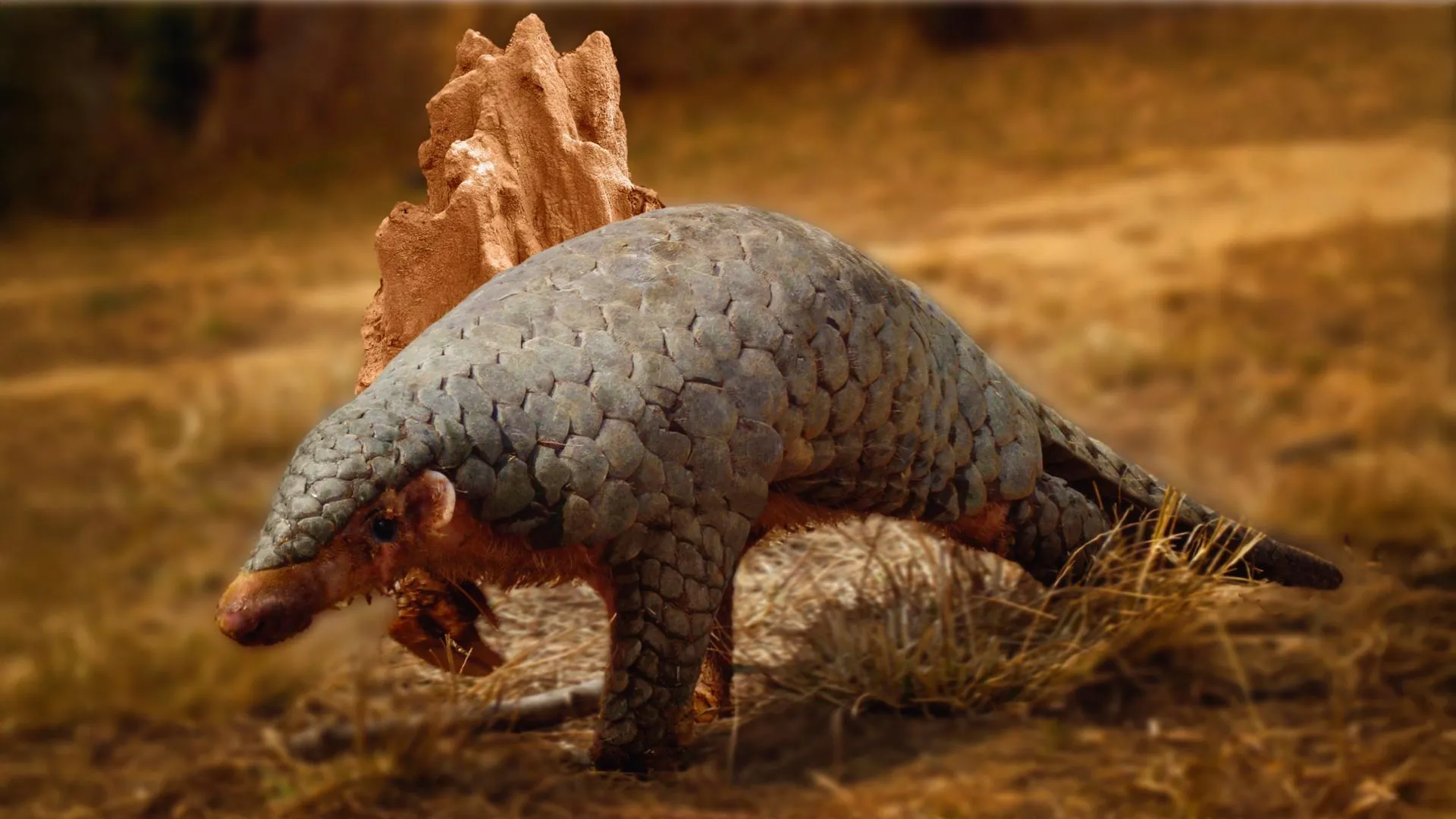
With their armor-plated, pinecone-like scales, powerful curved claws, and elongated, muscular tails, pangolins appear as if they have wandered directly out of the prehistoric era. These shy, medium-sized mammals, found exclusively across Africa and Asia, occupy a unique niche in the global ecosystem. However, their physical distinction has become their greatest burden. Due to the high demand for their keratin scales in traditional medicine and their meat as a luxury delicacy, pangolins have earned the unenviable title of the world’s most trafficked mammals. Many species now teeter on the precipice of total extinction.
In a landmark development for conservation biology, an international research team has confirmed the existence of a distinct, previously misclassified pangolin species: Manis aurita. Found across the rugged landscapes of Nepal and Northern India, this species had long been obscured by scientific confusion. The study, published in Communications Biology, does more than just update a taxonomy list; it provides a vital, scientifically backed framework that authorities hope will disrupt the global illegal wildlife trade and sharpen conservation strategies for an animal that is running out of time.
The Chronology of a Taxonomic Mystery
The road to identifying Manis aurita was a winding one, spanning nearly two centuries of observation and genetic analysis. The history of this species began in 1836, when scientists first described M. aurita. However, as scientific classification evolved, the species was eventually relegated to the status of a subspecies of the Chinese pangolin (Manis pentadactyla), effectively erasing it from the map of distinct, protected biodiversity.
The modern quest to "re-discover" the Himalayan pangolin began in earnest five years ago. Researchers in Nepal, led by Narayan Koju of the Nepal Engineering College at Pokhara University, documented evidence suggesting that the pangolins of the Himalayan foothills were genetically and morphologically distinct from their Chinese counterparts.
In 2025, a separate research group pushed the conversation forward by determining that animals previously grouped as "Chinese pangolins" were, in fact, two different entities. They proposed the name Manis indoburmanica—or the Indo-Burmese pangolin—for the mountain-dwelling form found in Nepal, India, Bhutan, and Myanmar.
However, taxonomic rules are governed by the principle of priority: the earliest validly published name must take precedence. This sparked a "taxonomic riddle" for Anderson Feijó of the Field Museum and his colleagues, who were simultaneously conducting a decade-long investigation into the evolutionary lineage of all pangolin species. They needed to know: were M. indoburmanica and the 1836-described M. aurita the same, and if so, which name was the rightful successor?
The resolution came from the Natural History Museum in London. By extracting and sequencing ancient DNA from a 190-year-old type specimen collected in 1836, the team confirmed a definitive match. The Himalayan pangolin is indeed Manis aurita, rendering the more recent 2025 designation a synonym.
The Science of the Himalayan Pangolin
The confirmation of M. aurita as a distinct species is based on a synthesis of modern genetic sequencing and morphological analysis. While to an untrained eye, all pangolins may look similar, the Himalayan pangolin possesses specific traits that set it apart from its Chinese cousin.
"Compared to the Chinese pangolin, the Himalayan pangolin has a bigger body, a longer tail, and smaller ears," explains Anderson Feijó, the Negaunee Assistant Curator of Mammals at the Field Museum. Interestingly, the name aurita is a nod to the animal’s distinctive ear morphology, a detail that had been overlooked for generations.
Beyond physical appearance, the geographic separation is key. The two species occupy distinct, non-overlapping ranges. For conservationists, this distinction is not merely academic—it is a matter of survival. Understanding the precise geographic limits of a species allows for better-targeted habitat protection and prevents the catastrophic errors of the past, such as the potential introduction of non-native species into a habitat during misguided, though well-intentioned, reintroduction programs.
Official Perspectives: The Value of Collaboration
The success of this study underscores the necessity of international cooperation and the indispensable role of natural history museums. The research was a massive undertaking, involving contributors from across the globe, including Guangzhou University, the Smithsonian National Museum of Natural History, the Guangdong Academy of Forestry, and the Chinese Wildlife Forensic Science Service.
"We can’t protect what we do not know," says Feijó. "Now that we have confirmed that this other species of pangolin exists, we can use that information to help protect these endangered animals."
Narayan Koju, the study’s first author, emphasized the long-term nature of this work. "The confirmation of Manis aurita as a valid species demonstrates the importance of long-term research, international collaboration, and museum collections. Most importantly, it provides a strong scientific basis for conservation planning, wildlife forensics, and efforts to protect one of the world’s most trafficked mammals from extinction."
The researchers noted that museum collections served as a "time machine," allowing them to access genetic material from populations that are now either extinct or extremely difficult to reach in the wild. Without the historical specimens curated in London, the true identity of the Himalayan pangolin might have remained hidden forever.
Implications for Global Conservation
The most profound implication of this study lies in the realm of wildlife forensics. Pangolin trafficking is notoriously difficult to police because illegal markets rarely contain intact animals. Instead, authorities typically seize thousands of loose, dried scales. Previously, identifying the exact source of these scales was nearly impossible, leaving investigators unable to pinpoint which populations were being decimated or where the poaching hotspots were located.
By defining the species boundaries of M. aurita, scientists have created a new "genetic map" for law enforcement. If officials can analyze DNA from confiscated scales and determine they originated from a specific, vulnerable population of Himalayan pangolins, they can trace that supply chain back to the source. This enables conservationists and law enforcement agencies to pivot from reactive enforcement to proactive protection, focusing their resources on the regions facing the highest poaching pressure.
Furthermore, this taxonomic clarity provides the necessary groundwork for future reintroduction efforts. Conservation programs are now better equipped to ensure that the animals they release into the wild are genetically compatible with the local, wild-dwelling population. By ensuring the "appropriate species is in the appropriate geographic range," scientists are drastically increasing the chances of successful recovery for the species.
A Future for the "Pinecone" Mammals
The story of Manis aurita is a reminder of how much of the natural world remains hidden in plain sight, often tucked away in the drawers of museum cabinets or obscured by centuries-old taxonomic errors. The confirmation of the Himalayan pangolin is a win for science, but the real test lies in the field.
As global demand for illegal wildlife products continues to threaten biodiversity, the ability to identify, track, and protect distinct species becomes the most powerful tool in the conservationist’s arsenal. Through the marriage of cutting-edge genomics and historical archives, researchers have given the Himalayan pangolin a fighting chance. Whether this information can be translated into policy that effectively ends the poaching crisis remains to be seen, but for now, the scientific community has provided the clearest roadmap yet to prevent another species from vanishing into the pages of history.