In the hallowed, dimly lit halls of the Natural History Museum in London, fossils often sit in quiet repose, their secrets buried beneath layers of dust and outdated scientific assumptions. For over 150 years, one such specimen—Praearcturus gigas—lay in wait, misidentified and largely misunderstood. Originally classified in 1871 as a primitive, giant crustacean akin to a prehistoric woodlouse, the fossil has finally been unmasked. A collaborative effort between researchers from The University of Manchester and the Natural History Museum has revealed that this creature was not a crustacean at all, but the largest scorpion ever known to science.
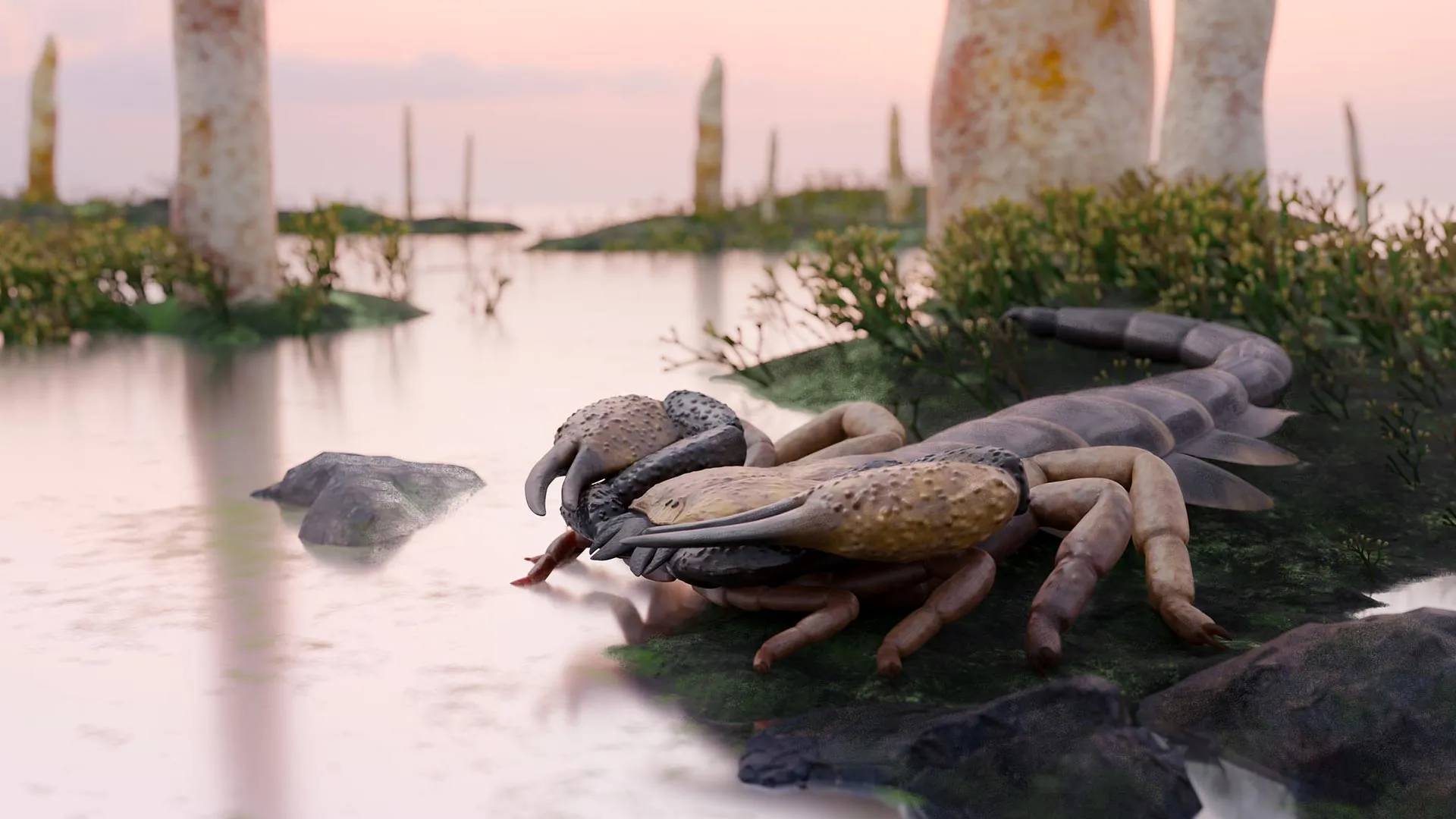
Measuring approximately one meter in length, with formidable pincers stretching over 16 centimeters, Praearcturus gigas was an apex predator that prowled the floodplains of the Early Devonian period, some 415 million years ago. This discovery does more than just rename a specimen; it fundamentally shifts the timeline of gigantism in the arthropod world, forcing paleontologists to reconsider the environmental pressures that drove prehistoric life to such extraordinary proportions.
A Chronology of Discovery: From Misclassification to Breakthrough
The saga of Praearcturus gigas is a testament to the enduring value of museum collections. When the fossils were first unearthed and cataloged in the late 19th century, paleontologists lacked the comparative anatomy and high-resolution imaging required to identify the creature’s true lineage. The fossilized remains were fragmentary, lacking the diagnostic tail segment—the "smoking gun" of scorpion morphology—which led early researchers to misidentify the animal as an isopod-like crustacean.
For more than a century, the fossil remained a taxonomic puzzle. However, the dawn of the 21st century brought a wave of technological advancement in paleontology. By utilizing modern analytical methods, including high-resolution CT scanning and digital reconstruction, researchers were able to compare the century-old specimens against more recently discovered, better-preserved fossil records.
The study, published in the prestigious journal Palaeontology, utilized these advanced imaging techniques to isolate anatomical markers specific to scorpions. The identification of specific body segments and appendage structures confirmed that Praearcturus was indeed a scorpion, marking it as a distinct species that predates the previously accepted era of giant arthropods by at least 50 million years.
Supporting Data: An Ecosystem Before the Forest
To understand the sheer scale of Praearcturus, one must understand the environment it inhabited. The Early Devonian was a world in transition. Terrestrial life was in its infancy; the landscape was devoid of the towering forests that would later define the Carboniferous period. Instead, the Earth was characterized by primitive, low-lying plants and sprawling fungal mats.
Traditional paleontological theory has long held that arthropod gigantism—the tendency for insects and arachnids to grow to massive sizes—was primarily driven by the oxygen-rich atmospheres of the later, forest-dense Carboniferous period. During that later epoch, oxygen levels were significantly higher than they are today, which purportedly allowed invertebrates with passive respiratory systems to support massive body sizes.
Praearcturus, however, shatters this model. Living well before the rise of the first true forests, it inhabited a world with different atmospheric dynamics. The researchers propose that the creature’s size was not a response to oxygen levels, but rather a product of "ecological opportunity." In an environment where land-based predators were scarce and competition for resources was low, Praearcturus found a niche where it could grow without the threat of being preyed upon or outcompeted by other large-bodied animals.
Aquatic Ambitions: A Bridge Between Worlds
A critical component of the research centers on the creature’s habitat. The fossilized specimens preserve unique flap-like structures on the abdomen—features strikingly similar to those seen in modern aquatic crustaceans like lobsters. This suggests that Praearcturus was likely semi-aquatic, capable of traversing both land and shallow water.
This hypothesis is bolstered by the prevalence of scorpion fossils in the sedimentary rocks of this era. The researchers note that scorpions are unusually abundant in these deposits, a pattern that points toward a preference for freshwater environments. Such habitats would have offered an easier path to fossilization, explaining why we have such a clear record of these early arachnids. This places Praearcturus at a pivotal moment in evolutionary history: a time when animals were testing the boundaries of the ocean, beginning the tentative, dangerous transition to a permanent life on land.
Official Responses: Voices from the Field
The scientific team involved in the re-evaluation of Praearcturus emphasizes that this discovery is a victory for both historical preservation and modern technology.
Dr. Richard J. Howard, Curator of Fossil Arthropods at the Natural History Museum and the study’s lead author, highlighted the significance of the findings: "When we think of giant arthropods, people often picture Carboniferous rainforests with giant millipedes or dragonfly-like insects. But Praearcturus lived at least 50 million years earlier, well before the evolution of trees, when life on land was only just getting started. Confirming that this animal is a scorpion fundamentally changes our understanding of how and when these creatures evolved to such extraordinary sizes."
Dr. Russell Garwood, a paleontologist at The University of Manchester, shared his enthusiasm for the project: "Praearcturus has puzzled us paleontologists for more than a century. By bringing together material from several collections and using cutting-edge imaging techniques, we’ve been able to build a clearer picture of the animal than was previously possible. What makes it so interesting is that it became enormous at a time when life on land was otherwise very small. It suggests a world that could somehow support a giant predator, perhaps because it spent a significant amount of time in the water, where life was historically larger."
Dr. Greg Edgecombe, a Merit Researcher at the Natural History Museum and co-author of the study, added a layer of complexity to the evolutionary narrative: "The boundary between land and sea was much less defined at this time. Praearcturus gives us a fascinating glimpse into how early animals adapted to these changing environments. It may even represent a lineage that returned to the water after earlier ancestors had already begun living on land."
The Broader Implications: Rewriting the Evolutionary Narrative
The identification of Praearcturus gigas as the world’s largest scorpion forces a re-evaluation of the "rules" of evolution. For decades, the narrative of invertebrate evolution was tied strictly to environmental triggers—most notably, oxygen spikes and the development of dense, complex vegetation. By identifying a giant that thrived in the absence of these factors, scientists must now pivot toward a more nuanced understanding of ecological dynamics.
The Power of Ecological Opportunity
The study posits that the most significant driver for the rise of this titan was the lack of competition. In the empty, burgeoning ecosystems of the Early Devonian, there were few, if any, large-bodied predators capable of challenging Praearcturus. This "ecological vacuum" allowed the scorpion to occupy a dominant role, reaching sizes that would later become a liability as more competitive and complex species began to populate the landscape.
A New Respect for Legacy Collections
Beyond the biological revelations, the study serves as a poignant reminder of the importance of natural history museums. In an era where funding for field research is often prioritized, this finding underscores the massive, untapped potential residing in the cabinets of archives across the globe. Thousands of fossils, collected by Victorian-era naturalists, remain identified by the outdated taxonomy of their time. The re-discovery of Praearcturus suggests that the next major breakthrough in evolutionary biology may not be found in a remote jungle or a deep-sea trench, but in a drawer that hasn’t been opened in over a century.
Future Research Directions
As the scientific community digests the implications of this discovery, the next steps are clear. Researchers intend to continue applying high-resolution imaging to other "misidentified" specimens from the same era. By expanding the sample size of these early arthropods, they hope to map the transition of life from the oceans to the continents with unprecedented clarity.
Furthermore, the team plans to investigate the biomechanics of Praearcturus. By modeling the movement of its pincers and the structure of its exoskeleton, they hope to determine how it navigated the rugged, changing terrain of a young Earth.
In conclusion, Praearcturus gigas is more than a prehistoric curiosity; it is a key that unlocks a deeper understanding of the early days of life on land. By challenging our assumptions about the causes of gigantism and proving the enduring importance of museum collections, this giant scorpion reminds us that the history of Earth is constantly being rewritten—one scan, one measurement, and one fossil at a time. The titan of the Devonian has finally emerged from the shadows of history, and in doing so, it has cast a long, fascinating shadow over everything we thought we knew about the evolution of the world’s most successful creatures.