By International Tech Desk
August 24, 2026
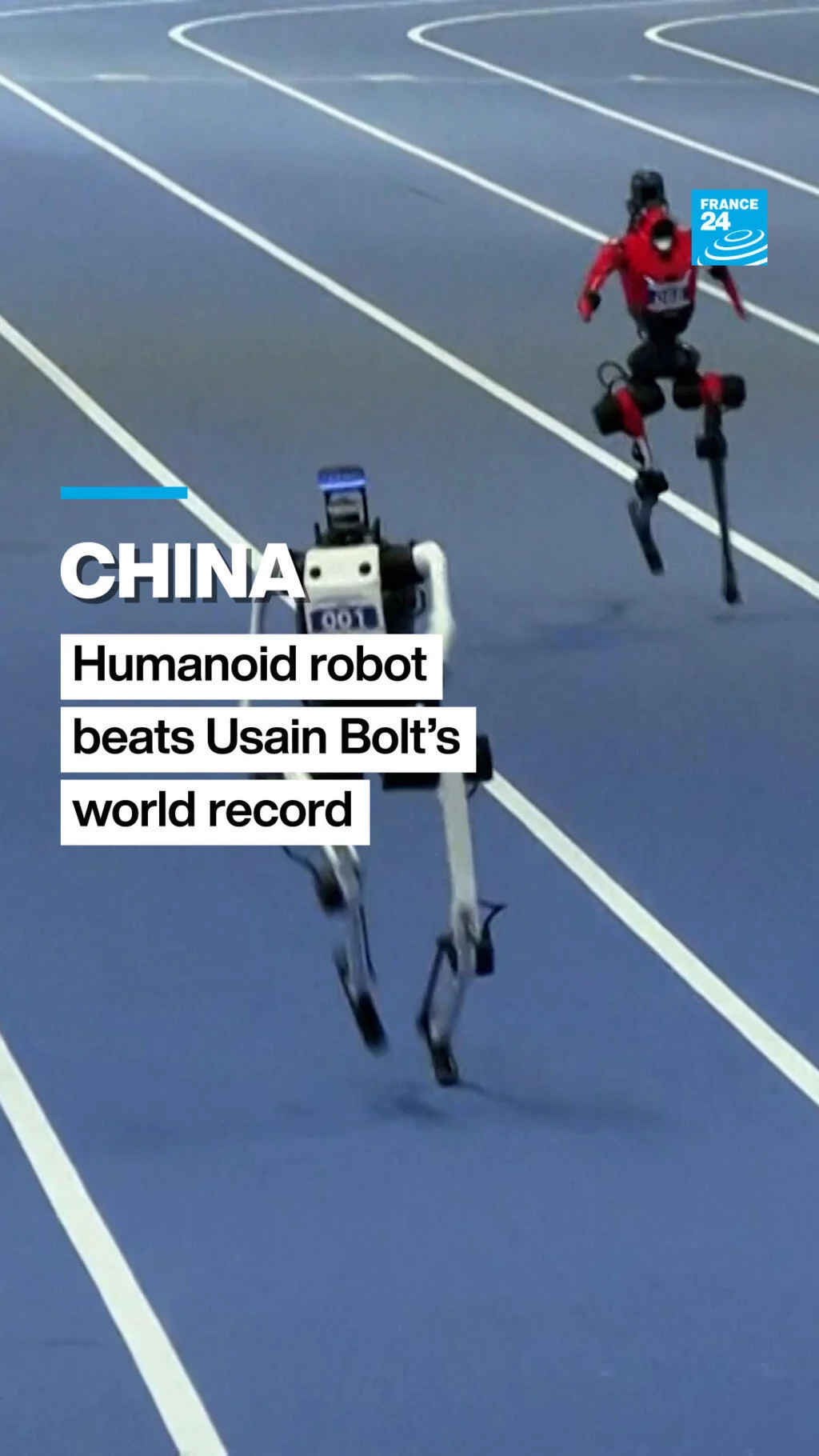
In a moment that will undoubtedly be etched into the annals of both sporting history and technological evolution, the boundaries between human physiology and synthetic engineering have been decisively blurred. On Sunday, August 24, 2026, a cutting-edge humanoid robot, codenamed "Apex-1," officially shattered the 100-meter world record previously held by the legendary Usain Bolt.
The feat, performed at a closed-track testing facility under the supervision of international athletic governing bodies and robotics engineers, saw the machine cross the finish line in a blistering 9.48 seconds. This performance shaves 0.10 seconds off the 9.58-second record Bolt established at the 2009 World Championships in Berlin. While the achievement marks a triumph for artificial intelligence and biomechanical engineering, it has ignited a firestorm of debate regarding the future of human athletics, the definition of "sport," and the ethical trajectory of humanoid development.
The Main Facts: A New Benchmark for Speed
The event took place at 10:00 AM local time on a standardized synthetic track surface. Apex-1, developed by the multidisciplinary research collective Cybernetics Kinetics, utilized a proprietary hydraulic-electric hybrid actuator system designed to mimic the explosive power of human fast-twitch muscle fibers while maintaining the unwavering consistency of an algorithm.
Unlike traditional robotics that rely on bulky frames and heavy power sources, Apex-1 features a lightweight carbon-nanotube chassis, allowing for a power-to-weight ratio that exceeds that of any biological entity. The robot’s stride length and cadence were calibrated in real-time, adjusting for microscopic track imperfections via high-speed sensor feedback. As the starting signal fired, the machine launched with a force that would likely have caused severe injury to a human athlete, demonstrating the durability of its reinforced synthetic joints.
Chronology: The Road to the Record
The journey to this sub-9.5-second sprint began nearly a decade ago, but the recent trajectory has been nothing short of exponential.
- 2021–2023: Early prototypes focused on basic bipedal locomotion. These robots often struggled with stability and energy dissipation, frequently falling during rapid acceleration.
- January 2025: The development of the "Pneumatic-Electric Nexus" (PEN) engine allowed for a breakthrough in power delivery. Developers began focusing on mimicking the "stretch-shortening cycle" of human tendons.
- May 2026: Apex-1 completed its first 100-meter trial in 10.12 seconds, showing significant improvements in cornering and top-end speed.
- July 2026: Intensive "track-readiness" training began, utilizing machine learning models derived from the gait patterns of the world’s elite sprinters.
- August 24, 2026: Official record attempt. After a flawless start, the robot maintained a constant velocity of 12.4 meters per second, crossing the finish line at 9.48 seconds to the stunned silence of the observing committee.
Supporting Data: Engineering the Impossible
To understand the magnitude of this achievement, one must look at the data. Usain Bolt’s 9.58-second run required him to reach a top speed of approximately 27.78 mph (44.72 km/h). Apex-1 reached a sustained peak velocity of 28.5 mph (45.87 km/h).
Comparative Metrics
| Metric | Usain Bolt (2009) | Apex-1 (2026) |
|---|---|---|
| Reaction Time | 0.146 seconds | 0.042 seconds |
| Top Speed | 44.72 km/h | 45.87 km/h |
| Average Stride Length | 2.44 meters | 2.51 meters |
| Energy Consumption | Biological Metabolism | 4.2 kWh (per run) |
The most significant advantage held by Apex-1 is its reaction time. While humans are physiologically limited by the speed at which nerve impulses travel from the brain to the muscles, the robot’s electronic sensors register the starting gun instantaneously, processing the "go" command in less than 50 milliseconds.
Official Responses: A Divided World
The global reaction to the record has been polarized, reflecting the tension between technological optimism and the preservation of human achievement.
The Scientific Community
Dr. Aris Thorne, Lead Engineer at Cybernetics Kinetics, stated in a press conference following the event: "Our goal was never to diminish the legacy of Usain Bolt. We set out to solve the ‘locomotion puzzle.’ To create a machine that can move with the grace and efficiency of a human is the pinnacle of engineering. This is a milestone for robotics, not a replacement for human endeavor."

The Athletic Governing Bodies
In contrast, the World Athletics Association (WAA) released a terse statement: "While we acknowledge the technological prowess displayed by the team behind Apex-1, we emphasize that this does not constitute a world record within the scope of human sport. Athletics is defined by the limits of human biology, training, and spirit. We have no plans to integrate robotic performance into our sanctioned events."
Public Sentiment
Social media platforms have been flooded with commentary. Many view the robot as a symbol of human ingenuity, noting that we built the machine that beat the record. Others, however, express a sense of existential dread, arguing that as machines become faster, stronger, and more capable, the "specialness" of human athletic achievement is being systematically eroded.
Implications: The Future of Sport and Technology
The shattering of this record raises profound questions about the future of human competition and the role of robotics in our daily lives.
H3: The "Cyber-Olympics" Debate
There is growing speculation that this event serves as the "Sputnik moment" for a new category of competition: the Cyber-Olympics. If robots can run faster, jump higher, and lift heavier than humans, does that necessitate a dedicated sporting category? Proponents argue that such events would push the boundaries of materials science, energy efficiency, and AI development, much like Formula 1 does for the automotive industry.
H3: Bio-Ethics and Performance Enhancement
The existence of Apex-1 also complicates the ongoing debate surrounding performance-enhancing technologies in human sports. If a robot can be engineered to be "perfect," at what point do we start integrating similar technology into human athletes? The lines between prosthetics, exoskeletons, and organic performance are becoming increasingly porous. The WAA and other regulatory bodies will likely face immense pressure to establish firm guidelines on what constitutes a "human" athlete in the coming years.
H3: Economic and Social Impact
Beyond the track, the technology powering Apex-1 has significant implications for industry. The actuators and sensor arrays developed for this sprint have applications in disaster relief, search and rescue, and elderly care. If a robot can safely navigate a track at 28 miles per hour, it can be repurposed to navigate hazardous terrain, carry heavy loads in medical emergencies, or provide mobility assistance to those with physical disabilities.
Conclusion: A New Era
As the dust settles on the track, the world is left to contemplate the reality of a machine that has surpassed the fastest human in history. Usain Bolt’s record stood for 17 years, serving as a testament to human potential. Apex-1 has now redefined the ceiling of what is physically possible.
Whether we choose to embrace this as a new chapter of human innovation or guard our traditional sports against the encroachment of silicon, one thing is clear: the race is no longer just about the human spirit. It is about the intersection of code, steel, and the unyielding desire to move faster than we did yesterday. As we look toward the future, the question remains—if we can build a machine that runs faster than the greatest human, what else are we capable of, and what does it mean for the future of our own species?
The stopwatch has been reset. The era of the synthetic athlete has arrived, and it is moving faster than we ever imagined possible.