In a remarkable testament to the hidden treasures lying within museum archives, a collaborative team of paleontologists has unearthed a breakthrough discovery from specimens that have remained dormant for over three decades. Researchers from the Okayama University of Science, Tokyo City University, and the Natural History Museum of Kishiwada have identified four fossilized bones—previously overlooked—embedded within rock matrix containing mosasaur remains.
This discovery, unveiled at the 177th Annual Meeting of the Palaeontological Society of Japan on June 27, 2026, has ignited excitement within the scientific community. Among the newly identified remains is a premaxilla—the foremost bone of the upper jaw—marking the first time such a specimen has been confirmed in a Japanese mosasaur fossil. Beyond its anatomical significance, the presence of unique, horn-like projections on the basisphenoid bone suggests that this prehistoric marine predator may represent a species entirely new to science.
Chronology of a Discovery: From Sobura to the Laboratory
The story of this specimen began in the early 1990s, a golden era for fossil hunting in the Osaka Prefecture. Between 1990 and 1992, field researchers discovered fossilized marine remains in the Sobura area of Kaizuka City. At the time, the fossils were carefully collected and transferred to the Natural History Museum in Kishiwada, where they were cataloged and stored.
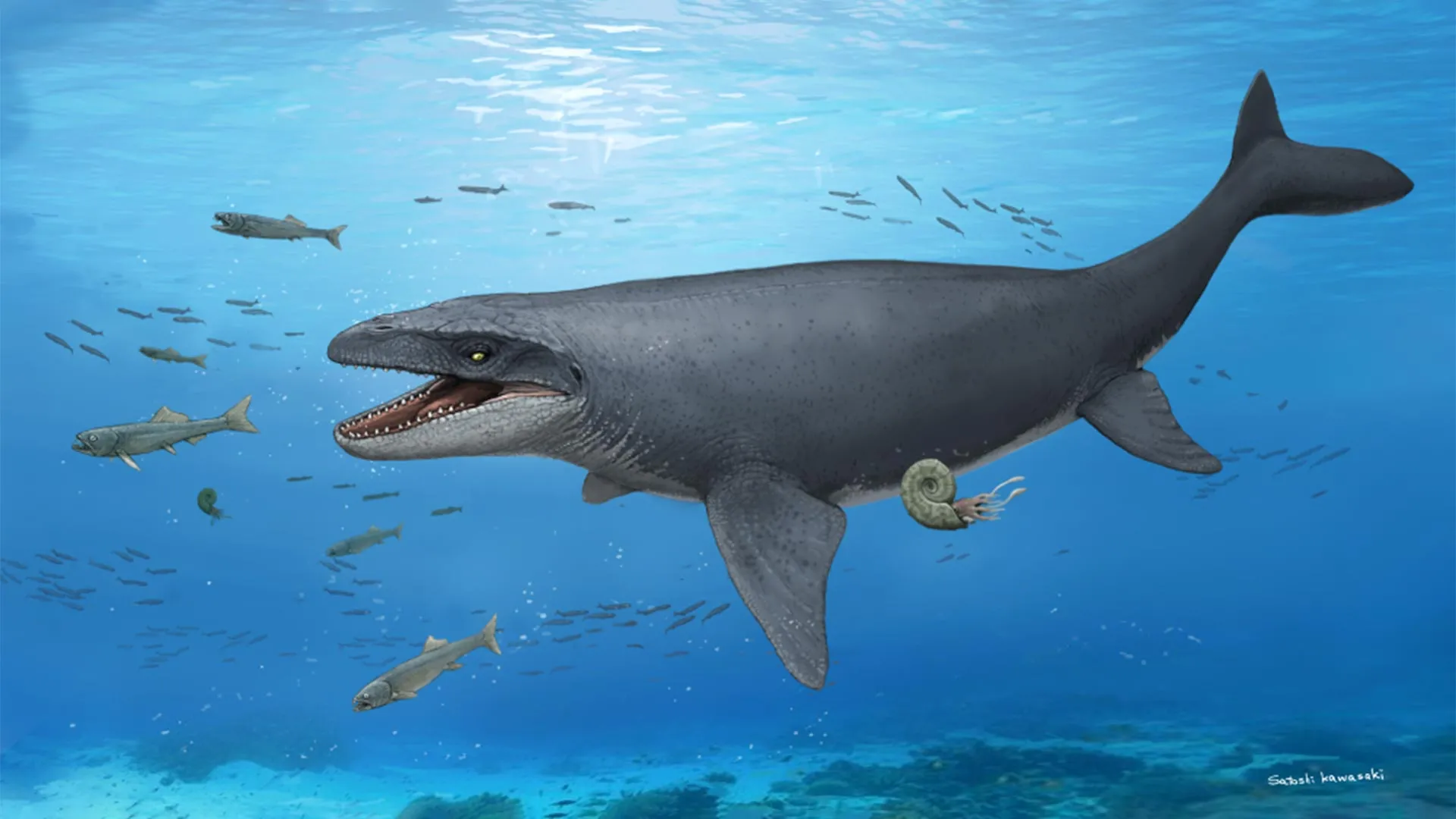
For nearly thirty years, the remains were studied using the limited comparative data available at the time. Paleontology in the early 1990s lacked the vast, digitized global databases and high-resolution imaging technology that define the field today. Consequently, while the bones were identified as belonging to a mosasaur—a fearsome group of apex marine reptiles that dominated the oceans during the Late Cretaceous (98 to 66 million years ago)—their specific anatomical nuances remained elusive.
The recent breakthrough occurred when a team of modern researchers decided to revisit the "unprepared" rock matrix surrounding the original find. Often, in the rush of initial discovery, fossilized bones remain partially encased in protective sedimentary rock. By utilizing advanced cleaning techniques and modern microscopic analysis, the team successfully extracted four additional bones that had been hidden in plain sight since the Cold War era.
Anatomical Anomalies: Defining a New Predator
The identification of the premaxilla is arguably the most significant aspect of the find. As the primary structural component of the snout, the premaxilla provides critical insights into the animal’s feeding habits, jaw mechanics, and overall evolutionary lineage. Prior to this discovery, the Japanese fossil record for mosasaurs was fragmented, often lacking the delicate cranial bones required for definitive species identification.
However, it was the analysis of the basisphenoid—a complex bone situated near the braincase—that truly signaled the possibility of a new species. When the team compared this bone against the established catalog of known mosasaur genera, they noted striking discrepancies.
The basisphenoid in the Sobura specimen features distinct, short, lateral projections that resemble horns. Furthermore, it notably lacks the ventral median groove typically observed in other documented mosasaur species of the era. In the biological world, such distinct structural variations in the cranial anatomy are often indicative of evolutionary divergence. While further analysis is required to confirm its status as a distinct species, the current evidence suggests that this marine reptile possessed a unique morphological profile that separated it from its contemporaries in the Pacific basin.
Supporting Data: The Evolution of Comparative Paleontology
The successful identification of these fossils underscores a critical shift in modern paleontology: the move toward "re-discovery" through data accumulation. In the 1990s, a researcher looking at a basisphenoid bone would have had to rely on a handful of physical casts or hand-drawn sketches from other museums. Today, the research team at Okayama University and their partners had access to a global network of comparative anatomical data.
This leap in information technology allowed the team to look at the "unusual" features of the bone not as aberrations, but as distinct taxonomic markers. By comparing the Sobura specimen against the wealth of data gathered from North American, European, and Middle Eastern mosasaur discoveries over the last thirty years, the researchers were able to confirm that the anatomy simply did not match any known genus.
This highlights the importance of preserving "unprepared" specimens. Many museums hold thousands of tons of rock and fossil material that were collected decades ago. As our understanding of evolutionary biology deepens, these archives become a "time capsule" of potential discoveries, waiting for the right technology and the right questions to be asked.
Implications for Northwestern Pacific Ecosystems
The presence of this potentially new mosasaur species offers a significant window into the marine ecosystems of the Northwestern Pacific during the Late Cretaceous. Mosasaurs were the "T-Rex of the seas," occupying the top of the food chain after the decline of ichthyosaurs and pliosaurs. Understanding their diversity in the waters surrounding what is now Japan is essential to mapping the biodiversity of the ancient Pacific.
If this specimen is confirmed as a new species, it suggests that the Cretaceous Pacific supported a more complex and localized variety of marine reptiles than previously realized. It implies that these creatures may have evolved in relative isolation or developed specialized adaptations to thrive in the specific environmental conditions of the ancient Japanese archipelago. This discovery may force a revision of current migration patterns and ecological models for the Late Cretaceous, as scientists begin to integrate this new "Osaka mosasaur" into the broader picture of marine evolution.
Official Responses and Future Research
The announcement at the 177th Annual Meeting of the Palaeontological Society of Japan has been met with both enthusiasm and professional caution. The research team, led by experts from Okayama University of Science and Tokyo City University, emphasized that while the morphological evidence is compelling, the taxonomic process is rigorous.
"We have uncovered a piece of the puzzle that was hidden for thirty years," noted one of the lead researchers during the presentation. "The anatomical markers are highly unusual, and they do not conform to existing models. However, the next phase of our work will involve peer-reviewed comparisons and, if possible, more detailed CT scanning of the interior of the bone structures to ensure our classification is accurate."
The Natural History Museum in Kishiwada, which has housed these specimens since the early 1990s, expressed pride in the role their archives played in the study. This collaboration serves as a model for future research: linking university-level expertise with regional museum collections.
As the team moves forward, they plan to conduct a comprehensive comparative study involving international partners. The goal is to reach a consensus on whether the Sobura mosasaur warrants a new genus and species name. Regardless of the final taxonomic classification, the discovery has already achieved something vital: it has reinvigorated interest in the Cretaceous history of the Osaka region and demonstrated that in paleontology, the most exciting discovery of the year might be sitting on a shelf, waiting to be rediscovered.
Conclusion: The Value of Archival Science
In an era where technology often overshadows traditional fieldwork, the Sobura mosasaur discovery serves as a powerful reminder of the value of archival science. It is not always necessary to dig in the dirt to make a groundbreaking discovery; sometimes, it is enough to look at what has already been found with fresh eyes and better tools.
As the scientific community awaits further validation of the potential new species, the story of these four bones continues to resonate. It is a story of patience, the power of collaboration, and the enduring mystery of the Late Cretaceous oceans. For the researchers at Okayama University and their partners, the work has only just begun. The Sobura mosasaur is no longer a forgotten relic of the 1990s; it is the center of a new, unfolding chapter in the history of marine life.