In the silent, pressurized vaults of the world’s most prestigious museums, thousands of blackened, calcified "bricks" sit in climate-controlled isolation. These are the scrolls of Herculaneum—the only intact library to survive from classical antiquity. For centuries, they have been considered functionally unreadable, their papyrus fibers fused together by the searing 79 C.E. volcanic surge of Mount Vesuvius. To attempt to unroll them is to invite their destruction, as they crumble into fine, carbonized dust at the slightest touch.
However, a breakthrough study published on September 16 in the journal PLOS ONE suggests that the key to unlocking this intellectual treasure trove has been hidden in plain sight: the chemistry of the ink itself. By recreating the catastrophe of Vesuvius on a miniature scale, an eclectic team of researchers led by Douglas Seiler, an affiliate of Berkeley SETI, has demonstrated that if ancient scribes used lead-based pigments, those long-lost words could be recovered with unprecedented clarity using X-ray tomography.
A Macabre Experiment: Recreating a Catastrophe
The path to this discovery was anything but traditional. Douglas Seiler, a retired inventor with a background in banking and real estate, approached the ancient mystery with the pragmatic ingenuity of an engineer. To test the hypothesis that metal-based ink could act as a beacon for X-ray imaging, he needed a control group—modern scrolls that mimicked the specific, brittle state of the Herculaneum artifacts.
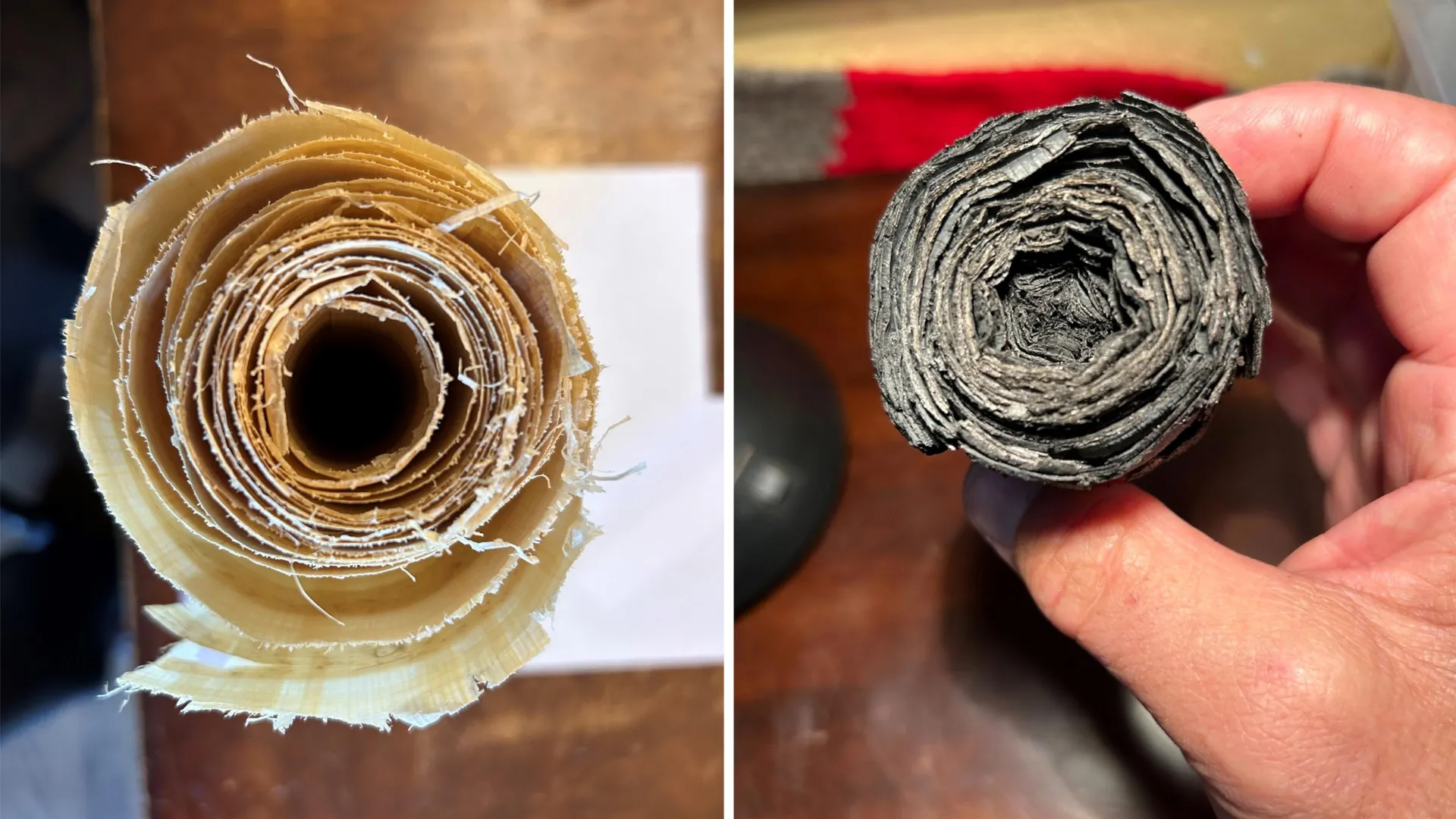
Seiler sourced authentic Egyptian papyrus and reed pens, pairing them with traditional Japanese lampblack ink. He then commissioned local high school students to transcribe a eclectic mix of texts—passages from the Bible, lines from Star Wars, and quotes from the cult science-fiction show The Outer Limits.
Once the writing was complete, the scrolls were rolled, sealed in airtight containers, and subjected to a high-temperature furnace. The goal was to replicate the rapid carbonization caused by the volcanic ash of Vesuvius. The result was a set of fragile, charred replicas that bore an eerie resemblance to the Roman scrolls recovered from the Villa of the Papyri.
The Chemistry of Clarity
The central hypothesis of Seiler’s research rests on the contrast between the ink and the medium. Historically, researchers have struggled to read carbonized scrolls because carbon ink on carbonized papyrus provides virtually zero visual contrast. Under X-rays, the two materials appear almost identical.
Seiler reasoned that if an ancient scribe used ink containing metallic elements—specifically lead—that material would absorb X-rays far more aggressively than the surrounding charred plant fibers. To test this, he enlisted retired Berkeley chemists David and Elena Kreimer to prepare inks with varying concentrations of lead nitrate.
The results were transformative. When subjected to X-ray computed tomography (CT) scans, the lead-infused letters "lit up like a Christmas tree." The lead absorbed as much as 25 times more X-ray radiation than the burned papyrus, creating a high-contrast signature that allowed computer algorithms to distinguish characters even within tightly rolled, charred layers.
Chronology of a Digital Excavation
The efforts to decipher Herculaneum’s secrets have spanned centuries, moving from disastrous physical attempts to sophisticated digital reconstruction:
- 1752: Discovery of the Villa of the Papyri. Early, invasive attempts to physically unroll the scrolls result in the destruction of countless irreplaceable texts.
- 2009: Dr. Brent Seales of the University of Kentucky pioneers the use of micro-CT scans to "virtually" look inside the scrolls without unrolling them.
- 2015: Seales demonstrates successful digital unrolling of a charred scroll from a 600 C.E. synagogue.
- 2023: The launch of the "Vesuvius Challenge," a global competition offering $700,000 to those who can decipher charred text using AI and CT imaging.
- 2024: AI researchers successfully recover 15 columns of text from a scroll, revealing a philosophical work on perception and pleasure.
- 2026: Further AI-driven breakthroughs identify texts attributed to ancient Stoic philosophers, potentially dating back to the 3rd century B.C.E.
- September 2024: Seiler’s team publishes the PLOS ONE study, providing a methodology to prioritize the most "readable" scrolls by screening for lead content using X-ray fluorescence.
Supporting Data: The "Holy Grail" of Archeology
The efficacy of Seiler’s method is supported by the work of Leah Packard-Grams, a papyrologist at UC Berkeley. By analyzing ink fragments from the Tebtunis Papyri—a collection of Egyptian documents spanning from 300 B.C.E. to 300 C.E.—Packard-Grams identified the presence of lead and copper in inks used as early as the first century C.E.
This suggests that the "metallic signature" is not just a theoretical possibility, but a historical reality. If the Herculaneum scrolls contain even trace amounts of these metals, handheld X-ray fluorescence scanners could act as a filter, allowing researchers to identify which of the 1,800 surviving scrolls are the most viable candidates for expensive, time-consuming CT scanning.
Furthermore, the team utilized a clever software adaptation to handle the imagery. Michael Cyrus Daugherty, a former NIST fellow, repurposed an algorithm originally designed to map the internal "jelly rolls" of lithium-ion batteries. By tweaking the code to accommodate the uneven, warped surface of a charred scroll, the team was able to digitally "unroll" their test samples with startling precision.
Official Responses and Scholarly Impact
The reaction within the academic community has been one of cautious optimism and intense excitement. Archaeology graduate student Leah Packard-Grams, who consulted on the project, notes that the stakes are "the largest in the history of Greek literature."
"Almost everything from antiquity has been destroyed," Seiler explains. "There’s very little left except papyrus that was in a dry climate… but some of the Herculaneum scrolls aren’t copies. These are books directly from the ancient world frozen in time."
Dr. Karl van Bibber, a professor of nuclear engineering at Berkeley, views Seiler as a modern iteration of the "gentleman scientist"—a researcher driven by intellectual curiosity rather than the constraints of traditional academia. His endorsement underscores the interdisciplinary nature of the project, which bridged the gap between nuclear physics, inorganic chemistry, and classical philology.
Implications for the Future of History
The potential implications of this study are profound. If we can systematically identify lead-rich scrolls, the current pace of decipherment could accelerate exponentially. For years, the Vesuvius Challenge has relied on the sheer computational power of AI to detect microscopic textural changes in CT scans—a process prone to error and ambiguity. Adding a "lead filter" to this process would provide a definitive chemical anchor for machine learning models, significantly reducing the noise and uncertainty in the output.
Beyond the technical success, the study highlights the value of experimental archeology. By building models that can be destroyed, burned, and scanned, researchers have developed a "safe space" to refine their tools. As Packard-Grams noted, "If you hurt a model, it’s fine. If you hurt a 2,300-year-old ancient artifact, you’ll have a bunch of archaeologists ready to jump you."
The journey from a hobbyist’s curiosity at the Berkeley SETI center to a peer-reviewed breakthrough in PLOS ONE has been long, but it has yielded a roadmap. We now know that the answers to some of history’s greatest mysteries may be hidden within the metallic isotopes of a scribe’s ink, waiting for the right frequency of light to reveal them. The "Holy Grail" of classical scholarship is no longer a myth; it is a task of scanning, sorting, and waiting for the silent, blackened pages of Herculaneum to speak once more.