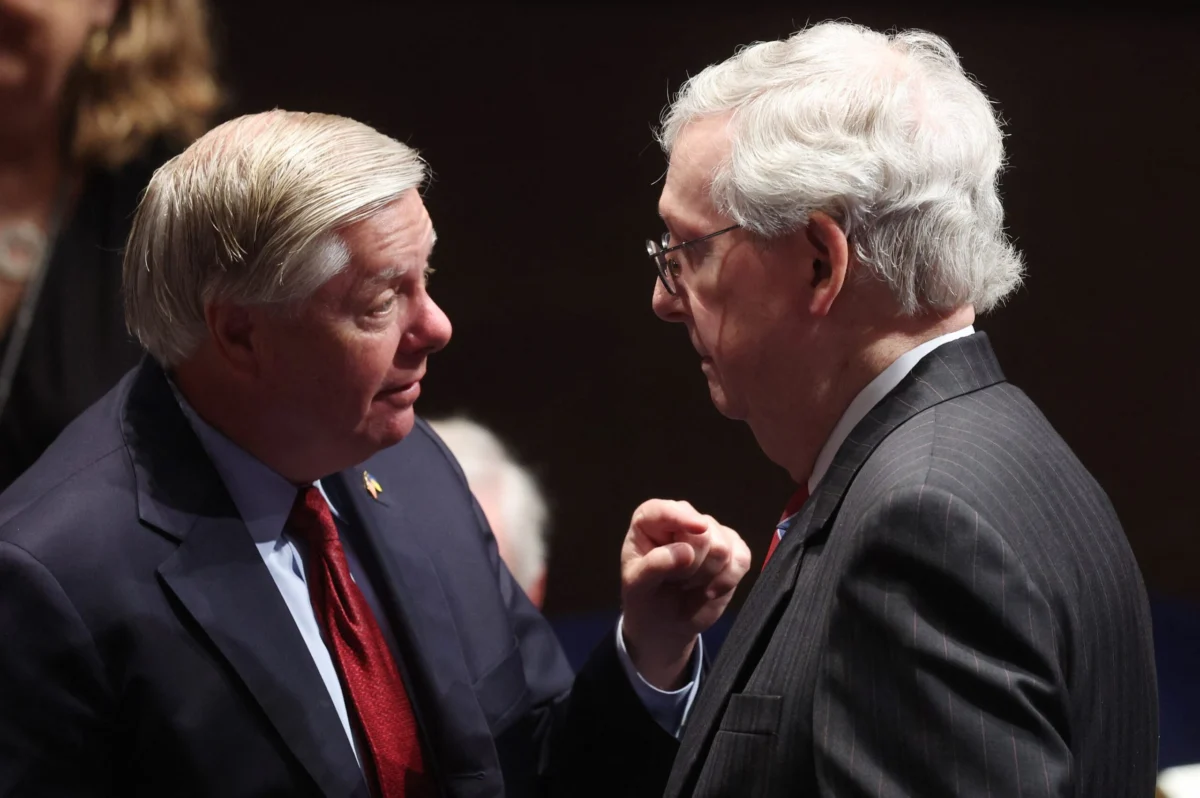
WASHINGTON D.C. — The Trump administration’s ambitious agenda to overhaul the American military apparatus and sustain a mounting conflict in Iran has hit a formidable legislative wall. A convergence of medical emergencies and personal tragedy within the Senate Republican leadership has left the party’s fiscal strategy in a state of paralysis, just as the window for passing the 2027 fiscal year budget begins to close.
With the unexpected death of Senator Lindsey Graham and the prolonged hospitalization of Senate Minority Leader Mitch McConnell, the White House finds itself deprived of its two most effective legislative navigators. The vacuum comes at a moment of extreme geopolitical volatility, as the United States grapples with a depleted munitions stockpile and a war in the Middle East that some experts predict could eventually carry a price tag exceeding $1 trillion.
Main Facts: A Leadership Void at the Hour of Need
The current crisis centers on the sudden absence of two titans of the Republican establishment. Senator Mitch McConnell (R-KY), the Chair of the Senate Appropriations defense subcommittee, broke weeks of silence this past Sunday to confirm he remains hospitalized following a fall, complicated by a subsequent bout of pneumonia. McConnell’s role is pivotal; his subcommittee is responsible for drafting the very legislation that authorizes and directs Pentagon funding. Without his presence, the subcommittee is currently deadlocked in a 14-14 partisan split, effectively halting the movement of any defense spending bills to the Senate floor.
Simultaneously, the GOP is mourning the loss of Senator Lindsey Graham (R-SC), who passed away following an aorta rupture. Graham was not merely a senior member of the Appropriations Committee; he was the Chair of the Budget Committee and arguably President Trump’s most vital conduit between the Oval Office and the Senate floor. While South Carolina Governor Henry McMaster has moved to appoint Graham’s sister, Darline Graham Nordone, to serve the remainder of his term, the loss of Graham’s decades of institutional knowledge and his unique ability to whip votes for reconciliation measures remains an unquantified setback for the administration.
The stakes are historically high. The Trump administration is seeking a $1.5 trillion defense budget—the largest since World War II—to fund a "Golden Dome" missile shield and secure critical mineral supply chains. However, the 2027 fiscal year base of $1.15 trillion remains unpassed, and a proposed $350 billion supplemental package intended for the Iran conflict is currently languishing in committee.
Chronology: From Legislative Momentum to Medical Emergency
The current legislative quagmire is the result of a rapid succession of events that have derailed what was intended to be a "summer of strength" for the Republican party.
- April 2026: The Trump administration unveils its $1.5 trillion defense vision, framing it as a necessary response to the escalating tensions with Iran and the need for a domestic missile defense system.
- May 2026: The administration successfully passes the "One Big Beautiful Bill Act," a massive reconciliation package that signaled a shift toward using simple-majority votes to bypass Democratic filibusters. However, a subsequent immigration-focused reconciliation package is sent back for reworking by the Senate Parliamentarian for failing to meet budget-centric "Byrd Rule" requirements.
- June 2026: Tensions in the Middle East escalate into a sustained kinetic conflict. Reports emerge that U.S. munitions—specifically high-end interceptors and precision-guided missiles—have been depleted by 50% due to the intensity of the exchanges.
- Early July 2026: Senator Mitch McConnell disappears from public view following a private fall. Silence from his office sparks rumors regarding the severity of his condition.
- July 12, 2026: The D.C. Medical Examiner confirms the death of Senator Lindsey Graham due to an aorta rupture and hardened arteries. The news sends shockwaves through the Capitol, as Graham was actively negotiating the $350 billion supplemental funding package.
- July 13, 2026: McConnell issues a statement from the hospital, revealing he is being treated for pneumonia in addition to injuries sustained in his fall. He offers no definitive timeline for his return.
- Upcoming Wednesday: Darline Graham Nordone is scheduled to be sworn in to replace her brother, though she enters the Senate with no prior legislative experience at a time of extreme procedural complexity.
Supporting Data: The Economics of a New Cold War
The financial pressures mounting on the Department of Defense are staggering. According to the Iran Cost Ticker, the conflict has already drained $113 billion from U.S. coffers. Public policy analysts at the Cato Institute and other think tanks suggest that if the war continues at its current trajectory, the total cost will easily surpass $1 trillion, rivaling the long-term costs of the wars in Iraq and Afghanistan.
The administration’s push for $1.5 trillion in total defense spending is broken down into several critical categories:
- The Base Budget ($1.15 Trillion): Intended to cover standard operations, personnel, and existing procurement.
- The Reconciliation Supplemental ($350 Billion): Specifically earmarked for the "Golden Dome" missile shield, domestic mining of critical minerals, and the replenishment of munitions lost in the Iran theater.
- Munitions Crisis: Internal Pentagon data suggests that the U.S. has used more than half of its "most expensive missiles" in the first few months of the Iran conflict. Replacing these stocks is not just a matter of money, but of industrial capacity, requiring long-term contracts that cannot be signed without a settled budget.
The procedural math in the Senate is equally unforgiving. The 14-14 split in the Appropriations defense subcommittee means that unless a Democrat crosses party lines—an unlikely scenario in an election year—the bill cannot be reported out of committee. Furthermore, the reconciliation process, which requires only 51 votes, is now endangered by the absence of McConnell’s strategic discipline and Graham’s persuasive power.
Official Responses: A Party in Search of a Strategy
The vacuum in leadership has prompted a range of reactions from political analysts and former officials, many of whom express doubt that the current Republican leadership can navigate the "perfect storm" of a war, a budget deadline, and an election.
Peter McLaughlin, a political science professor at the University of Rhode Island, emphasized the precariousness of the GOP’s position. "It’s a very tricky situation right now because you’re dealing with upcoming midterm elections, a war where there is disagreement within the party over it, and a big funding package that’s going to require pretty much partisan unity on the side of Republicans," McLaughlin told Fortune. He noted that the loss of Graham, in particular, removes the "connective tissue" between the populist White House and the traditionalist wing of the Senate.
Katherine Thompson, a former Trump administration Pentagon official now with the Cato Institute, offered a more critical assessment of the administration’s reliance on reconciliation. "If we’re being totally fair in blame, it’s both Congress not being able to move in an expeditious fashion… but then also the way the administration went about its legislative strategy in terms of requesting the funding in the first place," Thompson said. She characterized herself as a "Senate pessimist," predicting that the supplemental funding for the Iran war is unlikely to pass before the summer break.
From the White House, the message remains one of urgency. President Trump has urged the South Carolina governor to move quickly with the Nordone appointment and has signaled to Senate Majority Leader John Thune (R-SD) that the August recess should be on the chopping block if the defense bill is not moved.
Implications: The Sept. 30 Precipice and the Midterm Shadow
The immediate concern for the U.S. government is the September 30 deadline. If a spending bill—or at least a Continuing Resolution (CR)—is not passed by midnight on that date, the government faces a shutdown. While a CR would keep the lights on, it would be a disaster for the Pentagon. Continuing Resolutions typically lock spending at previous-year levels and prohibit the starting of "new starts" in procurement. This would effectively kill the "Golden Dome" project and prevent the $350 billion surge needed to replenish munitions for the Iran war.
Beyond the fiscal deadline lies the political one: the 2026 midterm elections.
- The Democratic Opportunity: If Republicans fail to pass a budget and the war in Iran continues to drain resources without a clear funding path, Democrats will likely weaponize the "chaos in Washington" to regain control of the Senate.
- The Leadership Vacuum: Senate Majority Leader John Thune now faces his greatest test. He must decide whether to cancel the August recess—a move that would keep senators in Washington to work but would anger members who need to campaign for reelection.
- The Reconciliation Risk: The "One Big Beautiful Bill" strategy is fraying. With the Parliamentarian already eyeing reconciliation packages with increased scrutiny, the GOP lacks the seasoned procedural experts (like Graham and McConnell’s staff) to "Byrd-proof" future legislation.
Ultimately, the Trump administration’s "America First" defense posture is currently hostage to the health of one man and the legacy of another. Without a swift resolution to the leadership crisis in the Senate, the ambitious $1.5 trillion plan to rebuild the military may remain a blueprint, while the reality of a costly war in Iran continues to deplete both the nation’s arsenal and its treasury. As Thompson noted, the "writing on the wall" suggests that the administration’s luck with aggressive legislative shortcuts may have finally run out.