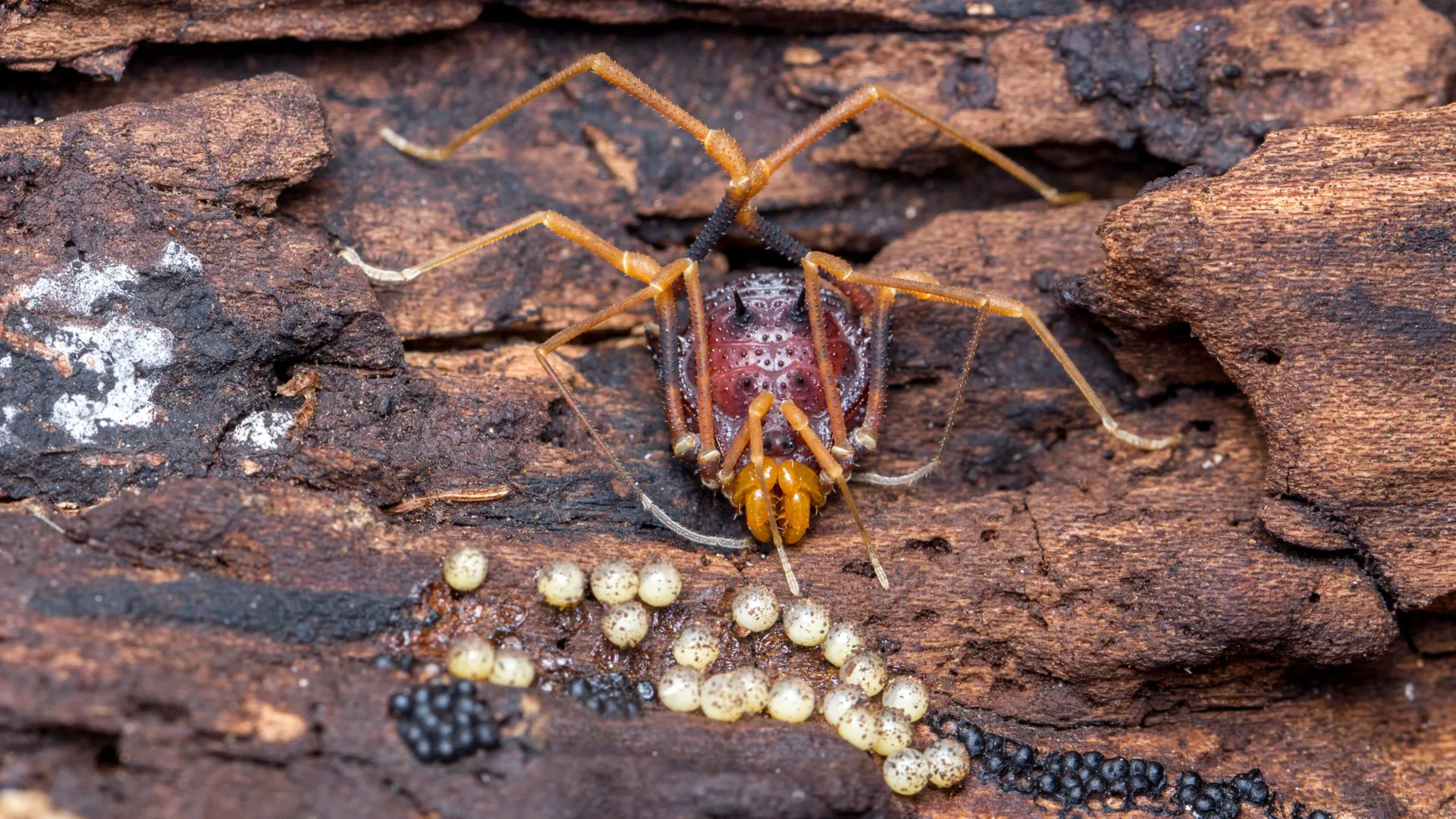
In the quiet, shadowed corners of forests across the globe, a curious drama of survival plays out. Harvestmen—eight-legged arachnids often mistaken for spiders—engage in complex behaviors that have long baffled evolutionary biologists. For decades, the enigma of why these creatures evolved to guard their eggs, and why this responsibility is sometimes maternal and other times paternal, remained a fragmented mystery. However, a groundbreaking study published in the Zoological Journal of the Linnean Society has finally pieced together this puzzle, thanks to an unlikely partnership between academic researchers and a global community of citizen scientists.
By leveraging the power of the popular nature observation platform iNaturalist, an international team led by researchers from the University of São Paulo has unveiled that parental guarding in harvestmen is not a static trait. Instead, it is a fluid, recurring evolutionary phenomenon that has been gained, lost, and regained throughout the superfamily Gonyleptoidea’s history.
The Evolutionary Tapestry of Parenting
The study represents a milestone in evolutionary biology. By synthesizing nearly 30 years of traditional field research with a massive influx of crowdsourced data, the team more than doubled the known examples of parental care in harvestmen. This expansion of the dataset allowed researchers to reconstruct the evolutionary history of the superfamily, providing the first clear look at how both maternal and paternal care emerged.
The findings suggest that the path to parental care is far from linear. In many lineages, guarding behaviors have appeared, vanished, and then re-emerged under different selective pressures. This "yo-yo" effect of evolutionary development challenges previous, simpler assumptions about how complex social behaviors become hardwired into a species.
Pathways to Care: Maternal vs. Paternal
One of the most striking revelations of the study concerns the diverging paths of parental roles. The analysis indicated that maternal care consistently evolved from ancestors that exhibited no parental care—a pattern that mirrors the evolution of maternal investment seen in various insect orders.
Paternal care, however, tells a more complex story. It appears to have followed two distinct evolutionary trajectories:
- Direct Emergence: Arising from ancestors that provided no care whatsoever.
- Sequential Evolution: Evolving from lineages where females already practiced egg guarding.
Researchers hypothesize that when paternal care emerged from maternal care, it was likely driven by a mechanism known as "enhanced fecundity." In these instances, females appear to exercise sexual selection, preferentially choosing to mate with males that have already begun the arduous task of guarding a clutch of eggs. This choice serves as an honest signal of the male’s quality and his commitment to the survival of the next generation.
Chronology of a Scientific Breakthrough
To understand the magnitude of this achievement, one must look at the timeline of harvestmen research. From 1936 to 2025, the scientific community had painstakingly documented parental guarding in only 80 species. This slow pace was dictated by the limitations of traditional fieldwork: the high costs of global travel, the time required to visit museum collections, and the sheer geographic vastness where these arachnids reside.
The paradigm shift occurred when lead author Professor Glauco Machado and his team turned to digital crowdsourcing. Inspired by similar successes in ornithology, the team utilized iNaturalist to scan for photographic evidence of parental behavior. The results were instantaneous and transformative.
In just two days of searching the platform, the researchers uncovered 62 new, verified records of parental care. Within a week, the team had effectively doubled the global knowledge base that had taken nearly a century to compile through traditional means. This acceleration marks a new epoch for biological research, where the "time-to-data" is measured in days rather than decades.
Supporting Data: The Power of the Crowd
The success of this study rests on the sheer volume and accessibility of data provided by non-specialists. iNaturalist functions as a global, georeferenced database of life on Earth. When an amateur photographer in a remote forest uploads a picture of a harvestman guarding its eggs, that image becomes a data point for a researcher on the other side of the planet.
Why Harvestmen are the Perfect Model
With over 6,900 identified species, harvestmen represent one of the most diverse and understudied groups of arachnids. While they constitute only about 0.6% of total arthropod diversity, they are disproportionately represented in the study of paternal care. In fact, harvestmen account for more than half of all known independent evolutionary instances of paternal care across all arthropods. This makes them the premier model for investigating the costs, benefits, and evolutionary triggers of "fatherhood" in the animal kingdom.
Official Perspectives: The Value of Global Collaboration
Professor Glauco Machado, the lead author of the study, views this project as a blueprint for the future of biology. He notes that the barrier to entry for studying niche behaviors has historically been the prohibitive cost of physical specimen collection.
"It is a tremendous source of information that can improve the velocity with which we accumulate biological information," Machado stated. "I would never be able to do this by visiting museums around the world. It would be very expensive, very time-consuming, but here we conducted the search in only one week."
Machado emphasizes that while the crowdsourced data is the "fuel" for this new era, it does not replace the need for traditional expertise. "Taxonomists’ role in modern science is more important than ever," he argues. "We cannot preserve a species that doesn’t have a name. And names are provided by taxonomists. So, it’s very important."
The researchers stress that human eyes—specifically trained expert eyes—are still required to verify the data. Determining whether a specimen is male or female, or distinguishing genuine parental care from mate guarding or mere proximity, requires the deep, specialized knowledge of a taxonomist. The partnership between the "citizen" and the "expert" is therefore not a replacement, but a symbiotic evolution of the scientific process itself.
Implications for Future Biological Research
The implications of this study reach far beyond the world of arachnids. By proving that citizen science can successfully address complex, abstract questions regarding evolutionary history, the team has opened a door for researchers working with amphibians, insects, and other groups where parental care is observed.
Addressing Limitations
The researchers are transparent about the challenges inherent in this methodology. The most significant hurdle is "sampling bias." Because guarding behaviors are often conspicuous, citizen scientists are more likely to photograph and report a parent guarding its eggs than a species that provides no care. This can create a skewed perception of how common these behaviors are in the wild.
However, the authors argue that the benefits far outweigh the limitations. By filling in the gaps—many of which were previously complete "blank spots" on the map—the study provides a framework that allows scientists to account for bias while simultaneously expanding the breadth of their investigations.
Democratizing Science
Perhaps the most significant takeaway from this research is the democratization of scientific discovery. By reducing the reliance on expensive expeditions and extensive travel, citizen science platforms like iNaturalist empower researchers in the Global South and in resource-limited institutions to perform world-class, large-scale studies.
As we move further into the 21st century, the marriage of human curiosity and digital connectivity is proving to be the most potent tool in the biologist’s kit. The story of the harvestman is not just one of evolution, but one of the evolution of science itself—a process that is becoming more inclusive, more efficient, and more profoundly connected to the world we seek to understand. Through the lenses of thousands of citizen observers, the hidden lives of the smallest creatures are finally coming into focus, one photograph at a time.