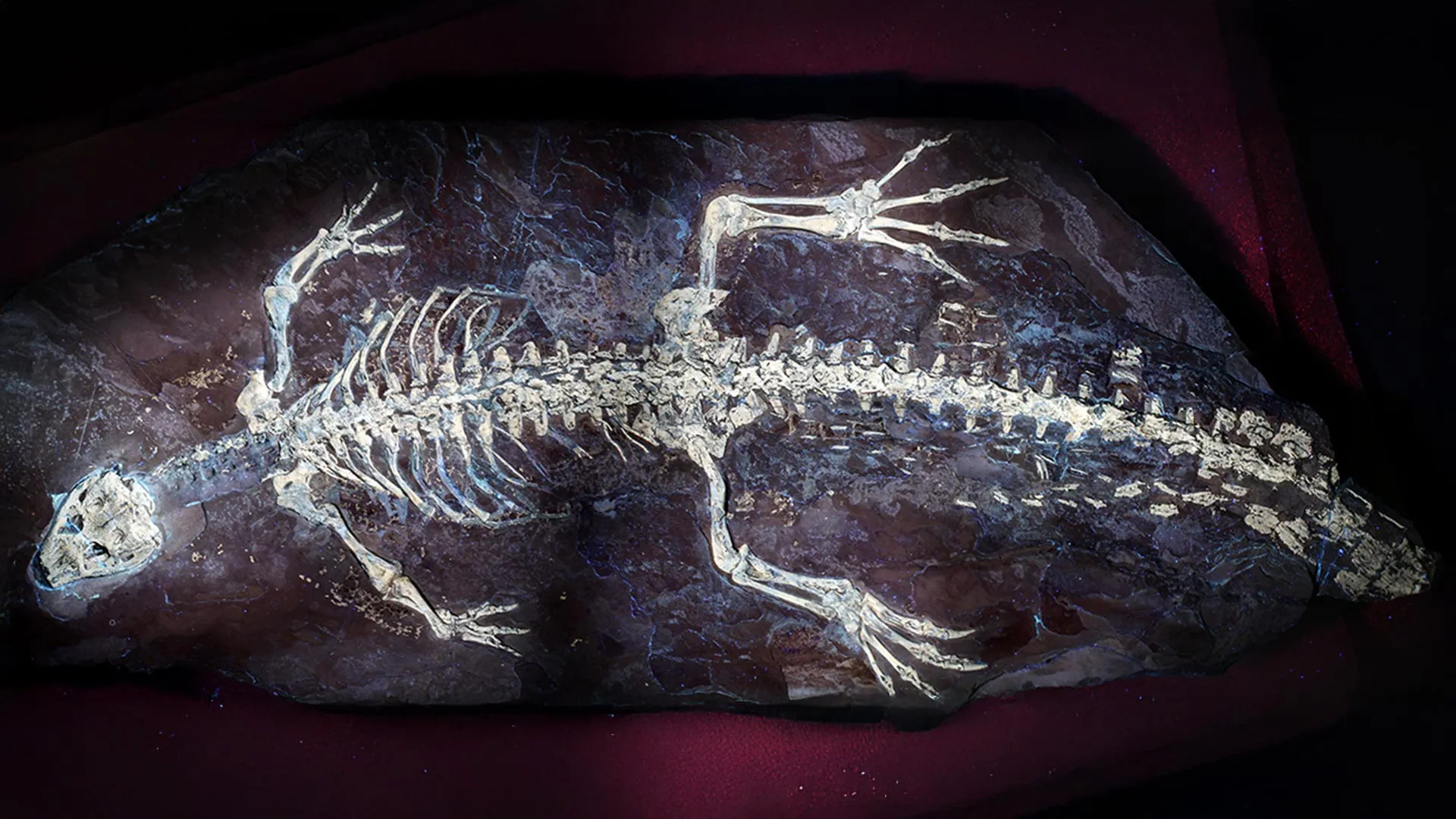
In a groundbreaking synthesis of paleontology and modern imaging technology, researchers have peered through the veil of 125 million years to reconstruct the life of a diminutive, long-extinct relative of the modern crocodile. The fossil, cataloged as MGB-512 and known to science as Montsecosuchus depereti, was unearthed in the lithographic limestones of Spain’s Pedrera de Meià site. While the specimen has been known to researchers since the early 20th century, a new study published in the Zoological Journal of the Linnean Society reveals that it still held tightly guarded secrets regarding its soft tissue anatomy, sensory capabilities, and even its external coloration.
Led by the Institut Català de Paleontologia Miquel Crusafont (ICP), the research team employed ultraviolet (UV) light imaging to expose fine details of the creature’s skin, respiratory structures, and camouflage patterns that had remained invisible under conventional laboratory lighting for over a century.
A Legacy Etched in Stone: The Chronology of MGB-512
The story of Montsecosuchus depereti begins in the Lower Cretaceous period, approximately 125 million years ago. At that time, the region now known as the Catalan Pre-Pyrenees was a vastly different landscape, dominated by karstic lakes nestled near a coastal environment. When this small crocodylomorph—measuring roughly 50 centimeters in length—perished, its body settled into the fine-grained, stagnant sediments at the bottom of a lake.
These specific conditions created what paleontologists call a Konservat-Lagerstätte—a geological site characterized by "extraordinary preservation." The lack of scavengers, combined with the rapid burial in fine sediment and the chemical composition of the water, prevented the usual decay processes from destroying the animal’s softer biological features. Over eons, the sediments solidified into the lithographic limestones of the Pedrera de Meià, now a centerpiece of the UNESCO Orígens Global Geopark.
For decades, the fossil sat in the collection of the Museum of Natural Sciences of Barcelona, largely viewed through the traditional lens of skeletal anatomy. It received cursory scientific attention in the 1990s, but the true breakthrough occurred when researchers Oscar Castillo and Jesús Serrano began a comprehensive database project cataloging fossils from the Montsec region. During a routine examination of the holotype under ultraviolet light, the team noticed anomalous structures that defied the standard appearance of rock matrix. This serendipitous observation sparked a rigorous investigation into the hidden biological data trapped within the limestone.
The UV Revolution: Peering Beneath the Surface
The application of ultraviolet light in paleontology has transformed the field, acting as a "virtual microscope" that highlights differences in fluorescence between mineralized fossil tissues and the surrounding host rock. In the case of Montsecosuchus, the UV analysis allowed the team to map out the distribution of soft tissues with unprecedented clarity.
The Anatomy of Skin and Scale
One of the most significant findings involves the creature’s epidermal structure. The analysis revealed that Montsecosuchus possessed a complex arrangement of scales that varied significantly in shape and size across its body. Contrary to the anatomy of modern crocodiles, which often feature high, paddle-like caudal fins designed for powerful swimming, this ancient relative lacked such structures, suggesting a different, perhaps more specialized, mode of locomotion in its aquatic habitat.
Sensory Evolution
Perhaps most intriguing is the discovery of potential sensory organs preserved within the scales. In modern crocodilians, integumentary sensory organs (ISOs) are essential for detecting minute vibrations, water pressure changes, and chemical gradients, helping them navigate murky waters and hunt effectively.
The researchers identified similar structures in the scales of Montsecosuchus, specifically located around the neck, limbs, and along the flanks. Interestingly, these structures were not uniform across the entire body, appearing only in localized, small-scaled areas. This distribution provides a crucial evolutionary clue: it suggests that sensory organs may have initially evolved in specific regions of the body to meet immediate environmental needs before becoming widespread across the skin in later, more derived crocodylomorph lineages.
Physiological Sophistication: Respiratory Adaptations
Beyond the external anatomy, the UV light imaging revealed remnants of cartilaginous structures within the animal’s thoracic cavity. These structures provide vital evidence regarding the respiratory efficiency of the creature.
The presence of well-developed cartilage in the chest suggests that Montsecosuchus possessed a sophisticated respiratory system, likely sharing functional parallels with modern crocodiles. This discovery is significant because it pushes back the timeline for the evolution of such complex thoracic mechanics. It indicates that even 125 million years ago, early crocodylomorphs were already highly specialized for a semi-aquatic lifestyle, possessing the physiological machinery required to regulate breathing while submerged or semi-submerged in their lacustrine environments.
Chromatic Clues: A 125-Million-Year-Old Color Pattern
Perhaps the most visually arresting result of the study is the evidence of color patterning on the animal’s tail. Under UV light, researchers observed distinct, alternating light and dark bands along the caudal region. While the exact pigments—such as melanins or carotenoids—have long since degraded, the preservation of the physical banding suggests a clear pattern of light and dark coloration.
Scientists interpret this as a form of disruptive camouflage. By breaking up the animal’s outline, such a pattern would have allowed the predator (or prey) to blend into the dappled light of the lake floor, making it difficult for predators or potential food sources to detect its presence. If this interpretation holds, Montsecosuchus depereti stands as the oldest known crocodylomorph to exhibit evidence of such complex color patterning, offering a rare glimpse into the visual world of the Lower Cretaceous.
Official Perspectives and Scientific Significance
The research team, which included Oscar Castillo-Visa, Albert G. Sellés, Àngel Galobart, and Phil Bell, emphasizes that while we cannot reconstruct the exact hues, the existence of a pattern is scientifically undeniable.
"At the moment we cannot say for sure what color the crocodile’s tail was, but it would be expected that it was not so different from current species, which also show different coloration patterns," stated Albert G. Sellés.
Lead author Oscar Castillo-Visa added, "UV light allows us to see details that would otherwise remain completely hidden in the rock. These traits indicate that, despite being a primitive animal, it was already very well adapted to a semi-aquatic lifestyle."
The implications of this study are far-reaching. By utilizing non-invasive, high-resolution imaging, the team has managed to extract a wealth of biological data from a specimen that was previously considered "exhausted" of information. This study not only refines our understanding of Montsecosuchus but also elevates the importance of the Catalan fossil record. The Pedrera de Meià, with its 8,000-plus cataloged specimens—including the world’s first known angiosperm, Montsechia—remains one of the most vital windows into the terrestrial and aquatic ecosystems of the Mesozoic era.
Implications for Future Research
The discovery of sensory organs and color patterns in Montsecosuchus suggests that many other fossils currently sitting in museum collections may hide similar, overlooked treasures. The success of this study serves as a call to action for paleontologists worldwide to re-examine existing holotypes using modern imaging techniques like UV fluorescence, laser-stimulated fluorescence, and high-resolution micro-CT scanning.
Furthermore, the study confirms that the "primitive" status of early crocodylomorphs should not be equated with a lack of complexity. On the contrary, the early evolution of sophisticated respiratory, sensory, and camouflage systems demonstrates that the crocodylomorph lineage was undergoing rapid and successful adaptive radiation during the Cretaceous.
As the scientific community continues to explore the rich archives of the Orígens Geopark and beyond, the story of Montsecosuchus serves as a poignant reminder that even the smallest fossils, when viewed through the right lens, can speak volumes about the intricate and colorful history of life on Earth. The project, funded by the Spanish Ministry of Science, Innovation and Universities and supported by the European NextGenerationEU program, underscores the critical value of interdisciplinary cooperation in uncovering the deep history of our planet.