In an educational landscape increasingly shaped by shifting federal mandates, Iowa has emerged as a focal point for the implementation of new, restrictive policies regarding access to career and technical education (CTE). Under the guidance of the U.S. Department of Education, the Iowa Department of Education has begun requiring school districts and community colleges to affirm that undocumented students are excluded from college-level CTE programs funded by federal Perkins grants.
This development marks a significant departure from decades of established practice, fueling a national debate over the scope of the Supreme Court’s landmark 1982 Plyler v. Doe decision. While some states have successfully challenged these restrictions in court, Iowa’s alignment with federal directives has placed its school districts in the position of navigating a complex web of compliance, administrative uncertainty, and potential civil rights implications.
The Shift in Federal Policy: A Chronology of Change
The current controversy stems from a strategic reversal of long-standing federal policy initiated last year. For nearly 30 years, federal guidance allowed undocumented students to participate in postsecondary adult education and CTE programs, under the interpretation that these programs were essential extensions of the public education system protected by Plyler v. Doe.
The transition began in mid-2025, when the administration of President Donald Trump moved to formally rescind the Clinton-era guidance. The federal government’s position—championed by U.S. Secretary of Education Linda McMahon—asserts that federal funding for postsecondary education constitutes a “federal public benefit.” Under this legal framework, the administration argues that such benefits are reserved exclusively for citizens and legal residents.
Key Milestones in the Policy Transition:
- July 2025: The U.S. Department of Education officially announces the end of federal funding for CTE dual-enrollment programs serving undocumented students.
- August 2025: The fallout becomes public as educators, including instructors at institutions like Johnson County Community College in Kansas, resign in protest over new requirements to verify student immigration status.
- September 2025: A federal judge in a multi-state lawsuit issues a preliminary injunction, halting the implementation of the guidance in states like New York and Massachusetts. The judge, Mary S. McElroy, characterizes the administration’s actions as "arbitrary and capricious."
- Late 2025–2026: The Iowa Department of Education issues its own internal memo to districts, mandating that they acknowledge the new federal eligibility requirements as a prerequisite for the renewal of Perkins grant funding.
The Legal Tug-of-War: ‘Basic’ vs. ‘Postsecondary’ Education
At the heart of the legal dispute is the Supreme Court’s 1982 ruling in Plyler v. Doe. The Court held that states cannot constitutionally deny students a free public K-12 education based on their immigration status, reasoning that excluding children from the classroom would create a permanent underclass and undermine the social fabric of the nation.
However, the current federal administration argues that the Plyler protections are narrow. They contend that the ruling applies strictly to "basic public education" and does not extend to college-level coursework, regardless of whether that coursework occurs on a high school campus through a dual-enrollment program.
Legal scholars and civil rights advocates remain divided on this interpretation. Critics of the administration’s policy argue that by creating a "bright line" between high school classes and college-credit classes, the government is effectively creating a barrier to workforce development for students who have lived and studied in the United States their entire lives.
Iowa’s Compliance and the Perkins Grant Requirement
In contrast to the states that challenged the federal guidance in court, Iowa has chosen a path of administrative compliance. According to records obtained by Chalkbeat, the Iowa Department of Education has integrated the federal eligibility standards directly into the state’s Perkins grant renewal process.
Heather Doe, communications director for the Iowa Department of Education, confirmed that districts and community colleges must "affirm that they acknowledge and understand" the federal guidance regarding eligibility for public benefits. For many districts, this acknowledgment has become a standard, if controversial, administrative hurdle.
The Scope of the Impact
While the mandate is significant, it is not all-encompassing. The policy specifically targets college-level CTE courses funded by federal Perkins grants. According to state data:

- There are 325 public school districts in Iowa.
- Approximately 126 of those districts offered CTE courses for college credit during the 2025–26 academic year.
- High school-level CTE courses—those not carrying college credit—remain unaffected by the new guidance.
Official Responses and the Burden of Proof
The administration’s rationale for these restrictions centers on the principle of taxpayer responsibility. Secretary Linda McMahon stated in a press release that "postsecondary education programs funded by the federal government should benefit American citizens, not illegal aliens." The administration maintains that it is fulfilling a mandate to ensure that taxpayer dollars are not subsidizing the education of individuals without legal status.
However, the practical application of this policy has created significant anxiety among school administrators. The primary challenge is that, historically, public schools do not track the immigration status of their students. Asking for such documentation creates an immediate conflict with the privacy-focused culture of public education.
The Compliance Dilemma
The Iowa Department of Education has clarified that it does not mandate that districts report the immigration status of their students to the state. However, the internal memo sent to districts warned that they "should be prepared to demonstrate that ineligible students are not being served" during routine federal audits or compliance visits.
This leaves school districts in a precarious position: they are tasked with ensuring compliance with a federal mandate without an explicit state-level mechanism for verifying eligibility, creating a "don’t ask, don’t tell" environment that may not withstand federal scrutiny during an audit.
Implications for Students and Workforce Development
The long-term implications of these restrictions are multifaceted, touching on economic policy, civil rights, and the future of the American workforce.
1. Workforce Shortages
CTE programs are designed to funnel students into high-demand trades such as welding, nursing, automotive repair, and advanced manufacturing. By restricting access to these programs, critics argue that Iowa may be inadvertently limiting its own labor pool, particularly in rural areas where vocational training is a primary engine of economic growth.
2. The "Administrative Chill"
Even in districts where immigration status is not being explicitly policed, the mere presence of these requirements can create a "chilling effect." Undocumented students, fearing exposure or the potential for deportation, may opt out of career-advancement opportunities altogether, even when those programs remain open to them.
3. Future Litigation
The preliminary injunction granted by Judge Mary S. McElroy suggests that the federal government’s path is not legally guaranteed. If the case reaches a higher court, the definition of "federal public benefit" and the extent of the executive branch’s power to redefine those benefits could be narrowed. Until then, Iowa remains in a state of administrative flux, balancing federal directives against the practical realities of managing a diverse and inclusive public school system.
Conclusion
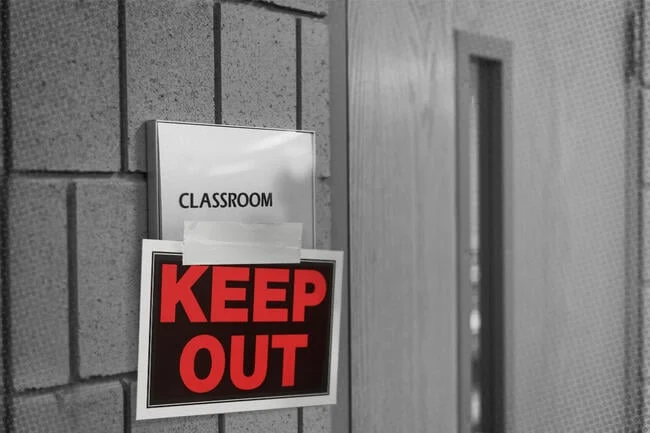
As Iowa school districts continue to navigate this new era of educational restriction, the focus remains on the tension between federal mandate and local institutional practice. Whether the federal government will intensify its audit requirements or whether further legal challenges will emerge to force a reversal remains to be seen. For now, the "keep out" signs appearing on the classroom doors of some CTE programs serve as a stark symbol of a shifting educational landscape—one where the opportunity to learn a trade is increasingly dictated by the intricacies of immigration law rather than the ambitions of the students themselves.